


- Business overview
- Application Procedure
- Classification of subjects
- Subject themes
- Distinctive subjects
- Contact Information
Business overview
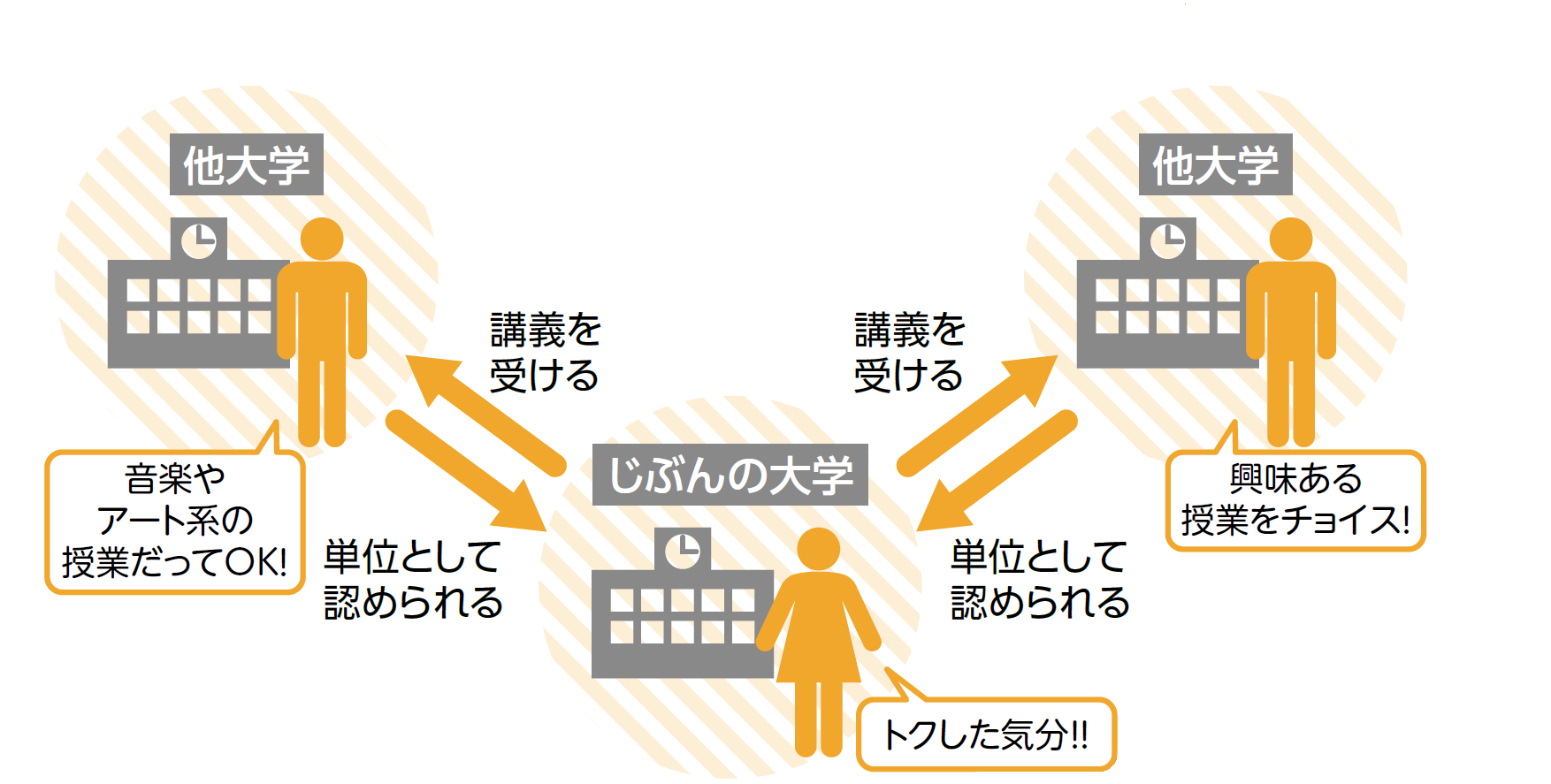
The credit transfer system is a system that allows students to have credits earned at other universities and junior colleges recognized as credits earned at their own university. The University Consortium Kyoto has been operating this system since its predecessor, the “Kyoto University Center,” was established in 1994, and currently has agreements with approximately 45 member institutions, with many students taking courses under this system. In 2015, they established a new course, “Kyoto World Heritage PBL,” which incorporates the PBL (Project Based Learning) learning method, offering courses unique to Kyoto.
Application Procedure
For detailed information on courses, application procedures, and participating universities, please check the Credit Transfer/Kyoto College Portal Site.
Credit Transfer – Kyoto College Portal Site
Classification of subjects
- Plaza Courses : Offered at Campus Plaza Kyoto
- On-campus courses : Offered at the university where the course is offered.
- Online courses : Take courses using the designated web tool.
Subject themes
The courses offered under the credit transfer system are broadly categorized into nine themes, A through I, so you can search for courses based on your interests. Please note that many courses overlap across themes, so be sure to refer to the syllabus for each course before selecting one.
| A. Learning about Kyoto | A group of subjects that explore Kyoto from diverse perspectives, including its history, traditional culture, industry, region, and tourism. |
| B. Learning History | A group of subjects that cultivate a sense of history, including Japanese history, world history, archaeology, geological history, folklore, local history, and ancient documents. |
| C. Learning about culture and art | A group of subjects that allow students to become familiar with culture and arts, including literature, classics, music, fine arts, design, painting, crafts, and performing arts. |
| D. Learning language | A group of subjects that focus on developing expressive abilities, including language studies, linguistics, foreign languages, expression, drama, and communication methods. |
| E. Learning about education and life philosophy | A group of subjects that consider how people live and how they are raised, including psychology, education, religious studies, philosophy, ethics, and thought. |
| F: Learning about lifestyle, health, and sports | A group of subjects that provide knowledge related to lifestyle, including living, welfare, nursing, health, sports, and biomedical sciences. |
| G Learning about nature and the environment | A group of subjects that involve the natural world, such as environmental science, geography, agriculture, astronomy, physics, biology, and ecology. |
| H Learning about modern society | A group of subjects that observe modern society from diverse perspectives, including law, economics, business administration, political science, sociology, science and technology, and information science. |
| I. Studying International Relations | A group of subjects that help students learn about world affairs and cultivate a global perspective through subjects such as law, politics, education, welfare, comparative culture, and overseas seminars. |
Distinctive subjects
Plaza Recommended Subjects
“Plaza Recommended Courses” are unique courses offered at Campus Plaza Kyoto, developed in collaboration with the University Consortium Kyoto and the universities for credit transfer purposes. These courses are characterized by their practical content, incorporating relay lectures by multiple faculty members and guest lecturers, as well as fieldwork.
Since 2015, they have offered “Kyoto World Heritage PBL Courses,” and since 2020, “Kyoto Museum PBL Courses,” providing valuable learning experiences unique to Kyoto. Please refer to the syllabus for details and enroll in courses that interest you.
Kyoto World Heritage Project-Based Learning (PBL) course
Among the Plaza’s recommended subjects, the “Kyoto World Heritage PBL Subject” is a course that uses Kyoto’s World Heritage sites as its field of study for
Project-Based Learning (PBL). The Kyoto World Heritage PBL Subject has been offered since 2015 through the cooperation of various universities, the Kyoto Cultural Heritage Platform for Tomorrow, and the University Consortium Kyoto. PBL (Project-Based Learning) is a type of learning that involves identifying and solving problems. Primarily through group learning, students identify problems themselves and propose solutions. Through this process, the aim is to cultivate various abilities and develop individuals who can thrive in an unpredictable era.
Intangible Cultural Heritage Subject Connecting Kyoto
Among the Plaza-recommended courses, “Connecting Kyoto’s Intangible Cultural Heritage” is a course that involves lectures and fieldwork related to Kyoto’s intangible cultural heritage. In this course, students will discover new charms of Kyoto, re-examine their significance and how to utilize them, and consider the way in which they should be preserved and transmitted as their own issue.
By learning while being exposed to diverse values, students will deepen their understanding of culture, develop a proactive attitude towards challenges, and cultivate a creative perspective for connecting intangible cultural heritage to the future.
Kyoto Museum PBL course
Among the Plaza-recommended courses, the “Kyoto Museum PBL Course” is a course that uses Kyoto’s museums (art galleries, etc.) as its field of study for project-based learning (PBL). The Kyoto Museum PBL Course was established in 2020 through collaboration between various universities, Kyoto City, and the University Consortium Kyoto. Taking advantage of Kyoto’s status as a cultural city, the course uses the diverse museums located in Kyoto as a field of study to learn about Kyoto’s fascinating culture, and by tackling various challenges within these museums, it aims to cultivate individuals who can utilize teamwork and demonstrate leadership in solving problems.
Recommended courses for lower-year students
The recommended courses for lower-year students are primarily designed to be attractive to lower-year students (junior college students and first and second-year students at four-year universities, and first, second, and third-year students at six-year universities) by offering them as much as possible intensively during the summer or on Saturdays. (However, if there are available spots, students in their third year or higher at four-year universities, and fourth year or higher at six-year universities can also take these courses.) The specific themes offered are (1) career-related subjects, (2) foreign language subjects, and (3) transitional and introductory education subjects.
Overseas training courses
University learning is not limited to lectures and exercises in the classroom. Our credit transfer system offers overseas research courses where students can participate in a training program abroad for a set period and have their achievements recognized for academic credit. Unlike a simple overseas trip, this program is an integral part of university learning, designed to deepen the knowledge gained through pre-departure studies while on-site.
Teaching subject
Kyoto University of Education offers courses that directly lead to obtaining a teaching license. Previously, teaching courses could only be taken at one’s own university, but now, as a “second option,” they can be taken through credit transfer. Some universities provide guidance on these courses, so please consult with your university’s teaching license office before applying.
Wide-area unit transfer system
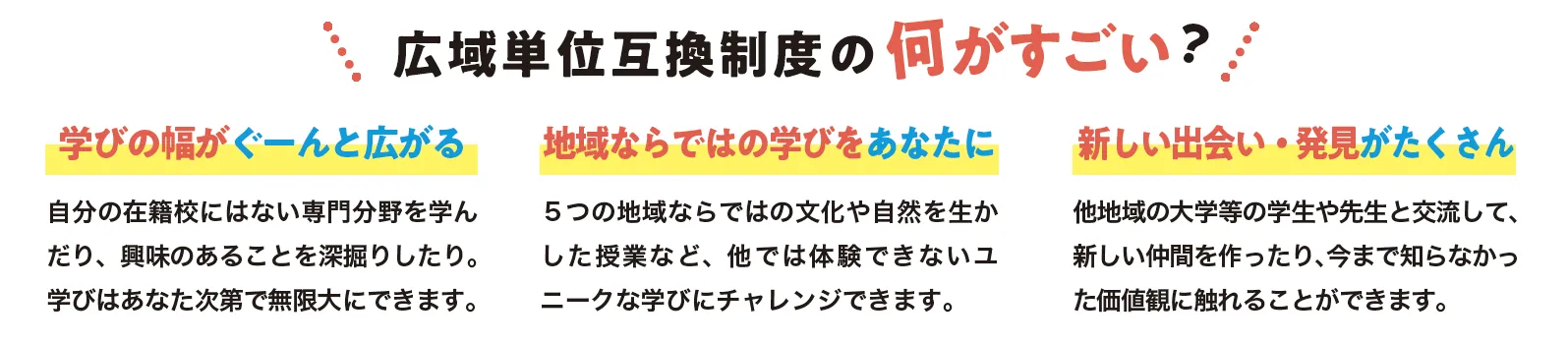
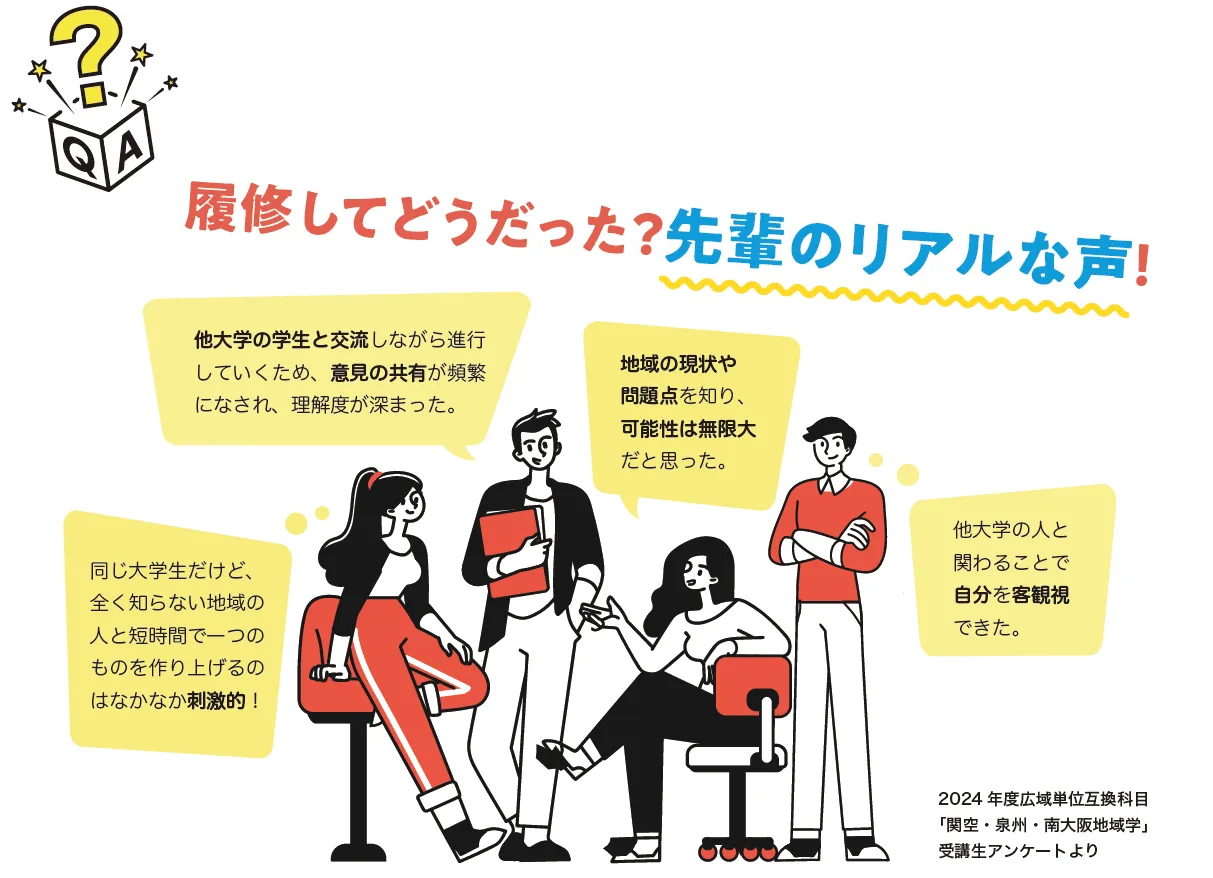
This system allows students to take courses offered by universities and other institutions outside the Kyoto area and receive academic credit for them.
This credit transfer system is implemented through collaboration among university consortia in various regions. Students of member universities (partner universities) of the following university consortia that have agreements with this system are eligible to take the courses. Experience an invaluable learning opportunity that you wouldn’t get in your traditional university life.
*Please be sure to check with your university, as they may have their own rules regarding application and credit recognition.
*For details on the application period and method, please contact your university.
List of participating university consortia (as of June 18, 2025)
▸ Campus Consortium Hakodate [Hokkaido]
▸ Education Network Chugoku [Hiroshima]
▸ University Consortium Ishikawa [Ishikawa]
▸ University Consortium Osaka [Osaka]
▸ Fujinokuni Regional University Consortium [Shizuoka]
▸ University Consortium Kyoto [Kyoto]
For details regarding courses offered and exam questions related to “Wide-Area Credit Transfer,” please check the following website:
https://www.consortium-osaka.gr.jp/tg/kouiki
For inquiries regarding this system in general, please contact:
Wide-Area Unit Exchange Network Management Council
(Secretariat: University Consortium Osaka, a specified non-profit organization)
[Phone] 06-6344-9560
[E-mail] tanigokan■conso-osaka.jp (Please replace ■ with @ when sending)
Contact Information
Application procedures, application periods, and whether or not credits will be recognized vary depending on your university. Please be sure to check with the relevant department at your university. For details regarding the content of the courses offered, please contact the relevant department at the university providing the course.
Kyoto University Consortium, Public Interest Incorporated Foundation, Credit Transfer Program
Tel: 075-353-9120 Fax: 075-353-9121
Email: tg■consortium.or.jp (Please replace ■ with @ when sending)
Address: Campus Plaza Kyoto, Shio-koji-dori, Nishinotoin-dori, Shimogyo-ku, Kyoto 600-8216
*Business Hours: Tuesday-Saturday 9:00-17:00 (excluding New Year holidays)