

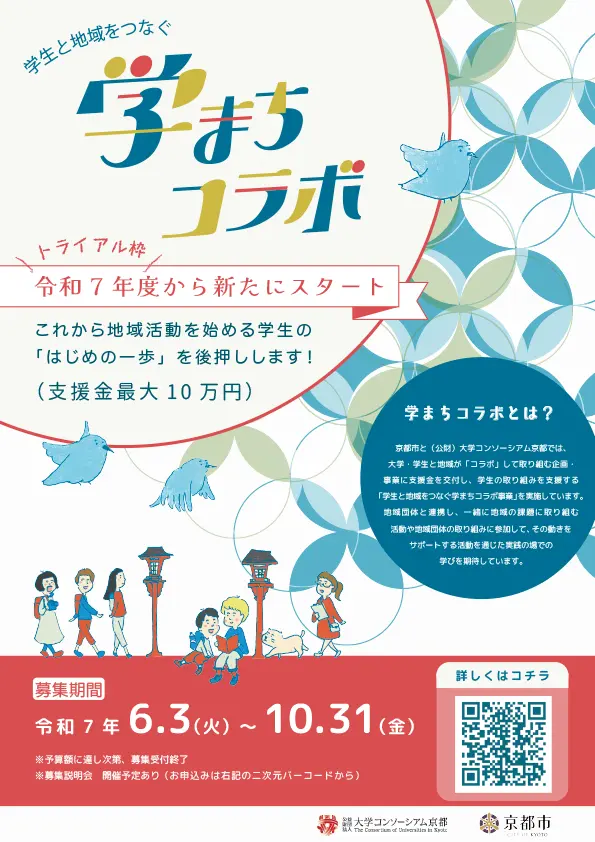
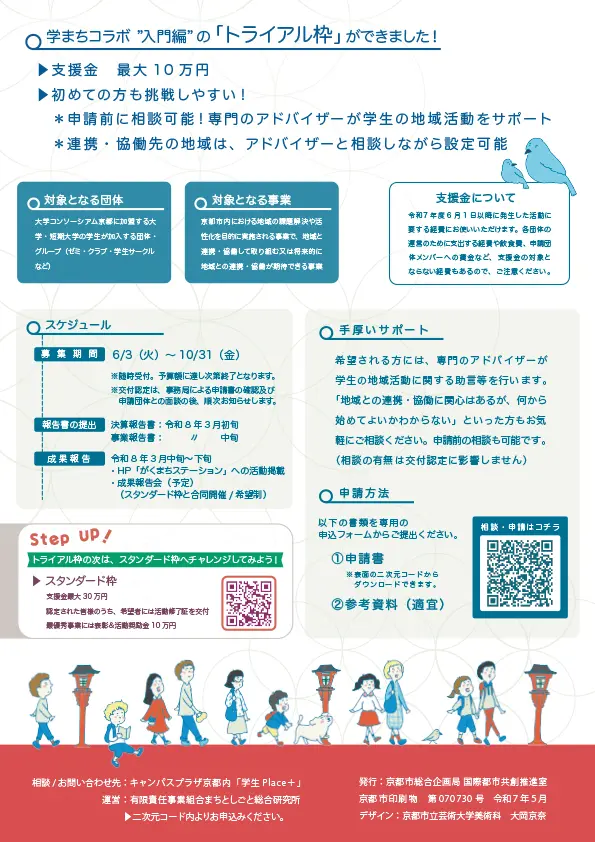
A trial slot has been created for the “Introductory Course” of the Gakumachi Collaboration!
We support students taking their first steps towards becoming involved in community activities.
▷ Up to 100,000 yen in support funds
▷ Easy for beginners to try!
*Consultation available before application! Specialized advisors will support students’ community activities.
* The region to partner with can be set in consultation with an advisor.
[Application Guidelines for the FY2025 “Student-Community Collaboration Project (Trial Program)”]
1. Target Organizations
Organizations and groups (*) whose members are students of universities and junior colleges affiliated with the Kyoto University Consortium, where the majority of members are students and the representative is a student. If the group consists of students from multiple universities, it is acceptable as long as the majority are students from universities and junior colleges affiliated with the Kyoto University Consortium. *Examples include university departments, research labs, seminars, clubs, and student circles (circles composed of students from multiple universities are also acceptable).
<Important Notes>
As a general rule, only one project can be submitted by the same organization or group. If multiple applications are received, they may be treated as a single project and either selected or rejected. Furthermore, even if applications are submitted by different organizations or groups, if they appear to be the same project, we will make a decision on how to handle them after confirming the project’s purpose, collaborating organizations, and other necessary details.
*Please consult us if you are unsure about how to proceed. We will consider your application based on its specific content.
2. Target projects
This program targets projects implemented in Kyoto City during this fiscal year (June 1, 2025 to March 31, 2026) with the aim of solving local issues and revitalizing the city, provided they meet the following requirements.
However, projects aimed at political activities, religious activities, the dissemination of specific ideologies, violent or destructive activities, or profit-making businesses are excluded.
[Requirements]
① Projects undertaken by organizations/groups with the aim of solving local issues or revitalizing the community, with students taking the lead in the activities.
*When conducting activities, it is necessary to designate a local community (mainly resident organizations, citizen activity groups, or businesses that operate within the Kyoto City area) as a partner, but applications are possible even if a partner has not yet been decided. In that case, please decide on a partner within the activities, for example, by consulting with an advisor.
② Projects that have not received grants or subsidies from Kyoto City other than the Student-Community Collaboration Project.
③ Projects that have not received a Student-Community Collaboration subsidy within the past 5 years. (Applications that were not approved are acceptable.)
④ Projects that have room for consideration for activities in the following year and beyond (including the possibility of applying for the Standard category).
3. Amount of support
Up to 100,000 yen / Approximately 10 to 15 cases
4. Regarding the application
(1) Application period
June 3, 2025 (Tue) – October 31, 2025 (Fri)
*However, applications will close once the total amount of support approved reaches the budget limit.
Applications for this project have now closed.
We would like to express our sincere gratitude to everyone who showed interest and applied.
We hope you will continue to support the “Student-Community Collaboration” project in the future.
(2) Information session for applications for the FY2025 School-Community Collaboration (Trial Program) project
We will be holding information sessions both in person and on-demand . (The in-person sessions have concluded.)
We are currently streaming an information session on YouTube.
Please check it out at the following link:
https://youtu.be/YH4_0vsCTI0
(3) Consultation and application
Comprehensive support
For those who wish, a specialist advisor will provide advice on student community activities. Please feel free to contact us even if you are interested in collaborating with the community but don’t know where to start. Consultations are also available before application. (Whether or not you consult will not affect the grant approval.) *For details and application, please check the “Apply” button below.
How to apply
Please submit the following documents. *For details and application, please click the “Apply” button below.
① Application Form
● FY2025 “Student-Community Collaboration Project (Trial Program)” Application Form (Word)
● Application Example
➁Reference materials (as appropriate)
*Registration is now closed.
5. Main Schedule for the Future
[ Application Period ]
June 3rd (Tue) – October 31st (Fri) *Applications accepted at any time. Applications will close once the budget is reached.
[ Submission of Reports ]
Financial Report: Early March 2026
Business Report: Mid-March 2026
[ Results report ]
Mid-to-late March 2020
6. List of projects certified under the Student-Community Collaboration Project (Trial Program) for FY2025
| Organization name | Overview of the initiative | University |
|---|---|---|
| Student organization FASTNER. | The student free magazine production group “FASTNER.” reinterprets the enduring charm of Kyoto from a student’s perspective, under the theme of “Yesterday, Kyoto, Tomorrow,” and connects it to the future. Since 2011, they have published the magazine twice a year, distributing 3,000 copies to 150 locations including universities and shops in Kyoto City, sharing the charm of Kyoto’s traditional crafts and everyday life with students. They have also collaborated with companies in the past. | Saga University of Arts, Kyoto University of the Arts, Kyoto Sangyo University, Doshisha Women’s University |
| Fighters | This four-person team was named with the intention of facing even difficult problems head-on. Aiming to alleviate loneliness among the elderly and strengthen their connections with the community, they strive to help seniors regain their smiles and sense of purpose by creating a warm and welcoming place that makes them want to return. | Ryukoku University |
| Takumi Rajury | With “tourism” as its theme, the project utilizes diverse expressive methods such as photography, video, graphics, and event planning to propose solutions that leverage local resources, using the tourist area of Arashiyama, Kyoto, from the perspectives of art and design. The project also involves collaborating with people outside the university on projects aimed at solving local issues and revitalizing the region. | Saga Art University |
| Kyomachiya Nanairo Community | Students at Ryukoku University are using their Machiya Campus as a field site to engage with residents and local organizations in the Fukakusa area, working to create individuals and communities that proactively address local issues (fostering local self-governance). | Ryukoku University |
| LUNA NEST | This student-led project addresses the health challenges faced by working women, working to create a safe and secure working environment for everyone through the development of private break rooms and the planning of seminars for companies and schools. | Kyoto Sangyo University |
| Ajiwau Kyoto | We operate an information website for foreign tourists visiting Japan who have dietary restrictions, such as being vegan or vegetarian. We explore and share the context of Japanese food from a vegan perspective. | Kyoto Women’s University, Kyoto Women’s University Graduate School |
| Kyoto T-Plaza | This community aims to connect Kyoto’s traditional culture to the future and create new attractions for Kyoto by bringing together young players, primarily students, and those involved in traditional industries. They organize events related to traditional culture, mainly for students in the Kansai region. | Doshisha University, Kyoto University, Kyoto Prefectural University, Kyoto University of the Arts, Kinki University |
| Doshisha University Faculty of Social Sciences, Department of Social Welfare Student PhotoVoice Project (A joint project between the Nomura Seminar and the welfare photography club “D’s!”) | This joint project uses the “PhotoVoice” method to uncover the voices of people of all generations in the Karahashi school district, giving shape to community-based mutual support activities and passing them on to future generations. (Implemented in cooperation with the Nomura Seminar of the Faculty of Sociology at Doshisha University and the welfare-related volunteer circle “D’s!”) | Doshisha University |
| KYOBI Architectural Research Group | This is an officially recognized student club at Kyoto University of Arts and Crafts, comprised of students from both the Architecture and Art faculties. Their main activities include revitalizing vacant houses, conducting workshops for local residents, and a tea room project for the Kyoto Student Festival. | Kyoto University of Arts and Crafts |
| Burari | This group is comprised of six volunteer students from the Department of Policy Studies, Faculty of Policy Studies, Doshisha University, who are studying environmental policy and urban development issues. Their activities aim to mitigate the problem of overtourism and to research, study, propose, and implement sustainable tourism based on an understanding of and respect for the unique culture and lifestyle of each region. | Doshisha University |
Contact Information
Student Place+ located within Campus Plaza Kyoto
is operated by: Urban and Work Research Institute, Limited Liability Partnership.
*Please inquire using the “Apply” button above.