The 17th Kyoto International Student Film Festival Pre-Event will be held!

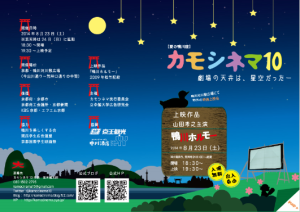
On Saturday, August 23rd, “Camo Cinema 10” will be held at the Kamogawa riverbed in Kyoto.
The Kyoto International Student Film Festival, in collaboration with Camo Cinema, will hold a pre-event to screen anime films that have been selected in the past at the festival before the main screening. Please come and visit us!

kamosinema ri-hu

Camo Cinema

Camo Cinema is an outdoor screening of films organized by the Ritsumeikan University Advertising Research Group held in Kamogawa, Kyoto. This year marks the 10th year of the event. This is a one-night-only summer event created by students who want more people to know the beauty and importance of the Kamo River, which is a representative place of Kyoto, through film screenings.

This year, we will screen the coming-of-age fantasy “Kamogawa Hormo” set in Kyoto.

In addition, Kamo Cinema also conducts cleanup activities to protect the beauty of the Kamo River before movie screenings.

Admission is free! Free to come and go! Why don’t you watch a movie while looking at the night sky above your head and relaxing on the Kamo River?

kamosinema

Camo Cinema 10 Outline

Re Doors open at 18:30 on Saturday, August 23, 2014 *Postponed to Sunday, August 24, 2014 in case of light rain and stormy weather
place South of Kamo Ohashi, riverbed on the west bank of the Kamo River (between Imadegawa Street ~ Arakamiguchi Street)
access 5-minute walk from the city bus “Kawaramachi Imadegawa”, 10-minute walk from the city bus “Demachiyanagi Station”
Keihan Electric Railway “Demachiyanagi Station” Exit 2 5 minutes walk
fee Free (free access)
schedule Doors open at 18:30
19:00 Screening / Pre-screening
Kyoto International Student Film Festival Competition Selection Screening (2 films)
19:30 Screening / Main Film Screening
“Kamogawa Hormo”
Director: Katsuhide Motoki / Script: Maruo Kyozuka / Original Story: Manabu Manjome
Cast: Takayuki Yamada, Chiaki Kuriyama / Music: Yoshikazu Suo

Camo Cinema 10 Official Websitekamosinema


Kyoto International Student Film Festival Pre-Event (Camo Cinema 10)

As a pre-screening before the main screening of Camo Cinema 10, the following two films that have been selected in the competition section of this festival in the past will be screened.

■Screening starts at 19:00 on Saturday, August 23 Akichi Play Goyalina and Mr./Ms. Reef
  Akichi Play Goyalina and Mr./Ms. Reef

Title of the work Director’s Name
affiliation
Awards time
genre
Akichi Play Ryosuke Oshiro
Tokyo University of the Arts Graduate School
2013 Final Jury Prize
Yoneo Ota Prize
5 minutes
animation
School, home, always lonely protagonist. I was always looking at friendship from a distance. One day, he came up with the idea of creating his own “city” in a vacant lot he found on his way home from school, and began drawing blueprints on the wall. At that moment, a boy approached. The boy begins to imitate the main character, which gradually develops into a fight. What exactly is friendship?
Goyalina and Mr./Ms. Reef Aika Oshiro
Okinawa Prefectural University of Arts Graduate School
2011 Final Jury Prize
Yuji Matsukura Prize
8 minutes
animation
This anime was created for the purpose of environmental education for children. The content is about Goyalina, a piglet who dreams of being a ballerina and always wears a slice of bitter gourd, learning about coral reefs. We expressed in a musical style that coral is a living creature, and that Mr./Ms.’s creatures live together with the coral.


kamosinema


Inquiries about planning

The 17th Kyoto International Student Film Festival Executive Committee
〒600-8216 Kyoto-shi, Shimogyo-ku, Nishitoin-dori, Shiokoji Shimoru Campus Plaza Kyoto 6F
TEL:075-353-9430 FAX:075-353-9101
MAIL: info.2014 at kisfvf.com
twitter:@kisfvf
Web: http://www.kisfvf.com

The entire city is a campus Kyoto B&S Project, the city of learning, has been launched!

Kyoto City, University Consortium Kyoto, and JTB West Japan are collaborating to provide a new educational travel program, the Kyoto B&S Program, as a place for university students who serve as guides to develop their motivation to go on to universities and junior colleges in the Kyoto area, as well as opportunities for university students who serve as guides to tell themselves and Kyoto to junior high and high school students. At the same time, we will conduct research on the educational effects of this project.
New Educational Travel Program Kyoto B&S Program


Click here for details


◆ Inquiries from general customers
Kyoto B&S Secretariat
〒600-8023 Kyoto-shi, Shimogyo-ku, Kawaramachi-dori, Matsubara-kamiru 2-chome, Tominaga-cho 338, Kyoto Shijo Kawaramachi Bldg. 7th floor JTB West Japan Kyoto Branch Corporate Sales Department
TEL: 075-365-7779   FAX: 075-365-7713Person
in charge: Murakawa, Nakagawa
Business hours: Weekdays 9:30~17:30 *Closed on Saturdays, Sundays, and holidays


◆ Inquiries from reporters

University Consortium Kyoto, Research & Public Relations Department, “Kyoto B&S Program”
〒600-8216 Shimogyo-ku, Kyoto-shi, Nishitoin-dori, Shiokoji Shimoru Campus Plaza Kyoto
TEL:075-353-9130  FAX:075-353-9101
Hours: Tue~Sat 9:00~17:00 (Closed on Sundays, Mondays and year-end and New Year holidays)

The University Consortium Kyoto was featured in the NYTimes newspaper!

The New York Times interviewed the mayor of Kyoto about Kyoto’s international student policy, and we would like to report that the credit transfer system of the University Consortium Kyoto has been published.

newspaper-154444_640


The New York Times, June 29, 2014[Click here for details]


(Japanese translation)

“Attracting International Students through Kyoto’s Diverse Attractions” Miki Tanigawa


Growing up in Kuala Lumpur, the capital of Malaysia, Leonie Lim was obsessed with Japan pop culture. For unknown reasons, she wanted to live and study in Japan someday.

“When I was seven years old, I asked my father to buy me a Japanese dictionary,” she said, “and I studied Japanese by myself while watching anime and manga.”

By the time she entered university, she had developed a comprehensive interest in Japan’s history, culture, and art. She chose Doshisha University in Kyoto to study Japanese, Japan culture and global culture.

“It’s a place where I feel like I’m close to the core of Japan’s culture and history,” says Lim, 20.

Her choice coincides with the trend of more international students in recent years choosing to study in Kyoto, the ancient capital of Japan and surrounded by historic temples and shrines, traditional performing arts and crafts, and rich culture.

According to an inter-university organization in Kyoto, which compiles statistics, the number of students studying in Kyoto has increased from 5,157 in 2009 to 7,017 (*) last year. * The basis of the figures is being confirmed.

Kyoto’s figures are increasing even as the overall number of international students in Japan has declined from a peak of 141,000 in 2010 to 135,000.

According to the Japan Student Services Organization, Kyoto ranks fourth in Japan as a whole, although it is a relatively small city, after Tokyo, Osaka, and Fukuoka, which attract almost half of international students.


The attraction of Kyoto, according to the students, is the fusion of its geography and Japan’s unique cultural, historical, and educational position.

Despite being a city of 1.47 million people, Kyoto is a tourist destination with old castles and imperial palaces, and is famous for its state-of-the-art manga museum, the concentration of world-class high-tech companies such as Nintendo, Kyocera, and Omron, and the environmental conference held in 1997. Although it is not a well-known university city, there are still more than 50 universities in and around the city, making Kyoto look like a sister city of Boston, with exchanges for more than 50 years.


“Tokyo is a great place to live, but Kyoto is a great place to study,” says Husin Shih, a 25-year-old from Vancouver, Canada.

Located in the Kansai region in the center of Honshu, the largest island in Japan, Kyoto, together with neighboring Osaka and Kobe, constitutes Japan’s second largest economic zone after Tokyo. However, the area is not as extensive as in Tokyo, and it is completed within a limited area.

“Kyoto is both a city and a village,” says 28-year-old Evdosia Kilopoulou, a graduate of the University of Thessaloniki in Greece and a film student at the Kyoto University of Art and Design.

“If you ride your bike for 20 minutes, you’re going to hit a mountain no matter which way you go,” she adds.

Grace Hennahan, an American in her second year at Doshisha, agrees. “Tokyo is too big, and Kyoto is a more manageable city. It’s not too noisy, and it’s not too urban. I really like that there are temples and shrines all over Kyoto, and I don’t have to look for them very hard.”

Kyoto retains the atmosphere of a small town, but there is a rich nightlife in the city center. Many bars and restaurants are crowded into small alleys. The downtown Gion district has been a place of entertainment for the rich and powerful for centuries, and is famous for its traditional teahouses and geisha known as maiko.

A compact town that has been carefully woven has an academic advantage. “It’s too distracting in Tokyo.” Kenji Yanobe, an artist and professor at Kyoto University of Art and Design, says. “In Kyoto, artists have a chance to get more attention, and in Tokyo, there are too many galleries trying to get noticed.”

Tsang Hanyan, a graduate student from China who is mentored by Yanobe, says, “Kyoto’s small size helps us build close collaborations.”

“I was shocked by his work,” he said, “and under the influence of his teacher, he dreams of critiquing Chinese consumerism and materialism in his work.

Daisaku Kadokawa, the mayor of Kyoto and former head of the Kyoto City Board of Education, is strongly promoting the attraction of more international students to Kyoto.

“For more than 1,000 years, we have nurtured and cultivated culture, arts, crafts, manufacturing, and a variety of studies and research,” he Mr./Ms.said.

To this end, Kyoto City provides partial subsidies for health insurance for international students, provides guarantors to facilitate housing security, and provides opportunities for international students to introduce their own culture at school. “International students should feel isolated in a foreign country,” the mayor said. “We will increase the number of international students to 10,000 in 2017.”

One of his major goals is to make Kyoto comparable to Boston. “Boston is a great city where 25 percent of the population is students,” he says. Kyoto is 10%, far behind Boston, but still higher than any other city in Japan.

The university itself is working hard to increase its international presence. Shiro Yamada, vice president of Doshisha University, said that international students pursuing all degrees receive some kind of scholarship. “It’s a burden financially, but it’s very significant in terms of increasing diversity and inspiring other students.”

Kyoto University, which has produced five Nobel Prize winners from its alumni in the past, recently announced that it will be looking for its next president internationally, which is unprecedented for a Japan university.

Kadokawa cited a consortium of universities that provide students with a credit transfer system as one of the city’s strengths as an educational hub, saying, “This will allow students to study at one university while taking unique classes at another.”

Another strength is that he can study a wide range of subjects, from traditional Japan art, architecture, and Buddhism to manga and anime.

Kyoto Seika University and Kyoto University of Art and Design have comprehensive manga courses, while Bukkyo University and Ryukoku University have faculties of Buddhist studies.

Hanazono University also offers courses in Zen and Japan culture, and the mayor said, “That’s where Mr./Ms.’s Western students study.”

more than



Kyoto University “Learning” Forum 2014 will be held!

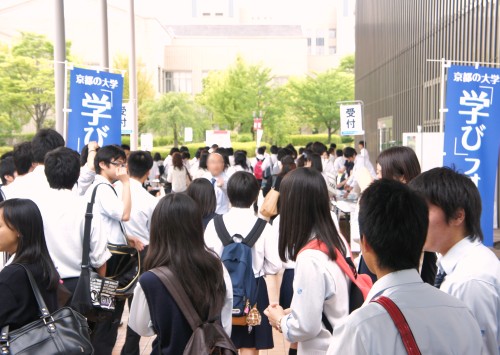
In fiscal 2014, we will hold the “Kyoto University Learning Forum” again. Universities in Kyoto gather in one place to hold mock lectures and hands-on courses in various fields. Not only high school students, but also parents can take the course freely. Please take this opportunity to experience university classes that are a little different from high school on the university campus!

For those who want to know more about universities, there are booths and resource corners for each university, as well as talk plans by university students, entrance examination preparation courses, and courses for parents. We look forward to seeing your high school students and parents from TakuMr./Ms.!

Kyoto University Learning Forum 2014
Date : Sunday, October 26, 2014 9:30~15:40Venue
: Doshisha University Imadegawa Campus Conshinkan


Organizer: Kyoto High School-University Collaborative Research Council
(Kyoto Prefectural Board of Education, Kyoto City Board of Education, Kyoto Prefectural Federation of Private Junior and Senior High Schools, Kyoto Chamber of Commerce and Industry, University Consortium Kyoto)


* The day of the week will be Sunday, unlike in previous years.
* The Shiga venue, which was usually held in June, will not be held in 2014.


Kyoto University “Learning” Forum 2014 [Click here for details]


University Consortium Kyoto, in charge of the University “Learning” Forum in Kyoto
〒600-8216 Shimogyo-ku, Kyoto-shi, Nishitoin-dori, Shiokoji Shimoru Campus Plaza Kyoto
TEL:075-353-9153  FAX:075-353-9101