【The 21st Policy Research Exchange Conference from Kyoto】Announcement of Winners

We would like to announce the winners of the 21st Kyoto Policy Research Exchange Conference, which was held on Sunday, December 14, 2025.


The 21st Policy Research Exchange Conference from Kyoto Winners

Research Encouragement Award>

★ University Consortium Kyoto President’s Award

Possibility of Utilization of Bridge Risk Score for Maintenance and Disaster Prevention Using Open Data – A Case Study Using Bridge Data in Fukuchiyama City

Aika Takada (Fukuchiyama Public University)
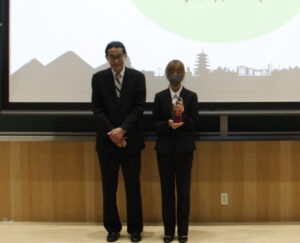
Aika Takada


★ Japan Society for Public Policy Award

Proposal of “Kyoto Idea Bakery” -Fostering Collective Knowledge through Citizen Exchange-

[Group name] Kazama Seminar Idea Bakery Group (Doshisha University)
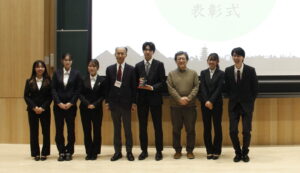
Kazama Seminar Idea Bakery Group


★ Award of Excellence

[Breakout Session 1]

Title: Examination of Effective Learning Support Methods for the Promotion of Legal Education: Starting from High School Education

Sato Seminar, 2nd year student, Faculty of Public Policy, Kyoto Prefecture University (Kyoto Prefecture University)
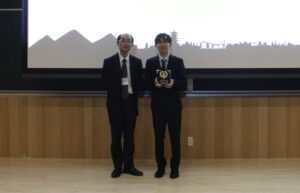
Kyoto Prefecture University Faculty of Public Policy 2nd year student Sato Seminar


[Breakout Session 2]

Presentation Title: The Impact of the Survival of Traditional Festivals on Migration and Settlement – Focusing on Traditional Festivals that Create Regional Exchanges

Iwamatsu Seminar Kakitama Soup Team (Kyoto Prefectural University)
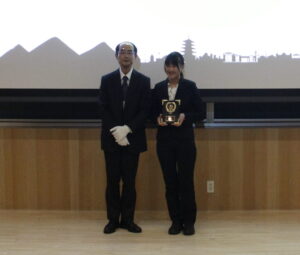
Iwamatsu Seminar Kakitama Soup Team


[Breakout Session 3]

Elimination of traffic congestion in Kyoto city center: Measuring the effectiveness of road pricing and park-and-ride based on scenario analysis

[Group name] Doshisha University Adachi Laboratory A (Doshisha University)
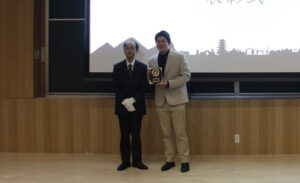
Doshisha University Adachi Laboratory A


[Breakout Session 4]

Presentation Title: Temporary Housing Supply Issues in Kyoto City and Proposal for Wide-area Evacuation Support

Group name: 9th generation of Ishihara Seminar, Faculty of Policy Studies, Ryukoku University (Ryukoku University)
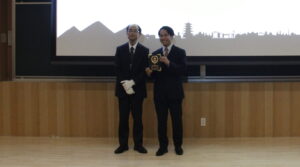
9th generation student of the Ishihara Seminar, Faculty of Policy Studies, Ryukoku University


[Breakout Session 5]

Practical Research on Disaster Prevention Education for Children Aiming to Raise Disaster Prevention Awareness at Home

[Organization] Fukuchiyama Public University Faculty of Regional Management Taniguchi Seminar Little Disaster Prevention Project (Fukuchiyama Public University)
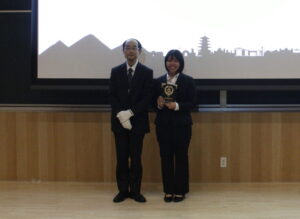
Fukuchiyama Public University Faculty of Regional Management Taniguchi Seminar

Little disaster prevention project


[Breakout Session 6]

Promoting Citizen Participation through the External Design of Meetings: Verification of the Effectiveness of Holding Private Facilities

[Group Name] Doshisha University Faculty of Policy Studies Noda Seminar Class A (Doshisha University)
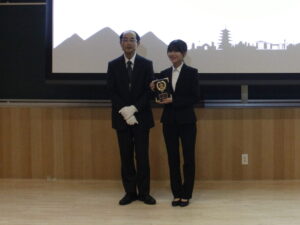
Doshisha University, Faculty of Policy Studies, Noda Seminar Group A


[Breakout Session 7]

Presentation Title: Children’s Medical Care Subsidy System and Social Growth and Decline: Panel Data Analysis for Kyoto City

[Group name] Tourism offside (Ryukoku University)
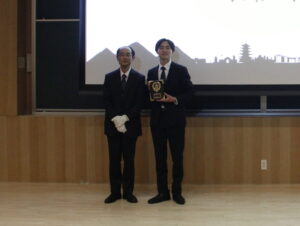
Tourism offside


[Breakout Session 8]

Purification of Touts in Downtown Areas Using Soundscapes: The Possibility of a Resonant Approach on Kiyamachi Street

[Group name] Doshisha University Noda Seminar Class B (Doshisha University)
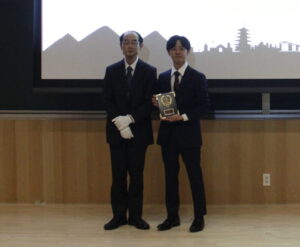
Doshisha University Noda Seminar Class B


[Breakout Session 9]

Presentation Title: Shopping Street Revitalization Project Utilizing Vacant Stores – Toward Balancing Local Communities and Economic Independence

[Group name] Ritsumei ☆ Kato Seminar ☆ (Ritsumeikan University)
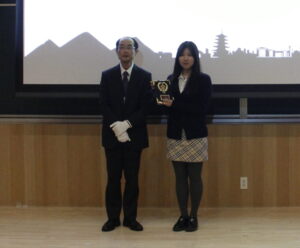
Ritsumei☆Kato Seminar☆


[Breakout Session 10]

Presentation Title: How to Raise Awareness Leaflets on Safety and Security – Effective Information Dissemination from the Police –

Abe Seminar Team A (Kyoto University of Advanced Science)
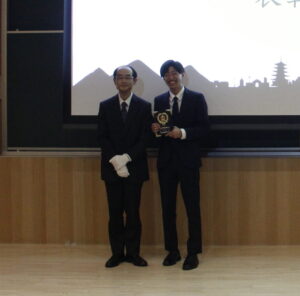
Abe Seminar Team A


Award>

[Group name] Doshisha Class A (Doshisha University)

Baby Lab (Ryukoku University)

[Group name] Doshisha University Adachi Laboratory A (Doshisha University)

Otani University Nomura Seminar Transportation Policy Team (Otani University)

[Group name] Kyoto Tachibana University Takayama Seminar (Kyoto Tachibana University)

[Group name] Iwamatsu Seminar Shopping Street Revitalization Group (Kyoto Prefecture University)

Iwamatsu Seminar 6th Industrialization Team (Kyoto Prefecture University)

[Group name] Doshisha University Noda Seminar Class B (Doshisha University)

[Group name] Ritsumei ☆ Kato Seminar ☆ (Ritsumeikan University)

Abe Seminar Team A (Kyoto University of Advanced Science)


Congratulations to all the winners!

The state of the event on the day of the competition and the PowerPoint materials of the winners will be posted on the following page at a later date.


◆Policy Research Exchange Conference from Kyoto

https://www.consortium.or.jp/project/seisaku/conference

FY2025 Industry-Academia Collaborative Education Program Project Planning Practice Course “Project Report” has been released.


Project planning practice course “Project Report” has been released.
*Project Planning Practice Course: A course to execute projects presented by companies and non-profit organizations from June to November. Through this project, the goal is to acquire the ability to look at the real world from various angles, grasp the current situation, discover issues, and solve those problems.

FY2025 Industry-Academia Collaborative Education Program “Project Planning Practice Course”
Trainees/Projects

the training center Inc. Co., Ltd. Inc. Co., Ltd.
Name ofProject Name
Insight HouseToday’s Yamashina-san Project
Impact Hub Kyoto ~Flower Back Field Lab Project~
Wine GlossaryPlanning and management of wine seminars by wine specialty stores
MOTHERSMake the Sanga Stadium food court go viral! vol.2
FP ConsultingProjects to spread wellbeing knowledge


Inquiries

University Consortium Kyoto Industry-Academia Collaborative Education Project Promotion Office
TEL 075-353-9106 FAX 075-353-9101
〒600-8216 Campus Plaza Kyoto, Shimogyo-ku, Nishidoin-dori Shiokoji, Kyoto
*Window reception hours: Tuesday ~ Saturday 9:00 ~ 17:00 (excluding year-end and New Year holidays)

Notice of power outage throughout the building


Due to the renewal of the high-voltage receiving and substation equipment, the entire Campus Plaza Kyoto will be without power.
During the power outage period below, there are items that cannot be used.
Please note.

During a power outage

1st session: January 31, 2026 (Sat) ~ February 3, 2026 (Tue)

2nd session February 7, 2026 (Sat) ~ February 10, 2026 (Tue)

3rd session February 13, 2026 (Friday) ~ February 15, 2026 (Sunday)


Please note that during a power outage, the following items will be unavailable or unavailable.
 (1) Sending and receiving e-mails, faxes, etc.
(2) Browse the availability confirmation page of Campus Plaza Kyoto (rental venue and facility usage information)
(3) Browsing the Foundation’s website, such as the Credit Compatibility Special Site

Depending on the recovery status, you may not be able to view the information even after the power outage period.
We apologize for any inconvenience this may cause and thank you for your understanding.

Notice of suspension of the vacancy confirmation page due to the power outage of the entire building


Due to the renewal of the high-voltage receiving and substation equipment, the entire Campus Plaza Kyoto will be without power.
During the power outage period below, you cannot use the availability confirmation page.
Please note.

During a power outage

1st session: January 31, 2026 (Sat) ~ February 3, 2026 (Tue)

2nd session February 7, 2026 (Sat) ~ February 10, 2026 (Tue)

3rd session February 13, 2026 (Friday) ~ February 15, 2026 (Sunday)


Please note that during a power outage, the following items will be unavailable or unavailable.
 (1) Sending and receiving e-mails, faxes, etc.
(2) Browse the availability confirmation page of Campus Plaza Kyoto (rental venue and facility usage information)
(3) Browsing the Foundation’s website, such as the Credit Compatibility Special Site

Depending on the recovery status, you may not be able to view the information even after the power outage period.
We apologize for any inconvenience this may cause and thank you for your understanding.

Closed during the year-end and New Year holidays


【Notice of Campus Plaza Kyoto Closed Days】

The holidays during the year-end and New Year holidays are as follows.
Thursday, December 28, 2023 ~ Thursday, January 4, 2024

The museum will be open as usual from Friday, January 5 for the new year.
Thank you for your continued use.

If you make a new facility reservation at the end of the year, you can only pay the usage fee in cash


Due to the year-end and New Year holidays (12/28~1/4), if you are accepting new facility reservations during the following period,
Payment of the usage fee can only be made in cash.

  Reservation period for reception that cannot be transferred (prepaid)
Wednesday, December 13, 2023     ~ Wednesday , December 27, 2023
* It is also not possible to respond by mail.

 ● Reservation period for
reception when payment by registered mail is not possible   
Wednesday, December 20, 2023 ~ Wednesday, December 27, 2023

* We apologize for any inconvenience this may cause and thank you for your understanding.

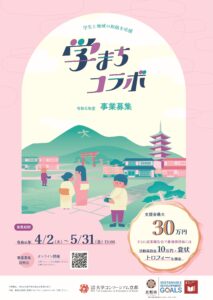
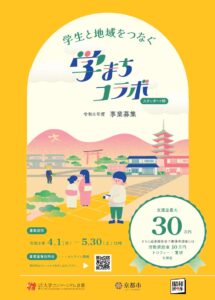
Reiwa 7 School Town Collaboration Project Connecting Students and Communities Initiative Introduction

Reiwa 7 Introducing the efforts of the school town collaboration project that connects students and the community.

The “Gakumachi Collaboration Project” is a “Gakumachi Collaboration Project” in which universities, students, and the community “collaborate” to solicit projects and projects that work on urban development and regional revitalization in Kyoto, and provide subsidy support.
We will inform you of the efforts of this year’s adopted organizations! !


【Activity Introduction (1)】Ritsumeikan University “Kinugasa Farm Kreis”
On Wednesday, August 20th, the “Kreis Community Cafeteria” was held at Ritsumeikan University Kinugasa Campus, and I visited it!

In 2020, “Kinugasa Farm Kreis” was launched in the midst of the coronavirus pandemic, and is a student organization that grows vegetables in collaboration with the local community. Approximately 70 students are taking the lead in activities that are conscious of local production, local exchange, and SDGs, starting with making mulch from fallen leaves with local people and delivering the harvested vegetables to school cafeterias and the community.

At the “Kreis Community Cafeteria”, which was held for the first time, 20 students and 15 local people participated in the curry using vegetables they grew themselves.                                          ”Because it is an area where there are many elderly people and children who eat alone, we wanted to create a warm table where everyone can gather around,” says the representative, Marin Shinohara.

As for public relations activities, posters were distributed to neighboring districts and bulletin boards set up in front of the farm were used. Since the farm is located on a walking course in front of Tochi-in, it naturally caught the attention of local people and became an opportunity to visit.                            The most difficult part of preparing for the event was not being able to read the harvest of vegetables. He said he was worried because he didn’t know which age group would come, but he was relieved that many people actually came to visit.                        In addition, in the past, when the university cafeteria closed during the summer vacation, it was difficult to find a supplier of the harvested vegetables, but it was a great achievement that we were able to utilize many summer vegetables through this event.

Regarding the future, Mr. Shinohara said, “I would be happy if you could come to the farm and have the opportunity to actually have fun talking with the students, and I hope that the fun of farming and awareness of SDGs will naturally spread through this activity.”

Finally, we who visited for the interview also feasted on freshly picked vegetable curry. A dish filled with the taste of fresh vegetables and the desire for activities. It was very delicious.

Thank you for the meal!

Please check the activity status at ↓.                                                                        https://www.instagram.com/kinugasanoen__kreis/


【Activity Introduction (2)】Ritsumeikan University “Fujibakama Project Student Team along the Randen Line”

From October 10th (Friday) ~ 19th (Sunday), “Fujibakama Yu” was held in Randen Arashiyama Station. On Thursday, the 9th, the day before the event, we covered the preparations!

*What is Fujibakama?                                                      Fragrant flowers with white to pale purple flowers in autumn. It was used in sachets during the Heian period, and is now popular as a flower called the migratory butterfly “Asagi Madara”.

The Fujibakama Project, which began in 2021, is carried out throughout the year with the cooperation of students, Randen and Ritsumeikan University faculty and staff, and local people.                                                 In spring, Fujibakama seedlings are planted, grown in summer, and bloom in autumn. Local elementary school students and volunteers also participate, deepening exchanges through the process of nurturing.

“Fujibakama Yu” is an event that has been going on since the beginning of the project, and it started with the desire to let many people know the charm of Fujibakama. Through the event held in Arashiyama, a tourist destination, we widely disseminate our activities to local people and tourists.

In preparation, we cooperated with Randen and landscaping companies to coordinate material transportation and setup. We had local people participate in the bud cuttings and planting work, and we were able to proceed with the cooperation of the entire region.

Mr. Iinuma, the representative, says, “The most difficult part of growing Fujibakama is watering.”                          Fujibakama is a water-loving plant that requires daily watering. This year, we used the subsidy money to install irrigation equipment and water automatically, but the students continued to water in turns during the summer vacation. As a result of their efforts, the flowers bloomed well this year and grew splendidly.

Growing strong Fujibakama will also lead to community development. If the leaves grow vigorously, events such as foot baths and scent bag making will be enhanced, and interactions with local people will be further expanded. In fact, Fujibakama has become a place that connects people, such as local people, students, faculty and staff, such as local people, students, and faculty members who visit to see the flowers.                                                          

In the future, while valuing the idea of “protecting and nurturing”, he would like to expand his activities together with the community.                             As a later story, it seems that the migratory butterfly “Asagi Madara” also flew to Fujibakama on the Kinugasa Campus!                                 I look forward to the expansion of conservation activities through Fujibakama in the future.

Please check the activity status at ↓.                                                                  https://www.instagram.com/fujibakama.r/


【Activity Introduction (3)】Kyoto City University of Arts, Kyoto University of the Arts, Kyoto Junior College of Economics, Kyoto University “Hozoji Exhibition Project”

On Saturday, October 11th, we covered the Hozoji exhibition project “Shisei Kanten”.

This project began with the desire of students from Kyoto City University of Arts to hold an exhibition in a place that is unique to Kyoto, and the project began at Hozoji Temple through the introduction of university officials. Under the call, students from Kyoto City University of Arts and other universities gathered to form a team of members who met for the first time.

From this year, we will hold a research work meeting once a month. He has been active at Hozoji Temple, universities, and Nishinari Ward, Osaka City, and has deepened his thoughts on “life and death” and “connection with people” through lectures at temples, meditation sessions, and visits to art community spaces in Nishinari Ward.

Through repeated exchanges of opinions, it became clear that each member’s interest could be concentrated in the word “view of life and death”, and the theme of the exhibition was decided to be “view of life and death”. The reason is that the affinity with the temple and the interest of the students overlapped. Each member created a work based on their own experiences and thoughts, and held an exhibition over four days. At the opening, a performance using motion capture was also shown, making it a time when traditional space and modern expression were harmonious.

In addition to posters, public relations were carried out through nearby temples, Kyoto Kawaramachi Station, and art-related facilities, and many local residents and tourists visited. Although there was no collaboration with local residents, Mr. Onuma, the representative, said that by opening Hozoji Temple to the community, he was able to create a place where people can gather and dialogue is born.

Although it is mainly a student, this exhibition confronts the heavy and deep theme of “view of life and death” head-on, and each member attempts to express it in a modern way. It was a place to ask many questions and awareness to visitors.

This exhibition was the first large-scale exhibition for the project. In the future, he plans to look back on his activities and consider his next development based on this experience.

I’m looking forward to the next exhibition!


Campus Plaza Kyoto Facility Reservation Schedule for 2024

Reservations for facilities after Monday, April 1, 2024 will be
accepted from 9 a.m. on Tuesday, March 5, 2024
.

(*The museum will be closed on Monday, April 1, 2024.) Please be careful. )

Reservations will be accepted on a priority basis from those who visit the museum on Tuesday, March 5.

Facility reservations by phone will be accepted after the reception of visitors is completed.
Please be careful.

* Last year’s facility reservations by phone will be accepted from around 3 p.m.
* The application and payment deadline for those who use the facility on April 2~5, 2024 is longer than usual.
Please note that it will be shorter.

Reiwa 7 School Town Collaboration Project Connecting Students and Communities Initiative Introduction

Reiwa 7 Introducing the efforts of the school town collaboration project that connects students and the community.

The “Gakumachi Collaboration Project” is a “Gakumachi Collaboration Project” in which universities, students, and the community “collaborate” to solicit projects and projects that work on urban development and regional revitalization in Kyoto, and provide subsidy support.
We will inform you of the efforts of this year’s adopted organizations! !


【Activity Introduction (1)】Ritsumeikan University “Kinugasa Farm Kreis”
On Wednesday, August 20th, the “Kreis Community Cafeteria” was held at Ritsumeikan University Kinugasa Campus, and I visited it!

In 2020, “Kinugasa Farm Kreis” was launched in the midst of the coronavirus pandemic, and is a student organization that grows vegetables in collaboration with the local community. Approximately 70 students are taking the lead in activities that are conscious of local production, local exchange, and SDGs, starting with making mulch from fallen leaves with local people and delivering the harvested vegetables to school cafeterias and the community.

At the “Kreis Community Cafeteria”, which was held for the first time, 20 students and 15 local people participated in the curry using vegetables they grew themselves.                                          ”Because it is an area where there are many elderly people and children who eat alone, we wanted to create a warm table where everyone can gather around,” says the representative, Marin Shinohara.

As for public relations activities, posters were distributed to neighboring districts and bulletin boards set up in front of the farm were used. Since the farm is located on a walking course in front of Tochi-in, it naturally caught the attention of local people and became an opportunity to visit.                            The most difficult part of preparing for the event was not being able to read the harvest of vegetables. He said he was worried because he didn’t know which age group would come, but he was relieved that many people actually came to visit.                        In addition, in the past, when the university cafeteria closed during the summer vacation, it was difficult to find a supplier of the harvested vegetables, but it was a great achievement that we were able to utilize many summer vegetables through this event.

Regarding the future, Mr. Shinohara said, “I would be happy if you could come to the farm and have the opportunity to actually have fun talking with the students, and I hope that the fun of farming and awareness of SDGs will naturally spread through this activity.”

Finally, we who visited for the interview also feasted on freshly picked vegetable curry. A dish filled with the taste of fresh vegetables and the desire for activities. It was very delicious.

Thank you for the meal!

Please check the activity status at ↓.                                                                        https://www.instagram.com/kinugasanoen__kreis/


【Activity Introduction (2)】Ritsumeikan University “Fujibakama Project Student Team along the Randen Line”

From October 10th (Friday) ~ 19th (Sunday), “Fujibakama Yu” was held in Randen Arashiyama Station. On Thursday, the 9th, the day before the event, we covered the preparations!

*What is Fujibakama?                                                      Fragrant flowers with white to pale purple flowers in autumn. It was used in sachets during the Heian period, and is now popular as a flower called the migratory butterfly “Asagi Madara”.

The Fujibakama Project, which began in 2021, is carried out throughout the year with the cooperation of students, Randen and Ritsumeikan University faculty and staff, and local people.                                                 In spring, Fujibakama seedlings are planted, grown in summer, and bloom in autumn. Local elementary school students and volunteers also participate, deepening exchanges through the process of nurturing.

“Fujibakama Yu” is an event that has been going on since the beginning of the project, and it started with the desire to let many people know the charm of Fujibakama. Through the event held in Arashiyama, a tourist destination, we widely disseminate our activities to local people and tourists.

In preparation, we cooperated with Randen and landscaping companies to coordinate material transportation and setup. We had local people participate in the bud cuttings and planting work, and we were able to proceed with the cooperation of the entire region.

Mr. Iinuma, the representative, says, “The most difficult part of growing Fujibakama is watering.”                          Fujibakama is a water-loving plant that requires daily watering. This year, we used the subsidy money to install irrigation equipment and water automatically, but the students continued to water in turns during the summer vacation. As a result of their efforts, the flowers bloomed well this year and grew splendidly.

Growing strong Fujibakama will also lead to community development. If the leaves grow vigorously, events such as foot baths and scent bag making will be enhanced, and interactions with local people will be further expanded. In fact, Fujibakama has become a place that connects people, such as local people, students, faculty and staff, such as local people, students, and faculty members who visit to see the flowers.                                                          

In the future, while valuing the idea of “protecting and nurturing”, he would like to expand his activities together with the community.                             As a later story, it seems that the migratory butterfly “Asagi Madara” also flew to Fujibakama on the Kinugasa Campus!                                 I look forward to the expansion of conservation activities through Fujibakama in the future.

Please check the activity status at ↓.                                                                  https://www.instagram.com/fujibakama.r/

Reiwa 7 School Town Collaboration Project Connecting Students and Communities Initiative Introduction

Reiwa 7 Introducing the efforts of the school town collaboration project that connects students and the community.

The “Gakumachi Collaboration Project” is a “Gakumachi Collaboration Project” in which universities, students, and the community “collaborate” to solicit projects and projects that work on urban development and regional revitalization in Kyoto, and provide subsidy support.
We will inform you of the efforts of this year’s adopted organizations! !


【Activity Introduction】Ritsumeikan University “Kinugasa Farm Kreis”
On Wednesday, August 20th, the “Kreis Community Cafeteria” was held at Ritsumeikan University Kinugasa Campus, and I visited it!

In 2020, “Kinugasa Farm Kreis” was launched in the midst of the coronavirus pandemic, and is a student organization that grows vegetables in collaboration with the local community. Approximately 70 students are taking the lead in activities that are conscious of local production, local exchange, and SDGs, starting with making mulch from fallen leaves with local people and delivering the harvested vegetables to school cafeterias and the community.

At the “Kreis Community Cafeteria”, which was held for the first time, 20 students and 15 local people participated in the curry using vegetables they grew themselves.                                          ”Because it is an area where there are many elderly people and children who eat alone, we wanted to create a warm table where everyone can gather around,” says the representative, Marin Shinohara.

As for public relations activities, posters were distributed to neighboring districts and bulletin boards set up in front of the farm were used. Since the farm is located on a walking course in front of Tochi-in, it naturally caught the attention of local people and became an opportunity to visit.                            The most difficult part of preparing for the event was not being able to read the harvest of vegetables. He said he was worried because he didn’t know which age group would come, but he was relieved that many people actually came to visit.                        In addition, in the past, when the university cafeteria closed during the summer vacation, it was difficult to find a supplier of the harvested vegetables, but it was a great achievement that we were able to utilize many summer vegetables through this event.

Regarding the future, Mr. Shinohara said, “I would be happy if you could come to the farm and have the opportunity to actually have fun talking with the students, and I hope that the fun of farming and awareness of SDGs will naturally spread through this activity.”

Finally, we who visited for the interview also feasted on freshly picked vegetable curry. A dish filled with the taste of fresh vegetables and the desire for activities. It was very delicious.

Thank you for the meal!

Please check the activity status at ↓.                                                                        https://www.instagram.com/kinugasanoen__kreis/