Garbage separation when using Campus Plaza Kyoto

From April 2016, the rules regarding garbage separation will change in the Campus Plaza Kyoto building.

Currently, only general garbage and cans and PET bottles are separated, but in order to comply with the ordinance of Kyoto City,
We will install a new waste bin for waste plastic and paper waste (miscellaneous paper).
For more information on the classification of garbage, please refer to the Kyoto City website(Opens in a new window).

We ask for your cooperation in separating garbage at the hotel.

We will hold a 27th “Gakumachi Collaboration Project” debriefing session!


Kyoto City and the University Consortium Kyoto will hold a report session on the “Gakumachi Collaboration Project (University Regional Collaboration Creation and Support Project)” to support efforts for regional revitalization implemented in collaboration with universities, students, and the local community.

At the debriefing session, the 14 business organizations selected this year will look back on their activities so far and present the results of their efforts.
Why don’t you find new possibilities for collaboration between the university and the community and hints for regional revitalization from the reports of accreditation projects by students, such as regional development through the inheritance of local customs and traditions?

In addition, a recruitment briefing session for the next year will be held at the same time on the day of the event.
If you are considering applying, please take this opportunity to participate.

In addition, on the day of the event, we will hold an opinion exchange meeting and a networking event with visitors.

It is free to come and go, and anyone can participate, so please feel free to join us.

Heisei 27 “Gakumachi Collaboration Project” report meeting

Date & Time Sunday, March 27, 2016 10:00~17:00
Venue Campus Plaza Kyoto, 5th Floor, Lecture Room 1 / Hall 2nd Floor
(939 Higashi-Shiokoji-cho, Nishitoin-dori, Shimogyo-ku, Kyoto)
[Access] 5 minutes walk from Kyoto Municipal Subway, JR, Kintetsu Kyoto Station
Flow of the day room on the floor>
10:00 ~ Heisei 27 Certified Business Report Meeting * 1 Presentation @ 13 minutes (including questions and substitutions)
14:40~Heisei 28 business recruitment briefing session
hall on floor>
15:00~Opinion exchange meeting, exchange meeting
16:30~Critique and Award Ceremony
17:00 End (tentative)

* Please see here for the detailed schedule ↓↓↓
“Heisei 27 Gakumachi Collaboration Project Report Meeting Schedule”
Occupancy 200 (80 for opinion exchange meetings and exchange meetings)
*All are on a first-come, first-served basis.
* If the capacity is not reached, we will accept applications on the day.
Participation Fee free


●Click here for the information flyer
⇒ Flyer announcing the debriefing session.pdf
●Click here for details of our business
⇒ https://www.consortium.or.jp/project/seisaku/gakumachi
●Click here for last year’s event
⇒ https://www.consortium.or.jp/project/seisaku/gakumachi/2014-1

Registration

 Applications are being accepted from Thursday, February 18, 2016 ~ Saturday, March 26, 2016.
If you would like to participate or attend the lecture, please apply using the application form below.

application

Inquiries and applications

University Consortium Kyoto Gakumachi Collaboration Project
TEL :075-353-9130 FAX: 075-353-9101
MAIL:gakumachi-admin-ml■consortium.or.jp
(Please change ■ to @ and send)
〒600-8216 Shimogyo-ku, Kyoto-shi, Nishitoin-dori, Shiokoji, Shimo-ku, Kyoto, Campus Plaza Kyoto
* Reception hours: Tuesday ~ Saturday 9:00 ~ 17:00

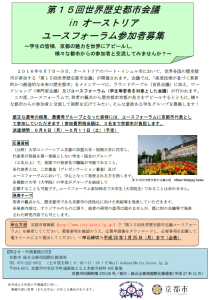
【Application Closed】Call for Participants for the 15th World Conference of Historical Cities Youth Forum

 
forum 
From June 7 to 9, 2016, the 15th World Conference of Historic Cities will be held in Bad Ischl, Austria, with the participation of historical cities from around the world.
As part of this effort, a conference for students and other young people called the “Youth Forum” will be held, where we will appeal to the merits of the historical city of Kyoto from the perspective of young people, and we will recruit motivated student groups who want to broaden their horizons by interacting with participants from various cities.
Why don’t you participate in the Youth Forum as a representative of Kyoto City, promote the charm of Kyoto to the world, and interact with participants from various cities?
We look forward to receiving your application.

(Participants will be selected through a strict screening process.) )

Eligibility

Students must be enrolled in a member university or junior college of the University Consortium Kyoto, and must be able to give presentations and discuss in English in a group (2 or more students) whose representative is not English as their first language.
* The representative refers to the person who will play a central role in the second screening (presentation screening) and the youth forum.
* It is also possible for students from multiple universities (graduate schools) to form a group and apply.
*Students are not required to be university students (graduate students) at the time of participating in the Youth Forum.

* Download the application guidelines (PDF) and application form (Word) *

Application Period

Friday, December 4, 2015 ~ Monday, January 25, 2016

Presentation Themes

From the perspective of young people, they will present their efforts to revitalize the historic city of Kyoto.
Please feel free to set the theme of your presentation, referring to the theme of the 15th World Conference on Historical Cities below.

< main theme>
“Smart, innovative, creative historical cities of the future”
(An innovative and creative historical city of the future with advanced technology)

< sub-theme>
①“Development of tourism to promote city identity”
(Tourism Policy for Improving the Rating of Cities)
②“Creating livable smart historical cities”
(A historic city where you can live forever)
③“Engaging citizens including young people to plan for the future”
(Active Involvement in Urban Planning by Citizens, Including Young People)

* The content of the presentation must be original, and plagiarism of other people’s research is not permitted.
* Research content that has already been presented at another conference is acceptable.

schedule

Application submission deadline: Monday, January 25, 2016

Notification of the results of the first screening (document screening): Mid-February 2016 (tentative)

Second screening (presentation screening): Early March 2016 (tentative)

Notification of the results of the second screening: Mid-March 2016 (tentative)

The 15th World Conference of Historical Cities Youth Forum: June 7 (Tue) ~ 9 (Thu), 2016
*The actual dispatch period is scheduled for June 6 (Mon) ~ 11 (Sat), 2016.

How to apply

Please check the application guidelines, fill out the application form, and submit it by e-mail.
January 25, 2016
Destination: Kyoto City General Planning Bureau, Internationalization Promotion Office kokusai@city.kyoto.lg.jp


Inquiries and application submission

Kyoto City General Planning Bureau Internationalization Promotion Office
〒604-8571 488 Kamihonnoji-maecho, Teramachi-dori, Nakagyo-ku, Kyoto
TEL 075-222-3072 FAX 075-222-3055
E-Mail: kokusai@city.kyoto.lg.jp
Kyoto City Information Center HP: http://www.city.kyoto.lg.jp/sogo/page/0000191385.html


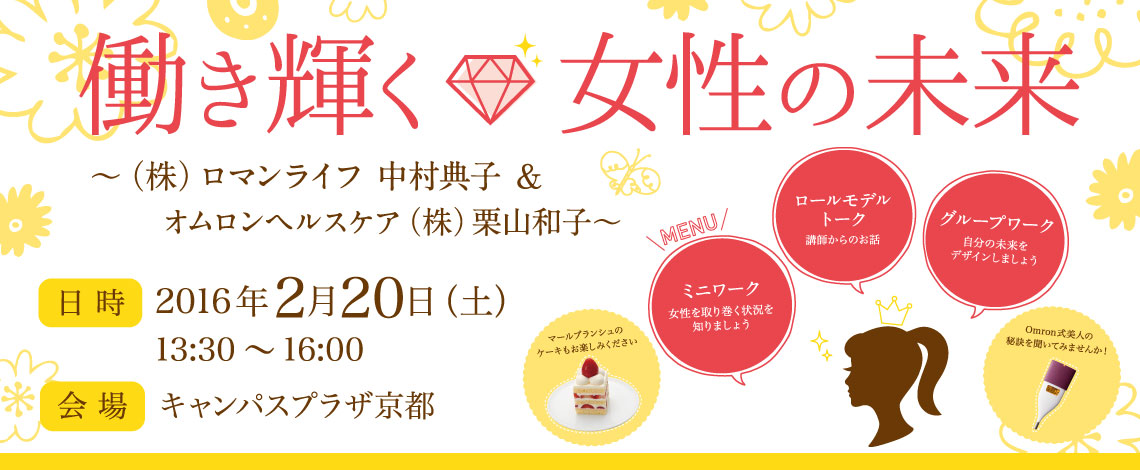
Girls’ Career Talk 《The Future of Working Women 》


Coordinate your work every day, more
freedom, for a career that suits me: Thegirls-web2


future of working women who shine
~Noriko Nakamura of Roman Life Co., Ltd. & Kazuko Kuriyama of OMRON Healthcare Co., Ltd. ~

girls-profile
 Kyoto Prefecture, the Kyoto High School University Collaborative Research Council, and the High School Consortium Kyoto will carry out a collaboration project for working and shining women.
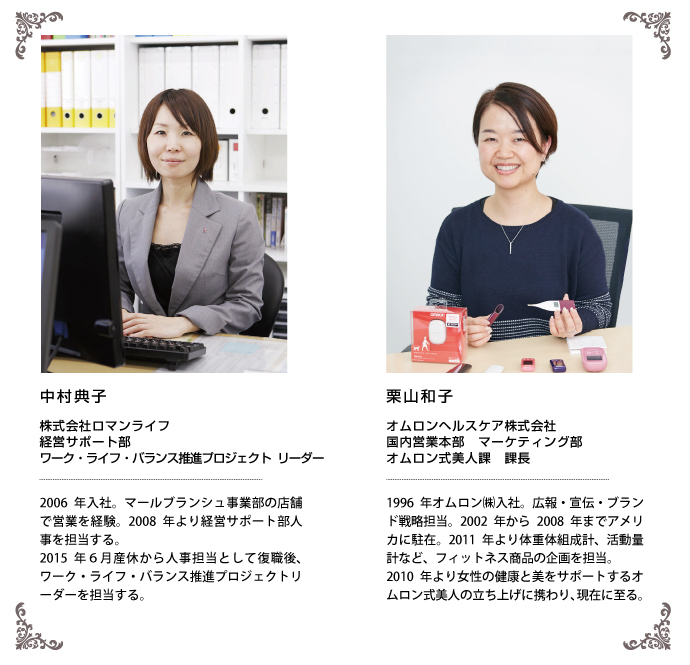
We invited Mr./Ms. Noriko Nakamura, who is involved in management support such as work-life balance and human resources at Roman Life Co., Ltd., which operates Kyoto Kitayama Malebranche that everyone who loves sweets in Kyoto knows, and Mr./Ms. Kazuko Kuriyama from OMRON Healthcare Co., Ltd., which pursues women’s health and beauty and even launched the “Omron Style Beauty Section”, for high school and university students who will go out into society. He will talk about how he got his current job, his experience so far, and the joy and significance of his work.
Why don’t you think together about what you should do now for your future?
We are looking forward to receiving applications from all Mr./Ms. female students and female students of the Mr./Ms..

Outline of the event

Date Saturday, February 20, 2016 13:30~16:00
Venue Campus Plaza Kyoto 2nd Floor Hall
Organizer Kyoto High School-University Collaborative Research Council (Kyoto Prefectural Teachers’ Committee, Kyoto City Board of Education, Kyoto Prefectural Federation of Private Junior and Senior High Schools, Kyoto Chamber of Commerce and Industry, University Consortium Kyoto)
Co-organizers Kyoto Prefecture / High School Consortium Kyoto
Target A total of 50 female students attending high schools in Kyoto Prefecture and female students attending universities in Kyoto Prefecture
Participation Fee free
Contents Moderator: Iwako Yamamoto (Associate Professor, Institute of Innovation, Kyoto Institute of Technology / Coordinator, Kyoto High School University Collaboration Promotion Office, University Consortium)

(1) Mini-work
Let’s get to know the situation surrounding women
Lecturer: Yoko Ichihara, Kyoto City Association for the Promotion of Gender Equality

(2) Role Model Talk
Stories of life experiences from seniors who work with a smile (going on to higher education, finding a job, changing jobs, getting married, balancing child-rearing, etc.)
Listen!
Lecturer: Noriko Nakamura Roman Life Co., Ltd. (Malebranche)
: Kazuko Kuriyama, OMRON Healthcare Corporation
 
(3) Group work
Design your own future

cake2  omron2


The future of working women
~Noriko Nakamura of Roman Life Co., Ltd. & Kazuko Kuriyama of OMRON Healthcare Co., Ltd.~
PDF

How to apply: E-mail application

Subject: “Application for the Future of Working Women and Shining Women”

Body: (1) Name (2) Affiliated university/faculty/high school affiliation (3) Grade (4) Telephone number (5) E-mail address

Please apply by e-mail to kodai■consortium.or.jp with the above contents.
(Please replace ■ with @)
We will send you a confirmation email after receiving your application.
At that time, we will send you a simple questionnaire form, so please cooperate with us.

Application Deadline

Wednesday, February 10, 2016
* If there are many applications, a lottery will be held.

Application and Inquiries

University Consortium Kyoto High School-University Collaboration and Internship Division
Tel: 075-353-9153 FAX: 075-353-9101
〒600-8216 Shimogyo-ku, Kyoto-shi, Nishitoin-dori, Shiokoji, Shimo-ku, Kyoto, Campus Plaza Kyoto
* Reception hours: Tuesday ~ Saturday 9:00 ~ 17:00 (excluding year-end and New Year holidays)


About the results of the implementation of “Maruttoku in Ayabe”


gist

High school students in the northern region of Kyoto Prefecture have fewer opportunities to learn about universities and interact with current university students than high school students in urban areas because there are no universities located nearby.
In addition, there are few opportunities to experience local history and culture and talk at length with people who work in the local area, and many young people graduate from high school without having an image of working and living in their hometown as adults, move to urban areas after graduating from high school, and start their careers as members of society in other areas after graduating from university.

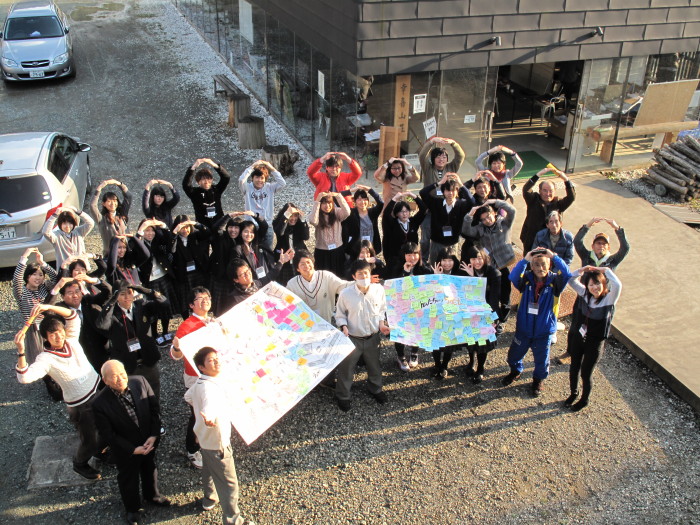
Therefore, with the aim of developing the careers of high school students in the northern region of Kyoto Prefecture and fostering human resources who will support the community, the Kyoto High School-University Collaborative Research Council held a workshop “Maruttoku in Ayabe” in Ayabe City, this time in Ayabe City, following on from Kumihama-cho, Kyotango City.

Marutoku Ayabe group photo

Outline of Implementation

schedule Friday, March 13, 2015 and Saturday, March 14, 2015
place Satoyama Exchange and Training Center (Ayabe City)
sponsorship Kyoto High School-University Collaborative Research Council (Kyoto Prefectural Board of Education, Kyoto City Board of Education, Kyoto Prefectural Federation of Private Junior and Senior High Schools, Kyoto Chamber of Commerce and Industry, University Consortium Kyoto)
cooperation Kyoto Prefecture Northern Regional and University Cooperation Organization
Non-profit organization Satoyama Net Ayabe
participant High School Students 16 students (15 students from Kyoto Prefectural Ayabe High School, 1 student from Kyoto Prefectural Fukuchiyama High School)
university student 15 (Ryukoku University, Kyoto Seika University, Doshisha Women’s University, Kyoto Women’s University, Ritsumeikan University, Kobe University, Kansai University, University)
working adult 13 (residents of the former Toyosato Nishi Elementary School District, etc.)

Implementation Report

Once again, the university students were able to deepen their understanding of local history and culture through a tour of the Gunze Museum, a walk around the Shigago area, and a lecture by the director of the Ayabe Special Products Museum, before the actual performance of the next day.
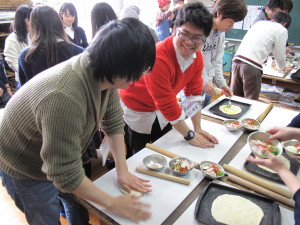
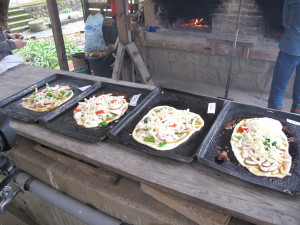
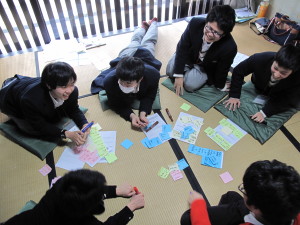
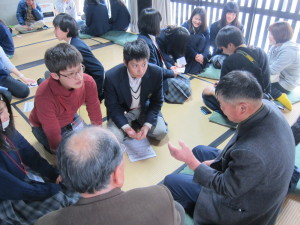
The high school students seemed a little nervous in the morning, but gradually relaxed as they made pizza with the university students, and in the afternoon they participated in the dialogue with the university students and working adults with relaxed expressions. In addition, I was impressed by the enthusiasm of university students and working adults about their life stories so far, and the way they wrestled and actively asked questions. The participants were not only people who have lived in the local area for a long time, but also people who have made I-turns and U-turns, and they spoke frankly about what they feel on a daily basis, such as the charms and challenges of Ayabe and expectations for young people, which was a good stimulus for university and high school students.

Pizza Making 2  Pizza kettle

Marutoku Work 2  Whole Dialogue

Through this workshop, the high school students were able to reaffirm their dreams and goals, gain the courage to move toward their realization, and reaffirm the charm of Ayabe, while the university students developed their facilitation skills by leading the dialogue and gained new insights by looking back on their lives so far. Local residents also commented, “It was good to be able to talk with young people, and I would like to participate again.” It became a meaningful initiative for high school students, university students, and local residents.

We would like to brush up on the results of this fiscal year and continue to implement this project next year.

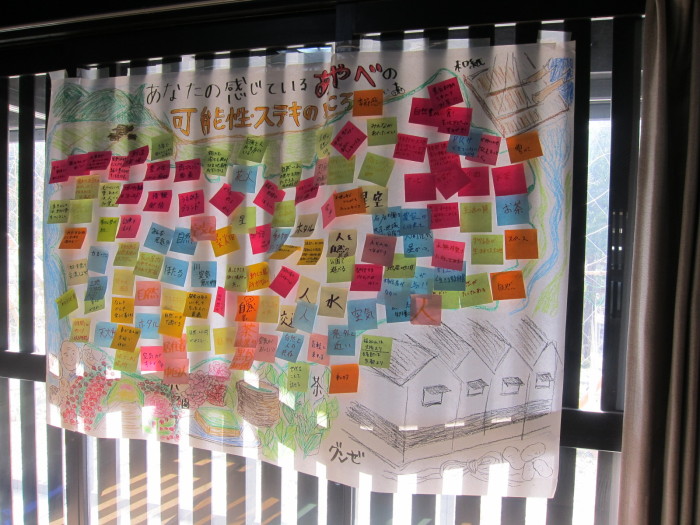
A label written down by each participant about the charm of Ayabe

A label written down by each participant about the charm of Ayabe

13 Day Time Schedule

9:30-12:00 University Student Mobility (Ayabe, Kyoto→)
12:00-13:15 ~Ayabe Satoyama Walk~ (Shiga Township Area)
[Lunch (Takematsu udon), walk, interaction with locals]
13:30-15:30 ~Walking around Ayabe Town~ (in front of Ayabe Station)
[Lecture by the director of the Ayabe Special Products Museum and tour of the Gunze Memorial Hall]
16:00-18:00 Preparatory Work @ Satoyama Training and Exchange Center
18:00-21:00 Dinner & Bathing @ Satoyama Training & Exchange Center
21:00-22:30 Venue Preparation @ Satoyama Training and Exchange Center
22:30 Bedtime [Accommodation] @里山研修交流センター

14 Day Time Schedule

9:00-11:30 ★ Opening of the Morning Session (High School × University Students)
Icebreaker
11:30-12:30 Stone oven pizza making experience ~ Using Ayabe ingredients (fukino tou miso, rape flowers, etc.) ~
13:00-13:10 ★ Opening of the afternoon session (high school students× university students× local professionals)
Explanation of the purpose of the project
13:10-14:00 Interview Work ~Group Dialogue on “Me” and “Ayabe”~
14:00-14:50 Self-introduction work (replace members and share the contents of the dialogue in each group)
14:50-15:50 Dialogue in small groups centered on high school students (dialogue based on the theme that high school students want to explore)
15:50-16:20 Fill out questionnaires, summarize, and take photos
16:30 closing

Contact us

Public Interest Incorporated Foundation University Consortium Kyoto High School University Collaboration
TEL 075-353-9153 FAX 075-353-9101
〒600-8216 Shimogyo-ku, Kyoto-shi, Nishitoin-dori, Shiokoji, Shimo-ku, Kyoto, Campus Plaza Kyoto
* Reception hours: Tuesday ~ Saturday 9:00 ~ 17:00 (excluding year-end and New Year holidays)

Kyoto Student Festival 12/6 (Sun) “Kyo Flame Sodefure! Please come ≪ us≫

To express our gratitude, we will hold the “Kyo Flame Sodefure Festival”!

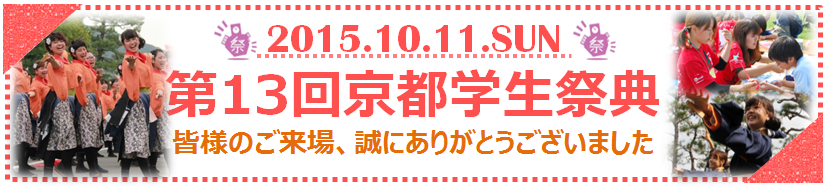
The 13th Kyoto Student Festival (Main Festival) held on Sunday, October 11 was a great success, with a total of 144,000 people attending. This year’s festival, which is based on the themes of “Kyoto” and “International,” is the culmination of various exchange activities throughout the year, and we have planned a variety of genres such as dance, food, music, and sports. In addition, due to the redevelopment work of Okazaki Park this year, the main stage with the newly reborn Jingu-do in the background of Otenmon was very popular with visitors, and the attractive performances by the students, centered on the powerful stage overlooking the entire venue, created a sense of unity throughout the venue.
We would like to express our gratitude once again to everyone who came to the event and who have been supporting this activity in various fields on a daily basis.
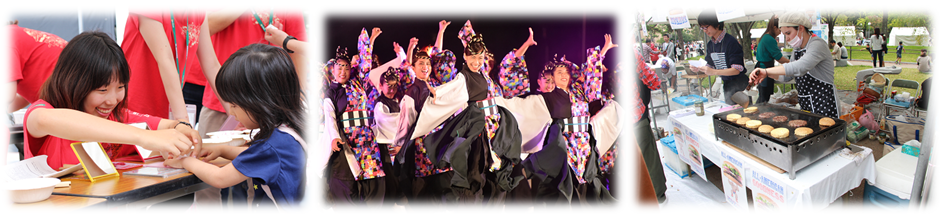
Therefore, to express our gratitude to all of you, we will hold the “Kyoen Sodefure Festival“. There are odori, delicious food, and many children’s projects, making it a place for interaction between Mr./Ms. and generations. Please invite your family and friends to join us. We look forward to seeing you there.

02102

Guidelines

Date & Time 2015December 6 (Sun) 11:00 ~ 14:00 (*Cancelled in case of rain)
Place: Umekoji Park Lawn Square
Contents dance
stage
Performances of each team that played an active role in the Kyoto Student Festival (Appearances: 17 teams in total) Kyo Flame Sodefure! Shibu / Kyo Flame Sodefure! Tacchi / Kyo Flame Sodefure! Bunmai Ran / Kyo Flame Sodefure! Ring Dance / Kyo Flame Sodefure! Odoritsu/Kyo Flame Sodefure! Aoiwa / Kyo Flame Sodefure! Flower Wind Appearance / Kyo Flame Sodetouch! Saikyo Front / Kyo Flame Sodefure! Hua Luo Hong / Kyo Flame Sodefure! Sakisanka / Kyo Flame Sodefure! Kyokomachi / Kyo Flame Sodefure! Kyo Boom / Kyo Flame Sodefure! The Great Cloudy Sky / Kyo Flame Sodetouche! Terukyo / Omiya Flame Dragon Maiden / Pink Child
(The performance schedule will be distributed on the day of the performance.)
eating and drinking
corner
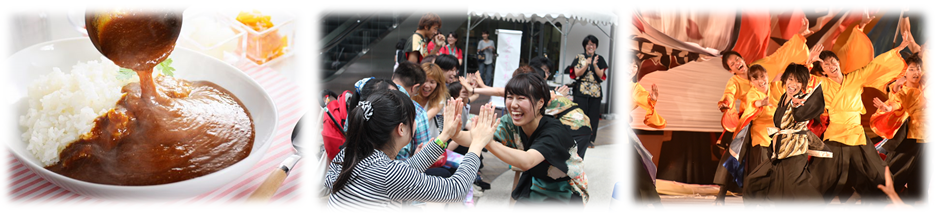
Original curry by Kyoto University Curry Club,
Pot-au-feu, chai tea, etc. (* Both food and drink are charged)
children
corner
Balloon Art
Kyo Flame Sodetouch! Mr./Ms. has a lot of projects that children can enjoy!
Odori classes will also be held at the same time!

* If it is canceled due to rain, we will inform you on the blog of the Kyoto Student Festival Student Executive Committee.
Click here for                the blog of the Student Executive Committee (The photo is an image)  
02102-2

What is the Kyoto Student Festival?

mvStudents in Kyoto, who transcend the boundaries of universities, collaborate with the business community, the government, the local community, and the university to disseminate “Kyoto as a student city” to society, further revitalize the Kyoto area, and create new attractions.
After a variety of community exchange activities throughout the year, such as the promotion of the original creative odori “Kyoen Sodefure!” and water sprinkling activities, a grand festival is held every October as the culmination of these activities.
The University Consortium Kyoto has set the goal of “student growth” in the daily activities of the Student Executive Committee, and is providing support aimed at “student independence” that allows students to think and act on their own, and supports the activities that have been accumulated since the establishment of the Executive Committee so that they can make the most of what they have accumulated in the course of their activities so far at the main festival in October.

Click here for the report on the 13th Kyoto Student Festival

Kyoto Student Festival Activities

If you would like to know more about the Kyoto Student Festival, check out this site!

Kyoto Student Festival Official Website       Facebook Logo      Twitter Logo

Contact us

Kyoto Student Festival Executive Committee
〒600-8216 Shimogyo-ku, Kyoto-shi, Nishitoin-dori, Shiokoji, Shimoru Campus Plaza Kyoto (closed on Mondays)
Tel:075-353-9432   Fax:075-353-9431
E-mail: saiten13th-ml■consortium.or.jp (Please replace ■ with @)
Kyoto Student Festival Official Website: http://www.kyoto-gakuseisaiten.com/


The Grand Prix of the 18th Kyoto International Student Film Festival has been announced! [Report on the holding of this festival]

Event Report

The 18th Kyoto International Student Film Festival, which was held for seven days from Saturday, November 21 to Friday, November 27, concluded successfully with a total of 13 programs. We would like to express our gratitude to everyone who came to the festival and to all those who supported and cooperated in various ways in holding this festival.

Outline of the event

schedule Saturday, November 21, 2015 ~ Friday, November 27, 2015
meeting place Kyoto Cinema (COCON Karasuma 3F)
sponsorship University Consortium Kyoto
Planning & Management The 18th Kyoto International Student Film Festival Executive Committee
Operational Support Kyoto International Student Film Festival Planning Review Committee

Programme

A
program
『New World』 Luzie Loose Filmakademie Baden-Wurttemberg Germany Live
『mind scape』 Kaori Liang Tokyo University of the Arts Graduate School Japan anime
『Cachorro Loko』 Igor Shin Moromisato Academy of Media Arts Cologne Germany anime
“Goron, Bang, Kyu” Kan Yamamoto Osaka University of Arts Japan Live
B
program
『Fidelity』 Ilker Çatak Hamburg Media School Germany Live
“The name of the house” Nao Sakagami Tokyo University of the Arts Graduate School Japan anime
『Laughter in the Dark』 Marta Trela Lodz Film School Poland Live
『CAMEO’n Me』 Toshihiro Mune Musashino Art University Graduate School Japan Live
C
program
“Not to Mr./Ms..” Sawako Kangi Tama Art University Japan anime
“You don’t have to look at anything.” Keigo Ito Osaka University of Arts Japan anime
“Dust in the Clouds” Yutaro Nakamura Tama Art University Japan Live
D
program
『100 Apples』 Chia-YaoWang National Chengchi University Taiwan Live
“The Scales of the Corner” Megumi Ishitani Tokyo University of the Arts Graduate School Japan anime
『I’m here』 Yukie Nakauchi, Riki Kamimizutaru Tokyo University of the Arts Graduate School Japan anime
『The Bad Old Us』 Lily Erlinger Filmakademie Baden-Wurttemberg Germany Live

Prize in each category

KingLive-Action Grand Prix
Live action Film Grand Prix

kisfvf2015_1

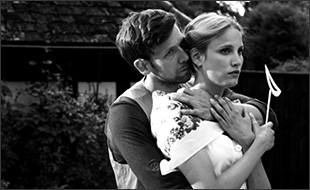
“The Bad Old US” Germany / 28min 
Director: Lily Erlinger
School: Filmakademie Baden-Wurttemberg

It’s about the village where the main character, Adrian, lives with his family, and the tradition of the annual raffle raffle competition there. The village is guided by the life philosophy of the village chief and the guards, and at first glance it seems peaceful. However, Adrian witnesses an unbearable truth deep in the forest…


KingAnime Division Grand Prix
Animation Film Grand Prix

kisfvf2015_1

“The Name of the House” Japan/4min 
Director: Nao Sakagami
School: Tokyo University of the Arts Graduate School

That’s where my grandparents, my parents, and I used to live. Even if we have forgotten distant memories and emotions, they are certainly present and will continue to be.


KingFinal Jury Prize
Shuichi Okita, Lee Feng Woo Prize (double winner)
Awards Of Shuichi Okita & LEE BONG-WOO

kisfvf2015_1

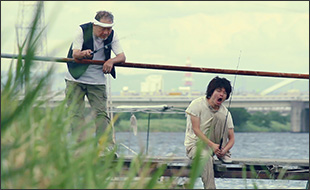
“Goron, Batang, Kyu” Japan / 54min 
Director: YAMAMOTO Kan
School: Osaka University of Arts

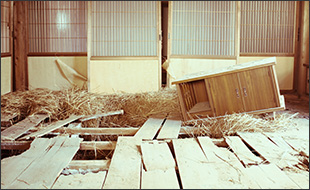
“Ataru” and “Mr./Ms. Sasaki” who live in a blue tent on the Yodogawa riverbed Although it is harsh, the two of them live with a smile. One day, he meets a woman who is in trouble because her bicycle is broken. There is the house of “Ataru” who is destroyed by the hands of “Ataru’s” father, “Tsunehiro”. How will the two people who have lost their homes live?


KingFinal Jury Prize
Sayoko Kinoshita Prize
Awards Of Sayoko Kinoshita

kisfvf2015_1

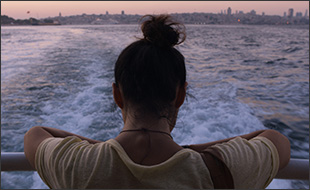
“Fidelity” Germany / 24min 
Director: Iiker Çatak
School: Hamburg Media School

Istanbul, 2014. As the anti-government movement gains momentum, Asli, a woman working at a hospital, helps a young male activist escape from being chased by the police. The police suspected her and visited her house. Asli refuses to cooperate with the investigation, but the situation worsens with her family involved.


KingAudience Award
Awards Of Audience

kisfvf2015_1

“Goron, Batang, Kyu” Japan / 54min 
Director: YAMAMOTO Kan
School: Osaka University of Arts

“Ataru” and “Mr./Ms. Sasaki” who live in a blue tent on the Yodogawa riverbed Although it is harsh, the two of them live with a smile. One day, he meets a woman who is in trouble because her bicycle is broken. There is the house of “Ataru” who is destroyed by the hands of “Ataru’s” father, “Tsunehiro”. How will the two people who have lost their homes live?


☆☆ The 18th Kyoto International Student Film Festival Click here for more information☆☆


☆☆ Kyoto International Student Film Festival Official Website ☆☆


Saturday, November 14: A debriefing session was held for the 2015 Internship Progress Course


In the “Internship Progress Course” of the University Consortium Kyoto, trainees worked on projects presented by host companies from mid-June to late November. On November 14, the results of the meeting were reported, and the nine projects made presentations over the course of one day. There were also presentations with videos and devising a format, showing the efforts and results of working on the project. At the graduation ceremony after the results debriefing session, the coordinator handed out a “certificate of completion” for each project. With this, the 2015 “Internship Progress Course” has come to an end.

Left: Achievement debriefing session
Photo right: Certificate of completion
2 Kiko Network 10Graduation Ceremony

Outline of Implementation

Date & Time Saturday, November 14, 2015 10:40~17:35
Venue Campus Plaza Kyoto, 4th Floor, Lecture Room 2
Number of companies and organizations participating in the project
(In order of presentation of the results report)
9Companies and Organizations
(Yumecom Co., Ltd. / Kiko Network Co., Ltd. / Wiz Co., Ltd. / Concept Glamour Co., Ltd. / Intelligence Office Co., Ltd. / Japan Women’s Professional Baseball League Kyoto Flora / Yosano Co., Ltd. / Specified Non-Profit Organization Children’s Independence Village Warm-up School from here / Kyoto Prefectural Board of Education)
Number of students 45 students from 10 universities
(Kyoto Prefectural University, Otani University, Kyoto Sangyo University, Kyoto Women’s University, Kyoto Tachibana University, Kyoto Notre Dame Women’s University, Kyoto Bunkyo University, Doshisha University, Doshisha Women’s University, Ryukoku University)
coordinator
Number of faculty members
8
(Kyoto Institute of Technology, Kyoto Gakuen University, Kyoto Women’s University, Kyoto Seika University, Doshisha University, Ryukoku University)


About the announcement

Presentation time is 25 minutes each (80 minutes for 4 schools in Kyoto Prefectural Board of Education)
Using PowerPoint and other means, each coordinator in charge will moderate.

Yumecom Inc. 
~Planning and production project of the information magazine “Lifelike” for nursing care for one’s own retirement and family~

I have been working with the goal of having my thoughts published in the magazine “Lifelike” published by Yumecom. As a result, the publication date of Lifelike may change, and we were not able to achieve our goal of showing the booklet at this achievement debriefing session. However, during the internship, I learned a lot of things, including how to make plans.

1 Yumecom

Kiko Network
~Let’s gather 500 students for “Earth Parade 2015 in Kyoto”~

COP21 will be held in Paris for two weeks from November 30.
In order to make many people aware of the new agreement that replaces the Kyoto Protocol, the host country planned the “Earth Parade” at the center. I was involved in the planning and publicity of the project, and I had a variety of experiences.
Through negotiations with environmental circles and university co-ops, I learned the importance of actually taking action.

Left: With the cooperation of Progress students, a photo shoot with students of the Progress Course
Right: Flyer for Earth Pace 2015. I imagined France.
Click here for more information about Earth Parade

kikounett   kikounett

Wiz Co., Ltd. ~Let’s make a movie, distribute it, promote it, and release it~

The Wiz’s goal is to create and distribute films and raise funds for the next release.
During the apprenticeship, I was involved in the creation of two films.
Movies have a variety of roles, and even if one of them is missing, such as location scouting, lighting, costumes, and sound, it will be reshot. No matter how hard we tried, there were times when we had no choice but to wait.
In such a situation, it was difficult to manage and schedule more than 200 costumes.
The staff roll of the finished film will also include the names of the apprentices.

3 Wiz

Concept Glamour Co., Ltd. ~Kyoto Asageiko~

Kyoto Asageiko started on October 20th. We planned the autumn place, and this time we planned “Adult Beautiful Letters”.
My first project was rejected, and I learned that it is difficult to grasp the “needs” when submitting a proposal, and how difficult it is.
It’s hard to be early in the morning, but it’s a healthy rhythm of life!
I made the most of my time in the morning and learned a lot of things.

4 Concept

Intelligence Office Co., Ltd. ~Hitomanabi Internship 2015~

An internship with the goal of creating a free paper. The free paper was successfully completed and distributed.
14 apprentices made 1,659 phone calls.
Of those, 69 appointments were made. We were faced with the rigors of sales activities.
The sales experience that I could not experience as a part-time job gave me an opportunity to think about my future path.
This is the last spurt for the event on December 5th.

Click here for event details

5 Intelligence

Japan Women’s Professional Baseball League Kyoto Flora ~Game Event Planning and Management~

The goal of this project is to “plan and manage events for official matches held in late August” and to have as many visitors as possible.
In order to make this a success, we conducted it in collaboration with students from the Faculty of Sport and Health Sciences at Ritsumeikan University.

Photo) I wore a Kyoto Flora uniform and made a presentation.
6 Flora

Yosano Co., Ltd. ~Efforts to raise awareness of Kyotango vegetables~

Yosano Co., Ltd. is located in Yosano Town in the northern part of Kyoto Prefecture. We have created a product plan for pasta sauce, which is Yosano’s main product. I had seen many catalogs and pamphlets, but this was my first experience as a producer, and there were many things I didn’t understand.
We created a product plan by devising layouts, illustrations, and product description text that would be conveyed to the reader.
It was a very happy experience for the company to use the product proposal as a material for the presentation.

7 Yosano

Specified Non-Profit Organization Children’s Independence Township Warm-up School from here
~Operation of a summer festival that connects the community of Yogo and the hearts of truant students, and creation of a place for interaction~

This is the fourth year of the summer festival, and we have planned and operated the BBQ site, which will serve as a place for interaction with local residents.
Through the cooperation of the children and the local community, we were able to successfully complete both missions, and we were able to realize the importance of “connection”.
Photo) All the participants wore the dharma coats used for the activities and made presentations.

8 From here

Kyoto Prefectural Board of Education ~Teacher Training Support Seminar~

<elementary school>
At the actual school site, I was involved in the work of providing individual support for classes, correcting homework and study printouts, and leading field trips. Under the guidance of the teachers, I was able to interact with the children and learn how to interact with them and talk to them, and I was able to realize the rewarding and attractive work of teachers.

<middle school>
From August to November, each student set a goal and conducted exercises at the school site. Through class observations, guidance on club activities, and participation in school events, I was able to interact with the students Mr./Ms. a valuable experience, valuing my perspective as a teacher.

Photo) I made a play and presented the situation at the time of teaching.
DSC_0071
 

get-together

After the debriefing session, a social gathering was held. Three students who are practicing concept glamour will serve as moderators. The banquet began with a greeting from the coordinator, Prof. Kubo. The student project is a bingo game with self-introductions and a sudden interview. It was a time to interact with the trainees at another training site. It was a social gathering with endless conversations with the trainees, coordinators, and host recipients. At the end of the session, the coordinator, Prof. Nishimura, gave a closing remark, and the 2015 Progress Course came to an end.

Social Gathering (3)  Banquet (5) 

Banquet (1)  Social Gathering (2)
  

Inquiries

University Consortium Kyoto Internship Project Promotion Office
TEL 075-353-9106 FAX 075-353-9101
〒600-8216 Shimogyo-ku, Kyoto-shi, Nishitoin-dori, Shiokoji, Shimo-ku, Kyoto, Campus Plaza Kyoto
* Reception hours: Tuesday ~ Saturday 9:00 ~ 17:00 (excluding year-end and New Year holidays)

The class report of the Kyoto World Heritage PBL course has been updated.


This is a report on the contents of the classes and activities of the Kyoto World Heritage PBL course, which was launched in 2015.

On May 30, a joint orientation was held for all subjects in the Kyoto World Heritage PBL course.
Activities for each subject have started sequentially. Please take a look at what the students are learning in each subject.
(Click on the name of each temple or shrine × university to see the progress report.)


kamigamo toji daigoji-r

nijojo kiyomizu ninnaji

Inquiries

University Consortium Kyoto Credit Transfer Project
TEL 075-353-9120 FAX 075-353-9121
〒600-8216 Shimogyo-ku, Kyoto-shi, Nishitoin-dori, Shiokoji, Shimo-ku, Kyoto, Campus Plaza Kyoto
* Reception hours: Tuesday ~ Saturday 9:00 ~ 17:00 (excluding year-end and New Year holidays)

Kiyomizu-dera Temple× Ritsumeikan University “Proposal for a barrier-free flow line around the highlights of the precincts of famous temples and shrines in Kyoto”

Here, we will report on the class and the activities of the students of Kiyomizu-dera × Ritsumeikan University’s “Proposal for a barrier-free flow line around the highlights of the precincts of Kyoto’s famous temples and shrines” (in charge: Professor Shinsaku Munemoto).

Classes after the interim presentation

After the interim presentation on Saturday, October 24, a review meeting was held based on the impressions and comments from the interim presentation, and a meeting was held to present the results and create the final product, the video.

In preparation for the creation of the video, each class was given a total of about 15 minutes, 4~5 minutes, and cautions were given about the copyright of the background music to be used and consideration of portrait rights when shooting the video.
We also discussed points to keep in mind when using deliverable videos on tablets.

From now on, we will start shooting and producing full-fledged videos. I’m really looking forward to seeing what kind of videos you can make.

1024_kiyomizu

Preparation for the interim presentation

On Saturday, October 17, we had a rehearsal for the presentation for the interim presentation at Campus Plaza Kyoto. The class was attended by three teachers and Kiyoaki Mori of Kiyomizu-dera Temple, who gave advice on each group’s presentation. In addition, the order of presentations at the interim presentation was determined based on the content of each group, and as common advice, instructions were given that 4 to 5 slides were appropriate because the presentation time per group was 1 minute and 30 seconds, and that the manuscript should not be read during the mid-term presentation.

Nakajima Group “Kiyomizu-dera Pole -Gracefully Touring, Hoping, Knowing-“

Mr./Ms. Nakajima’s (Ryukoku University) group proposed the installation of original “spot seats” at attractions unique to wheelchairs and the route. The teachers said that it would be better to clarify the concept of “looking at the building from a little farther away” or “looking up from a wheelchair and appreciating the building” because it is an appeal to visitors in wheelchairs. There was also a suggestion that there might be an idea to have them look for it locally.
In addition, the order of presentation at the presentation was the fourth of the birds.

Washio Group “Shimizu Tourism with a Reduced Time Distance”

Mr./Ms. Washio (Ritsumeikan University) proposed a worship route that shortened both the distance and the time required to take into account the burden on worshippers in wheelchairs. The proposal included that it would be recommended to travel by car in places where cars are allowed. The report did not report a specific number of hours that could be saved, so we were instructed to check the actual time it would take.
In addition, the order of presentation at the presentation will be the second in the order of presentation.

Touhou Group “Take your time”

Mr./Ms.’s group (Ryukoku University) focused on the “degree of fatigue” caused by the difference in height within the precincts of Kiyomizu-dera Temple and proposed the establishment of three resting places. The teachers expressed the opinion that it is necessary to show in an easy-to-understand manner how much of a height difference there actually is in Kiyomizu-dera Temple, and that the perspective of the caregiver should be taken into account.
In addition, I was to serve as the top batter at the presentation.

Okazawa Group “Barrier-free from the line of sight”

Mr./Ms. Okazawa’s (Ryukoku University) group discovered that the location of the fire hydrant was easy for wheelchair users to see from a survey of the precincts so far, and proposed to create a map that would allow people to prepare themselves mentally for ‘what lies ahead’ at a glance under the theme of barrier-free sight. The teachers expressed their opinions that the image of “barrier-free line of sight” in the title of the presentation was difficult to understand, and that it should be improved.
In addition, the order of presentation is now third.

In response to these suggestions, the students will prepare for the mid-term presentation in one week.

IMG_0011


Video Story and Structure Draft Critique (Esquis) Part 2

In the class on Sunday, October 4, we continued from the previous class and critiqued the theme, point of view, and story of the video that will be the deliverable. The location was the same as last time, at the Entsuden of Kiyomizu-dera.

In the previous critique, the teachers pointed out the importance of discovering and proposing the pleasures unique to wheelchairs, rather than improving what cannot be done in a wheelchair, as a common issue for each team. This time, in response to these suggestions, each team gave a presentation on the concept of the video that they had reworked for about 30 minutes. In addition, we conducted an additional survey of the precincts using the free time of the critique.

In the group (1) led by Mr./Ms. Nakajima (Ryukoku University), suggestions were made on spots unique to wheelchairs and spots where people can stop, and several points where it is easy to see the surroundings, such as around the three-story pagoda, in front of the stage, and in front of the Koyasu Tower, were introduced. In addition, the concept of signage indicating such spots and the expression of images such as pulling back from the zoom was also reported. In response to this, the teachers expressed the opinion that keywords such as stopping and looking around, taking a leisurely tour from a point a little away with binoculars, or enjoying the view of Kyoto city from the precincts on a hill would also lead to the clarity of the proposal.

1004_1

In group (2), led by Mr./Ms. Washio (Ritsumeikan University), the results of a survey were reported on proposals for more specific ways to enjoy the tour, such as drawing fortunes on stage, rather than whether you can go or not, as well as a tour of the Koyasu Pagoda by renting out car chairs and route proposals to avoid crowds.
In response to this, the teachers suggested that we should focus on the worship route and the time required for it, from the perspective of organizing the proposal and avoiding the crowds that we have been focusing on from the beginning. As a result of discussions with team members, it was decided to include a proposal for parking spaces for shuttle vehicles in the wheelchair tour route.

1004_2

In Group (3), led by Mr./Ms. Higashikata (Ryukoku University), proposals were presented for enjoying together from the perspective of caregivers. Specifically, it was reported that there were points in the undulating precincts where wheelchairs could be stopped and a short break, and viewpoints that were “rewarded” in relation to the direction of movement of the wheelchairs. In response to this, the teachers suggested that as information for proposing these points, they should investigate the undulations of the route around the precincts and the conditions of the ground, such as cobblestones and gravel, which strongly affect the ease of pushing wheelchairs, and make proposals that incorporate these.

1004_3

Group (4), led by Mr./Ms. Okazawa (Ryukoku University), presented a proposal to enjoy the scenery from the perspective of a wheelchair with a new concept of “barrier-free eyes.” We set up the stage, the Koan Pagoda, and the Otowa Waterfall as points to enjoy in wheelchairs, and proposed ways to devise ways to do so. The teachers suggested that more detailed points should be set to avoid handrails and crowds as highlights for wheelchair users. It was organized as a proposal to plot the highlights in more detail on the current barrier-free route, and to provide information on whether to leave the route on the left or right side of the route.

1004_4

After each group’s presentation, the participants organized their work for the summary and interim reports. In the evening, a voiceover training was held at the Campus Plaza.


Draft review of the story and structure of the video (Esquis)

On Sunday, August 23rd, the class held a critique of the draft story of the video that will be the deliverable at the Entsuden Hall of Kiyomizu-dera Temple.

In this class, which was held at Kiyomizu-dera Temple on Saturday, July 18, each group conducted fieldwork in the temple grounds using a wheelchair. Then, as an extracurricular study, the students summarized the results of their fieldwork in groups and developed a draft of the video story that would be the final product. This class is a critique of the first draft.

150719_01 150719_02
Fieldwork in the previous class

At the beginning of the class, the teacher gave a lecture on how to use video editing software and the differences between Windows and Mac for future video creation.

In the critique session that followed, each group had 40 minutes to present their proposals and receive critiques from the teachers.

In the group (1) led by Mr./Ms. Nakajima (Ryukoku University), it was reported that the buildings look different from usual when viewed from a wheelchair, and that when visiting the main hall, you can fully visit the Koyasu Pagoda and Otowa Falls without being on the stage with steps. In addition, depending on the slope of the approach, there are places where the path of wheelchairs becomes narrow, so we suggested that improvements should be considered.
In response to this, the teachers expressed the opinion that by more restricting the points unique to wheelchairs, it would be a more meaningful route for wheelchairs that have difficulty moving.

150823_1


Group (2), led by Mr./Ms. Washio (Ritsumeikan University), initially envisioned a route that runs in the opposite direction of the general route, but when a field survey was conducted, it was actually difficult due to the large number of general worshippers, so a route was proposed to avoid congestion when visiting the regular route. In addition, since the route to the Koyasu Pagoda and the Jishu Shrine is difficult for wheelchairs to pass, we proposed the installation of a wheelchair lift leading to the Jishu Shrine in particular.
In response, the teachers suggested that they should add original discoveries to their proposals and find ways to avoid crowds while still being wheelchair-accessible.

150823_2


Group (3), led by Mr./Ms. Higashikata (Ryukoku University), proposed the installation of new ramps at Sui Kyudo Hall and Niomon Gate, as well as the creation of rest spaces for caregivers.
In response to this, the teachers suggested that from the viewpoint of feasibility, we should think about ways to enjoy wheelchair users in the current environment of Kiyomizu-dera, and that we should develop the idea of a caregiver’s perspective.

150823_3


Group (4), led by Mr./Ms. Okazawa (Ryukoku University), proposed the concept of “sharing the excitement (of wheelchair users and caregivers)” and introducing a machine that eliminates the difference in eye height at the highlight spots, and investigating examples of other companies using videos and proposing that it would be effective to include guides and captions in the videos.
The professors suggested that it would be difficult to use large-scale machinery and equipment in terms of feasibility, so it would be possible to consider a method that could achieve the same effect in a simpler way by making use of this idea.

150823_4


After each group’s presentation, the teacher summarized and explained the future work policy.
In addition, the students took advantage of their spare time for the presentations to conduct additional surveys and photographs of the precincts of Kiyomizu-dera Temple using wheelchairs, as they did in the previous session.

The next class will also be held at Kiyomizu-dera Temple, and each group will be able to flesh out the concept of the video.

Visit to Kiyomizu-dera Temple × the first day of the project

On Sunday, June 21, a class was held by Professor Munemoto of Ritsumeikan University, who is developing activities at Kiyomizu-dera Temple. This was the first time that Professor Munemoto’s class was held on Saturday, May 30, at a joint opening ceremony and general orientation with other subjects, so this was the first time that he had a class held alone. On this day, which was the first day of the project, classes were held at Kiyomizu-dera Temple.

The theme of Professor Munemoto’s class is “discovering new highlights of Kiyomizu-dera Temple and proposing further ‘universal design.'”
With a history of more than 1,200 years, Kiyomizu-dera Temple is one of the most popular tourist destinations in Kyoto, with more than 50 million tourists visiting annually (as of 2013). Kiyomizu-dera Temple is built at the foot of Mt. Otowa, and there are steep slopes and stone steps in the temple grounds. At Kiyomizu-dera Temple, we have been working to make the precincts barrier-free by paving the approach road and installing ramps for more than ten years so that wheelchair users and the elderly can visit the temple, and now wheelchairs can go around the precincts.
The purpose of Professor Munemoto’s class is to explore the attractions in the precincts of Kiyomizu-dera Temple from a barrier-free perspective, propose the charms they have discovered and new flow lines around them, and produce a video to introduce them as the final product.

At the beginning of the class, Mr. Kiyoaki Mori of Kiyomizu-dera Temple gave a lecture on the history and transformation of Kiyomizu-dera. In the lecture, he explained that Kiyomizu-dera Temple has a history of 1,200 years of taking on numerous challenges while respecting tradition and cultural properties, and that barrier-free access was one of those changes, and that the fact that it has been able to overcome crises such as repeated fires and wars is the result of being watched over by the local people for 1,200 years without fail. He said that he would like to make Kiyomizu-dera a temple loved by many people in the future.
After Mr. Mori’s lecture, the participants were divided into groups in a unique way, which Prof. Munemoto himself experienced when he studied abroad as a student. From now on, the activities of this group will be based on the activities.

0621_kougi 0621_group

After that, under the guidance of Mr. Mori, each group toured the precincts of Kiyomizu-dera Temple. The halls and gates of Kiyomizu-dera Temple were destroyed and rebuilt due to fires at different times, and even the existing ones were built at different times. He carefully explained each of Kiyomizu-dera’s cultural properties, such as the fact that the design and style differ depending on the era in which it was built, the introduction of the Kannon statue with its unique appearance, and the story of the secret Buddha. In addition, he explained the concept and points of making the precincts barrier-free while actually showing us around the site.

0621_keidai1 0621_keidai2

After the tour of the precincts, each group immediately held a strategy meeting, and some groups went to the precincts again to investigate. At Kiyomizu-dera Temple, which is one of Japan’s leading cultural heritage sites and tourist destinations, I have high hopes for the students’ future efforts to discover unknown attractions.