Reiwa 4th Year Gakumachi Collaboration Project Gakumachi NEWS!

We will introduce the efforts of the Reiwa 4th year school town collaboration project.

The “Gakumachi Collaboration Project” is a “learning town collaboration project” in which universities and students and the local community collaborate to recruit and support projects and projects that work on urban development and regional revitalization in Kyoto.
We would like to inform you of the efforts of this year’s selected organizations!

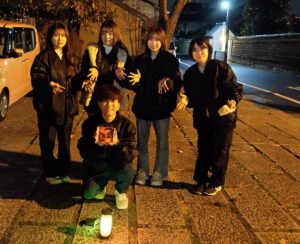
【Activities】Ritsumeikan University Camo Cinema 17 Executive Committee

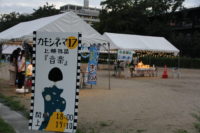
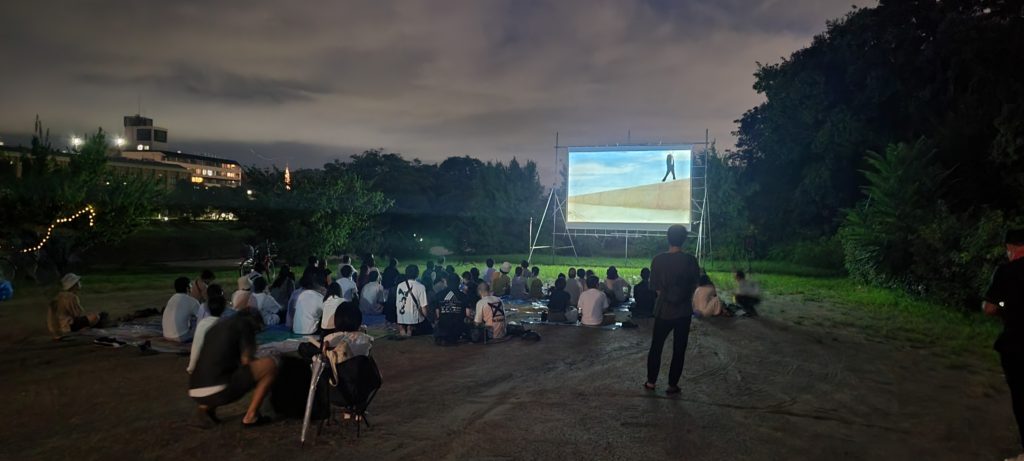
On Sunday, August 21st, I visited “Camo Cinema 17“!

This time, it was held for the first time in three years due to the influence of the Corona disaster.                                                       He was actively engaged in public relations activities such as SNS on Instagram, Twitter, and blogs, and distributing leaflets on the street and at events. The original date of the event, Saturday 20th, was postponed to the next day due to rain, and on Sunday 21st, there was a time when it rained heavily during the day, but the event was held safely without a hitch.

“Kamo Cinema” was launched 20 years ago by Ritsumeikan University students who were interested in environmental conservation of the Kamo River, the symbol of Kyoto, and currently has 35 members. In Kyoto, a city of students, as an effort to raise awareness of beautification among young people of the same generation, cleanup activities and outdoor movie screenings are held every summer. Since then, this year marks the 17th year of the event as an event that connects people to people, people to movies, and people to the Kamo River.

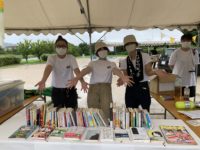
On the day of the event, a cleanup activity called “Pikakamo” was held from 3:30 p.m., slightly staggered due to rain. At the same time, the first “used book exchange event” was held. This is a project in which participants bring books and exchange them for new used books. By reducing the number of books that are thrown away, it was also part of the SDGs initiatives, and books of various genres were lined up at the venue, from novels to picture books, illustrated books, and old magazines. Some of the books had messages for the exchangers, and it was such a project that warmed the feelings of the recipients. In addition, there was a quiz-style project for children and their families, and it was an event that men and women of all ages could participate in.

This year’s film is “Music.”                                                             It is an anime film that skillfully visualizes the “initial impulse to music”.                                            When I asked the executive committee members why “Music” was chosen among the many film works, they said that it was a film that reminded us of the importance of “culture” through film, and that we decided to screen such a work at this Camo Cinema because it reminded us of the importance of “culture” while the opportunities to come into contact with and interact with culture and art are disappearing due to the coronavirus pandemic.

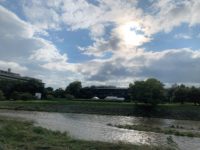
Even when the sun went down, the temperature did not drop much and it was hot, but as the screening time approached, more and more people came to watch the film, and many people who were strolling along the Kamo River stopped to look at the screen.

In the future, he said that he is thinking of events that can be done on a daily basis, not just once a year.                              We look forward to your future activities!

【Activities】Kyoto University, Ritsumeikan University, etc. Kyoto Student Theater Festival Executive Committee

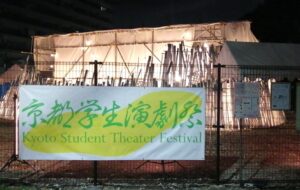
On Thursday, September 15th, we visited the “Kyoto Student Theater Festival 2022“!

This year, the festival will be held from September 9th (Friday) ~ 19th (Monday), and it is a large-scale theater festival with 11 performing groups and 10 executive committee members. It is said that it may be full on Saturdays and Sundays, and on the day of the interview, Mr./Ms.’s audience was in the audience.

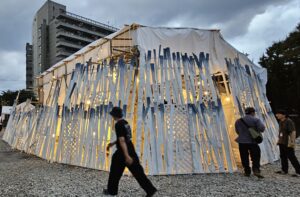
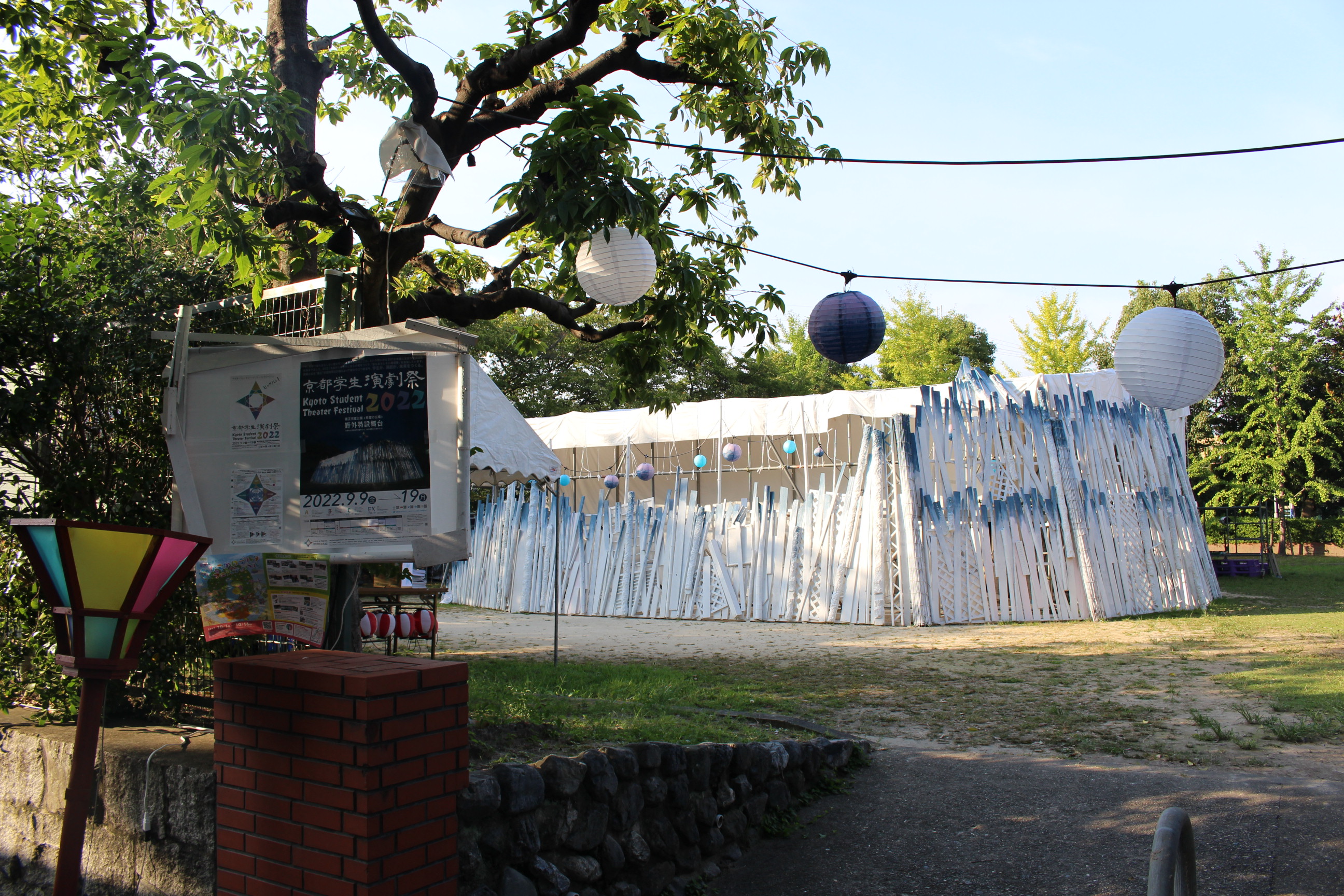
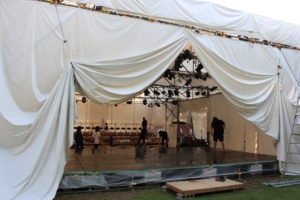
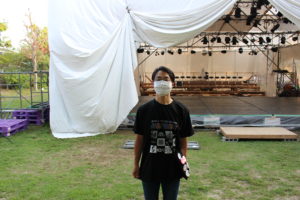
The venue is “Yosho Children’s Park” located about a 5-minute walk from Demachiyanagi Station.                                             As soon as I arrived, I saw a large white outdoor stage. The special outdoor stage, which is also a symbol, was larger and more sturdy than I had imagined when I saw it on the website, and the sides were covered with wooden pillars painted in white and blue. There is something warm about the large and sturdy structure, and it is convincing that it was made with the image of a cocoon.                                                                    I was also able to see the inside of the special outdoor stage that was being prepared, and it was very spacious, and the distance between the stage and the audience seats was just right. Even during the interview, I was very impressed by the way each person in charge was silently preparing for the start of the performance.

According to executive committee member Mr./Ms. Okada, the venue was moved from indoors to the outdoor “Yosho Children’s Park” from last year due to the influence of the coronavirus.                                                  He talked about how he held regular meetings with local residents, gradually increasing the number of opportunities for interaction and providing a place for students who had lost the opportunity to see theater due Mr./Ms. Corona. Of course, there were difficulties such as weather problems unique to the outdoors and insect repellent measures, but it was clear that the local people were watching over them, and that theater-related professionals and student Mr./Ms. worked together to create a wonderful stage.

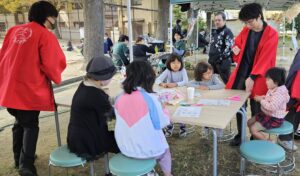
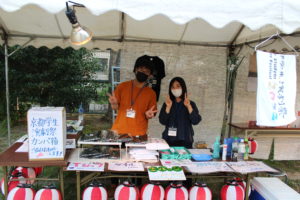
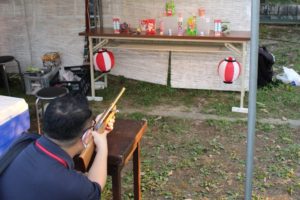
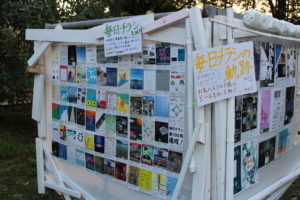
In the park, there was a shooting corner where goods were sold and sweets were given as prizes, and there was also an exhibition corner of “Mainichi Flyers” created every day to liven up the theater festival. From the leaflets displayed by Taku-san, Mr./Ms. put stickers on the leaflets they liked, and other ways to enjoy the waiting time until the play started.

While I was enjoying the park, it was time for the show to start, and thanks to the kindness of the executive committee members, I was able to watch the play.                          The first time I saw a play by a student group, it was, in a word, a masterpiece! I was fascinated by the emotional expressiveness, and at times it made me think, and it was a quick 45 minutes. There was a train running very close to the park, and it was also attractive that they skillfully incorporated it into the play.

On the final day, two awards, the Audience Award and the Jury Award, will be announced, and the group with the highest audience score will be eligible to participate in the National Student Theater Festival to be held next year. I would also like to hope that future stage actors will be born from here.

Although it was a short interview, I was able to hear about the passion of the executive committee members, the charm of the theater festival, the difficulties they faced, and their thoughts for the future, and I was able to enjoy the charm of the Kyoto Student Theater Festival by watching the play.                                                          I’m looking forward to your future activities!


【Activities】Kyoto Seika University, Kyoto City University of Arts, Seian University of Art and Design, Saga-Art University BORDER! Executive Committee

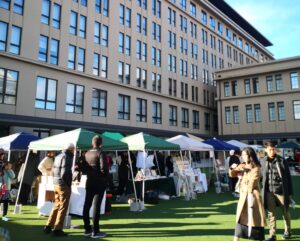
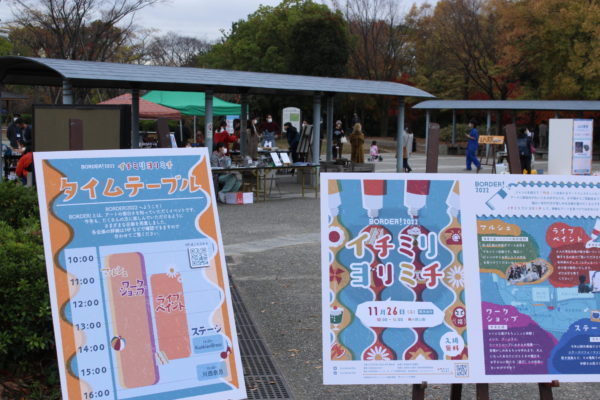
On Saturday, November 26th, we visited the “Art Festival BORDER!2022” at Umekoji Park!

BORDER!The Executive Committee, whose members are mainly art university students in the Kansai region, plans, operates, and implements art festivals with the main objectives of creating opportunities for citizens to come into contact with art and fostering young artists.

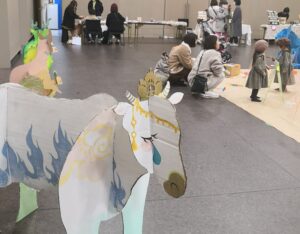
This year’s theme is “Ichimiri Yorimichi” Aiming to be an event where you can enjoy the world of art with just a “one-millimeter detour”, in addition to the usual marche, live events, and workshops, we will deliver an even wider range of art with the first outdoor event and stage performance.

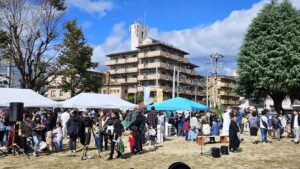
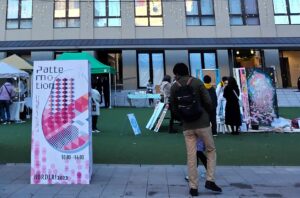
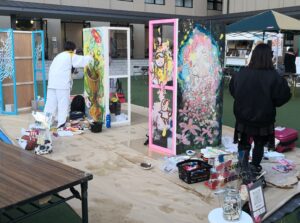
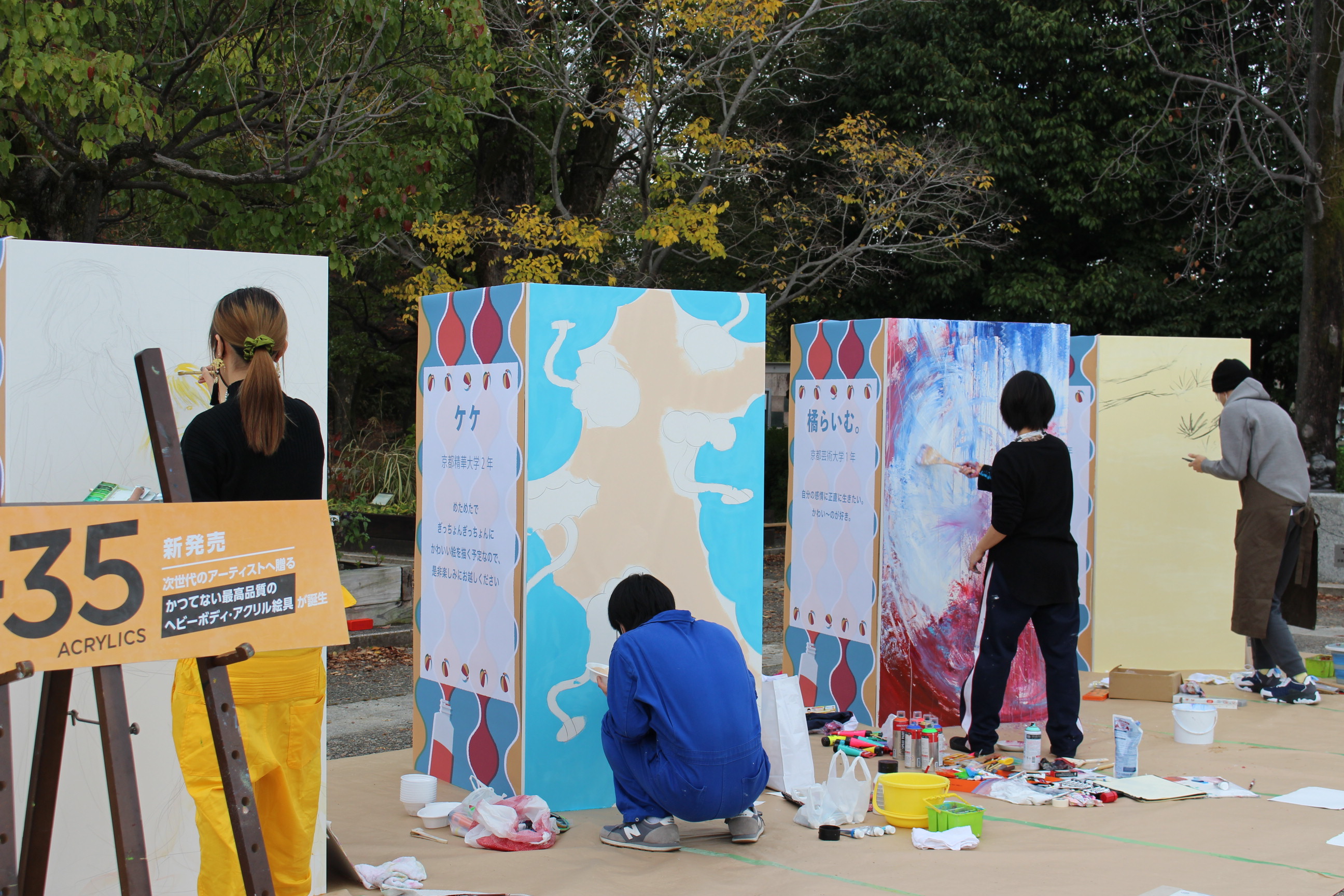
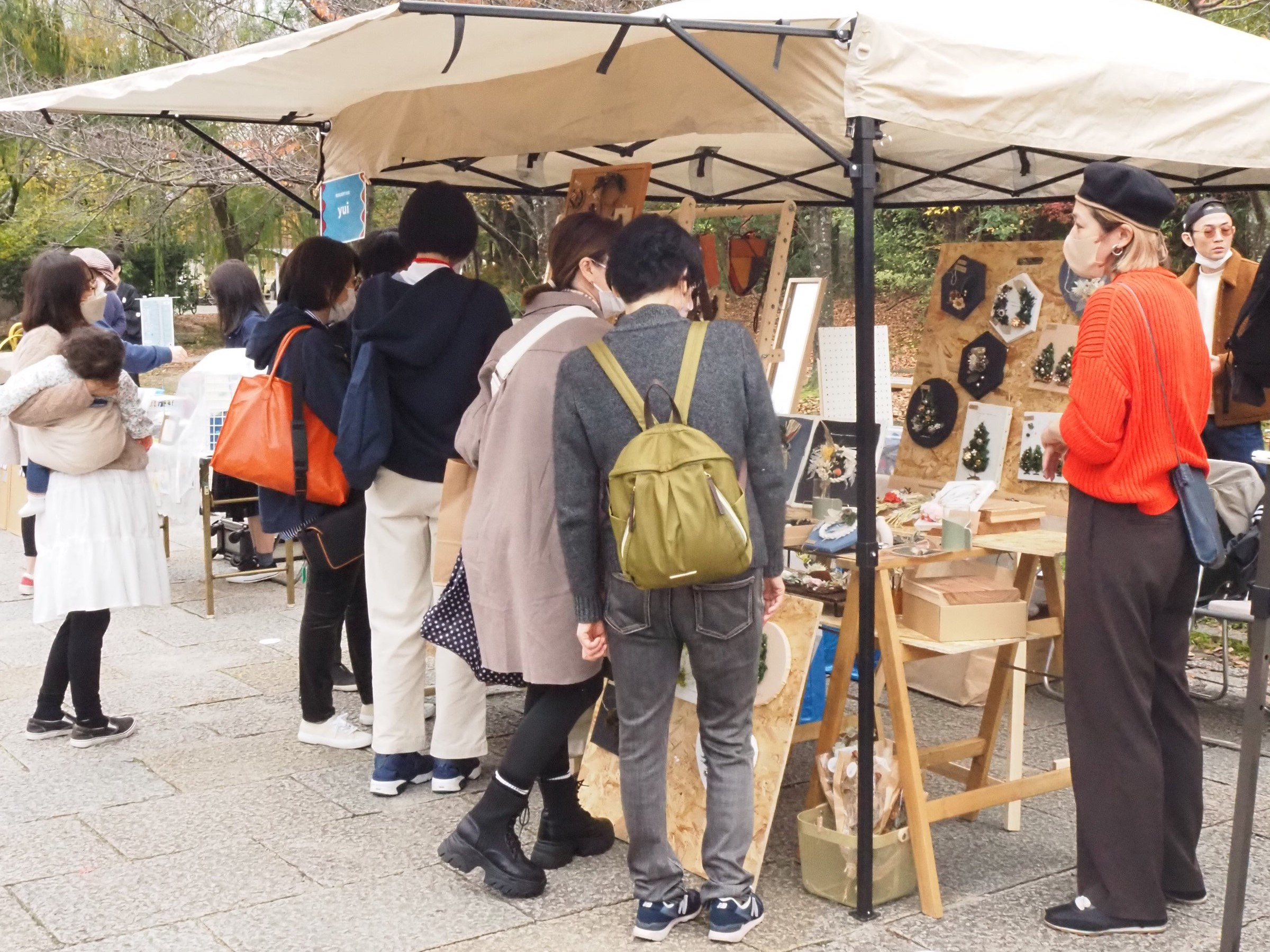
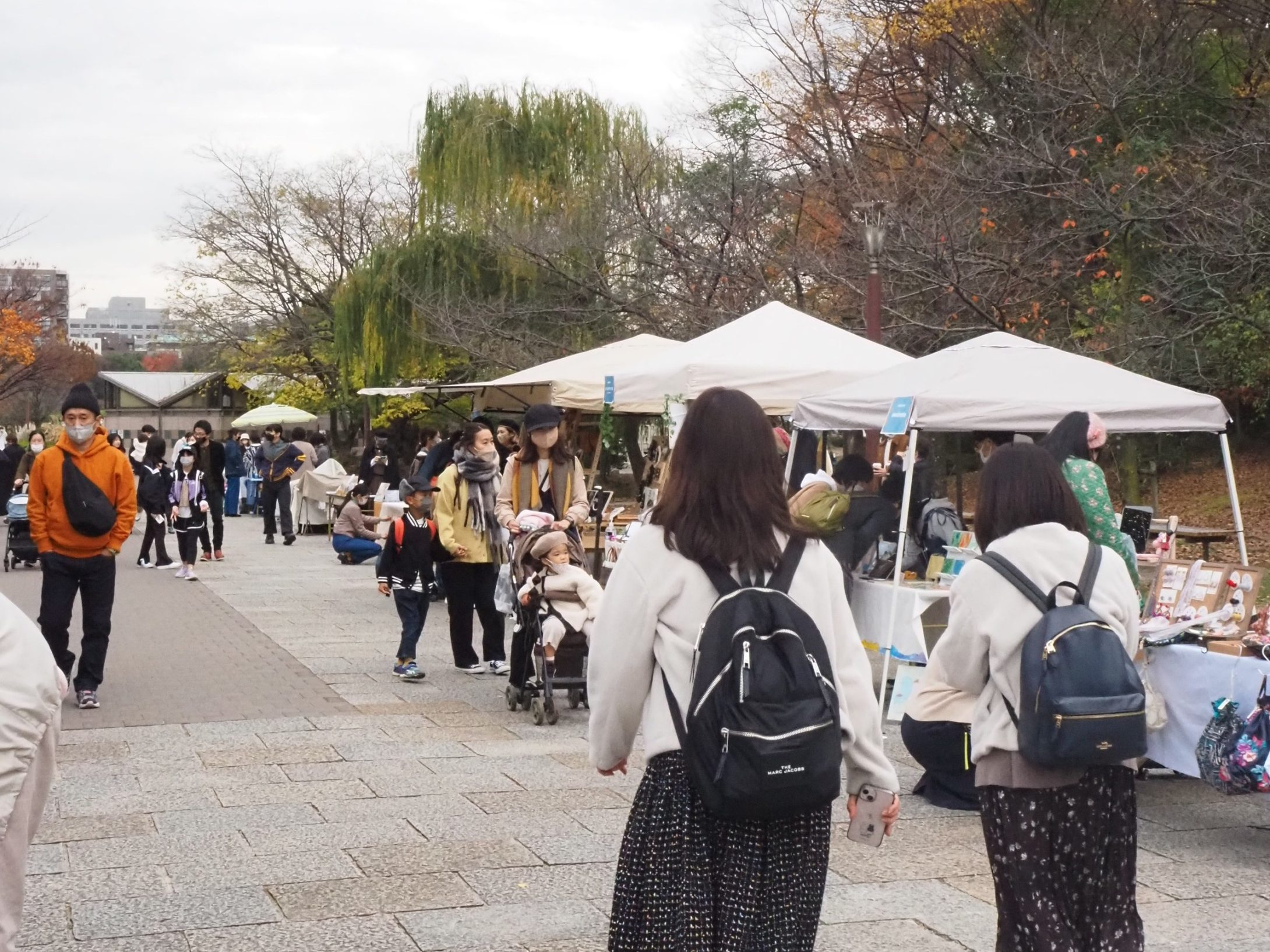
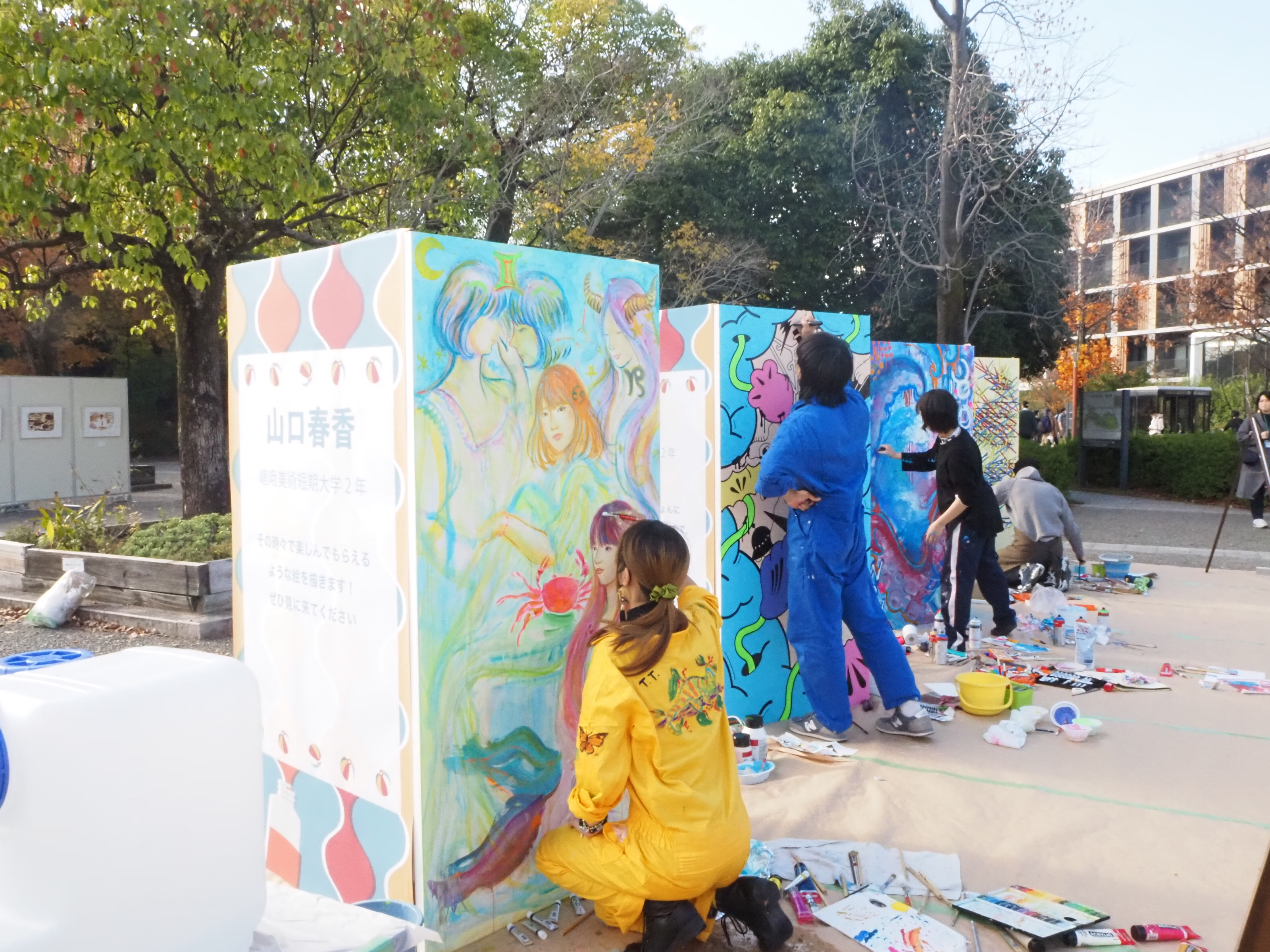
On the day of the event, the weather was cloudy, but the autumn leaves of the trees were beautiful and it was a comfortable season, so there were many people with various purposes Mr./Ms. the park. According to Mr./Ms. Okazaki, a member of the executive committee, last year’s event was held at Zest Oike, so it was mainly train users, but this year it was the first outdoor event, and the crowds changed considerably, and he was happy that a wide range of people, regardless of age or gender, could see it.                                                        In fact, citizens and tourists who happened to be passing by stopped by and eagerly watched the live painting and marche, and I think it was an opportunity to get people of all ages interested.                                                             On the other hand, there were about 30 exhibiting artists at the Marche, which was the main project, but the number of exhibitors was almost the same as last year’s despite the large site, so they wanted to make it an issue for the future.

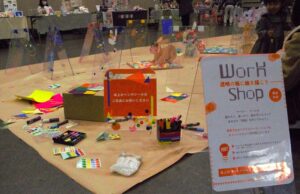
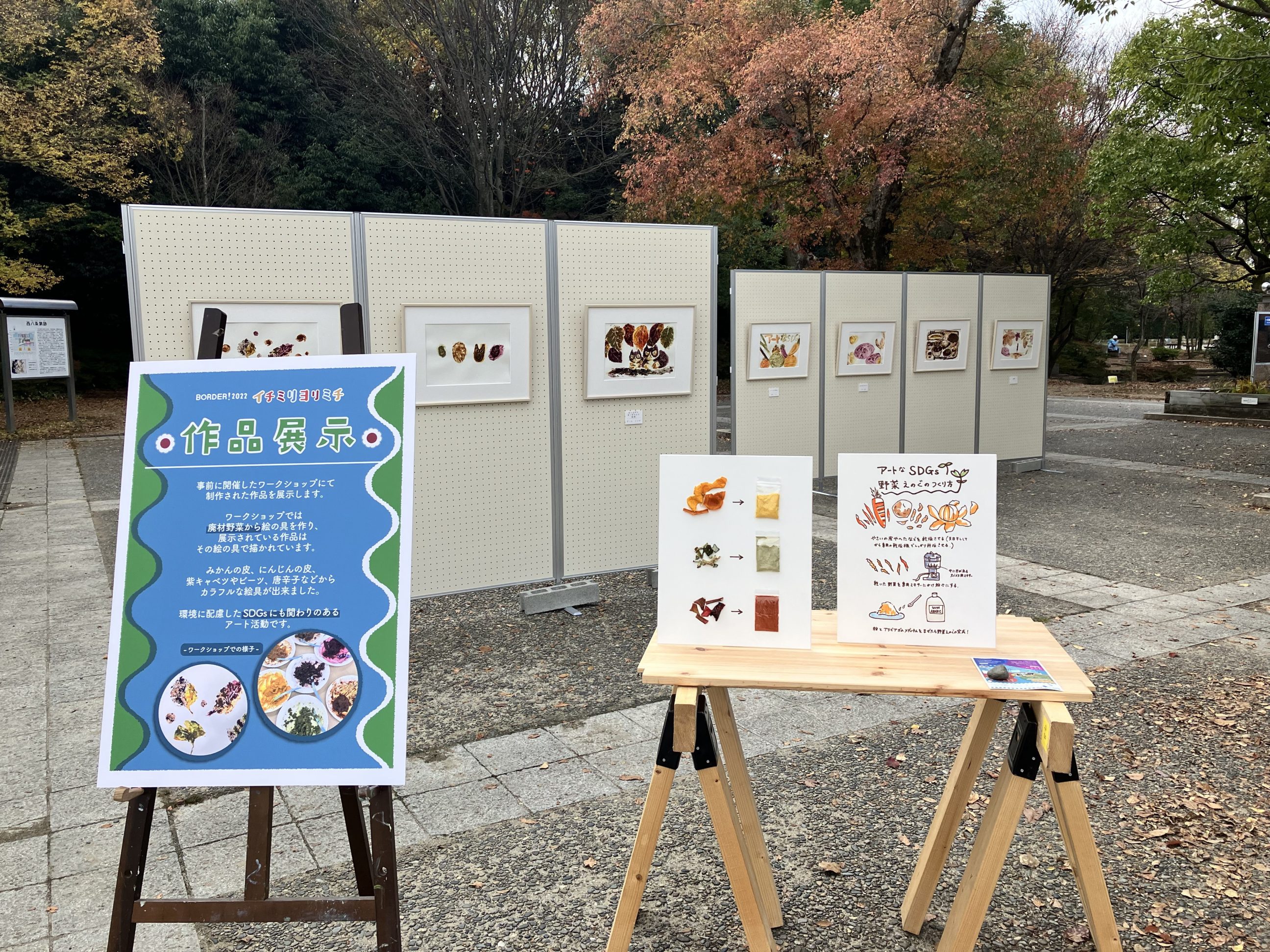
At this event, efforts were also implemented to be conscious of the SDGs in terms of reducing food loss.                               Workshops were held in advance to make paints and create works of art based on discarded vegetables and fruits, and the works were exhibited. The gentle colors made the picture look warm.

A report will be published on future activities.                                               Every year, the website is also attractive, so be sure to check it out as well!                      Even if you couldn’t make it to the event this time, please try the art!

Click here for the website of BORDER!2022 → https://borderfes.art/


【Activities】Doshisha Women’s University, Ryukoku University, Doshisha University, Ritsumeikan University, Kyoto University, etc.

On Saturday, December 10th, we visited “Miyako Light ’22“!

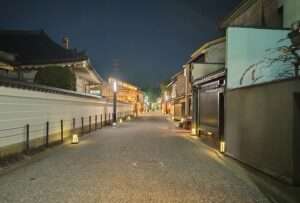
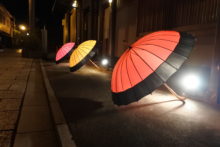
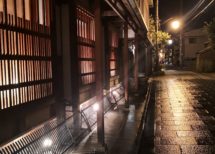
Miyako Light is a light-up event for Kyomachiya that has been held since 2005 in the Shimogyo-ku neighborhood of Kyoto City (this year, Kamishichiken and Jofukuji-dori Daikokucho).                                        This year’s concept is “the light of revival that connects people and illuminates townhouses.”                                              As the bonds between people fade and the vitality of the city becomes weaker than before, the idea is to restore vitality to the city and restore human connections.

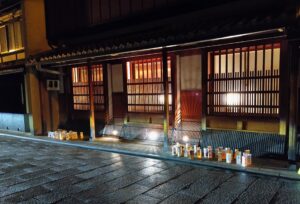
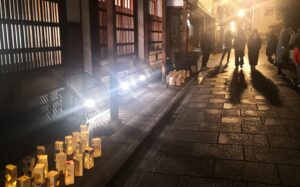
At the venue, the “light of life” was expressed, with lights lit from the inside of the townhouse. Unlike the glittering lights that are associated with the word “light up,” the soft light that leaked from the lattice further enhanced the taste of the Kyomachiya.

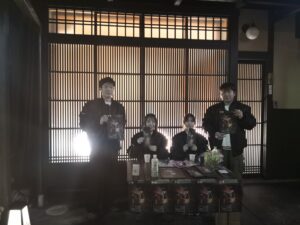
Due to the Corona disaster, we refrained from planning plans and PR activities aimed at attracting customers, and members were replaced … We interviewed Mr./Ms. Mitsuhashi, a member of the executive committee, about how they have continued their activities in the midst of changing environments.

“We have always valued our connections with the local community in holding events, and thanks to your support and cooperation, we have been able to continue for many years. If we don’t live in harmony with the community, it will be difficult to hold the event itself, so I am full of gratitude.                                               On the other hand, we have not been able to adequately convey the appeal of the “lights of life” that we want to convey, and we have received comments that they are “inconspicuous” and “difficult to understand.”                                        We will keep an eye on the situation with the new coronavirus infection, but in the future, we would like to hold events and other events to promote it a little more.”

Mr./Ms. Mitsuhashi mentioned issues such as strengthening PR capabilities, but on the day of the event, we were able to see many heartwarming scenes, such as the alumni and alumni of the Tokyo Light Executive Committee and the local community rejoicing at the reunion after a long absence, and the participants visiting stores that have extended their business hours to coincide with the event. I think this is also a form of “coexistence with the community” that was realized because Mr./Ms. has continued to value connections with local people for 18 years.

In the future, he will prepare a report of the event and thank the local people.                                             We can’t wait to see what the event will be like next year!


Reiwa 4th Year Gakumachi Collaboration Project Gakumachi NEWS!

We will introduce the efforts of the Reiwa 4th year school town collaboration project.

The “Gakumachi Collaboration Project” is a “learning town collaboration project” in which universities and students and the local community collaborate to recruit and support projects and projects that work on urban development and regional revitalization in Kyoto.
We would like to inform you of the efforts of this year’s selected organizations!

【Activities】Ritsumeikan University Camo Cinema 17 Executive Committee

On Sunday, August 21st, I visited “Camo Cinema 17“!

This time, it was held for the first time in three years due to the influence of the Corona disaster.                                                       He was actively engaged in public relations activities such as SNS on Instagram, Twitter, and blogs, and distributing leaflets on the street and at events. The original date of the event, Saturday 20th, was postponed to the next day due to rain, and on Sunday 21st, there was a time when it rained heavily during the day, but the event was held safely without a hitch.

“Kamo Cinema” was launched 20 years ago by Ritsumeikan University students who were interested in environmental conservation of the Kamo River, the symbol of Kyoto, and currently has 35 members. In Kyoto, a city of students, as an effort to raise awareness of beautification among young people of the same generation, cleanup activities and outdoor movie screenings are held every summer. Since then, this year marks the 17th year of the event as an event that connects people to people, people to movies, and people to the Kamo River.

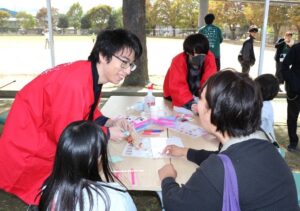
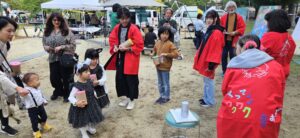
On the day of the event, a cleanup activity called “Pikakamo” was held from 3:30 p.m., slightly staggered due to rain. At the same time, the first “used book exchange event” was held. This is a project in which participants bring books and exchange them for new used books. By reducing the number of books that are thrown away, it was also part of the SDGs initiatives, and books of various genres were lined up at the venue, from novels to picture books, illustrated books, and old magazines. Some of the books had messages for the exchangers, and it was such a project that warmed the feelings of the recipients. In addition, there was a quiz-style project for children and their families, and it was an event that men and women of all ages could participate in.

This year’s film is “Music.”                                                             It is an anime film that skillfully visualizes the “initial impulse to music”.                                            When I asked the executive committee members why “Music” was chosen among the many film works, they said that it was a film that reminded us of the importance of “culture” through film, and that we decided to screen such a work at this Camo Cinema because it reminded us of the importance of “culture” while the opportunities to come into contact with and interact with culture and art are disappearing due to the coronavirus pandemic.

Even when the sun went down, the temperature did not drop much and it was hot, but as the screening time approached, more and more people came to watch the film, and many people who were strolling along the Kamo River stopped to look at the screen.

In the future, he said that he is thinking of events that can be done on a daily basis, not just once a year.                              We look forward to your future activities!


【Activities】Kyoto University, Ritsumeikan University, etc. Kyoto Student Theater Festival Executive Committee

On Thursday, September 15th, we visited the “Kyoto Student Theater Festival 2022“!

This year, the festival will be held from September 9th (Friday) ~ 19th (Monday), and it is a large-scale theater festival with 11 performing groups and 10 executive committee members. It is said that it may be full on Saturdays and Sundays, and on the day of the interview, Mr./Ms.’s audience was in the audience.

The venue is “Yosho Children’s Park” located about a 5-minute walk from Demachiyanagi Station.                                             As soon as I arrived, I saw a large white outdoor stage. The special outdoor stage, which is also a symbol, was larger and more sturdy than I had imagined when I saw it on the website, and the sides were covered with wooden pillars painted in white and blue. There is something warm about the large and sturdy structure, and it is convincing that it was made with the image of a cocoon.                                                                    I was also able to see the inside of the special outdoor stage that was being prepared, and it was very spacious, and the distance between the stage and the audience seats was just right. Even during the interview, I was very impressed by the way each person in charge was silently preparing for the start of the performance.

According to executive committee member Mr./Ms. Okada, the venue was moved from indoors to the outdoor “Yosho Children’s Park” from last year due to the influence of the coronavirus.                                                  He talked about how he held regular meetings with local residents, gradually increasing the number of opportunities for interaction and providing a place for students who had lost the opportunity to see theater due Mr./Ms. Corona. Of course, there were difficulties such as weather problems unique to the outdoors and insect repellent measures, but it was clear that the local people were watching over them, and that theater-related professionals and student Mr./Ms. worked together to create a wonderful stage.

In the park, there was a shooting corner where goods were sold and sweets were given as prizes, and there was also an exhibition corner of “Mainichi Flyers” created every day to liven up the theater festival. From the leaflets displayed by Taku-san, Mr./Ms. put stickers on the leaflets they liked, and other ways to enjoy the waiting time until the play started.

While I was enjoying the park, it was time for the show to start, and thanks to the kindness of the executive committee members, I was able to watch the play.                          The first time I saw a play by a student group, it was, in a word, a masterpiece! I was fascinated by the emotional expressiveness, and at times it made me think, and it was a quick 45 minutes. There was a train running very close to the park, and it was also attractive that they skillfully incorporated it into the play.

On the final day, two awards, the Audience Award and the Jury Award, will be announced, and the group with the highest audience score will be eligible to participate in the National Student Theater Festival to be held next year. I would also like to hope that future stage actors will be born from here.

Although it was a short interview, I was able to hear about the passion of the executive committee members, the charm of the theater festival, the difficulties they faced, and their thoughts for the future, and I was able to enjoy the charm of the Kyoto Student Theater Festival by watching the play.                                                          I’m looking forward to your future activities!


【Activities】Kyoto Seika University, Kyoto City University of Arts, Seian University of Art and Design, Saga-Art University BORDER! Executive Committee

On Saturday, November 26th, we visited the “Art Festival BORDER!2022” at Umekoji Park!

BORDER!The Executive Committee, whose members are mainly art university students in the Kansai region, plans, operates, and implements art festivals with the main objectives of creating opportunities for citizens to come into contact with art and fostering young artists.

This year’s theme is “Ichimiri Yorimichi” Aiming to be an event where you can enjoy the world of art with just a “one-millimeter detour”, in addition to the usual marche, live events, and workshops, we will deliver an even wider range of art with the first outdoor event and stage performance.

On the day of the event, the weather was cloudy, but the autumn leaves of the trees were beautiful and it was a comfortable season, so there were many people with various purposes Mr./Ms. the park. According to Mr./Ms. Okazaki, a member of the executive committee, last year’s event was held at Zest Oike, so it was mainly train users, but this year it was the first outdoor event, and the crowds changed considerably, and he was happy that a wide range of people, regardless of age or gender, could see it.                                                        In fact, citizens and tourists who happened to be passing by stopped by and eagerly watched the live painting and marche, and I think it was an opportunity to get people of all ages interested.                                                             On the other hand, there were about 30 exhibiting artists at the Marche, which was the main project, but the number of exhibitors was almost the same as last year’s despite the large site, so they wanted to make it an issue for the future.

At this event, efforts were also implemented to be conscious of the SDGs in terms of reducing food loss.                               Workshops were held in advance to make paints and create works of art based on discarded vegetables and fruits, and the works were exhibited. The gentle colors made the picture look warm.

A report will be published on future activities.                                               Every year, the website is also attractive, so be sure to check it out as well!                      Even if you couldn’t make it to the event this time, please try the art!

Click here for the website of BORDER!2022 → https://borderfes.art/


Reiwa 4th Year Gakumachi Collaboration Project Gakumachi NEWS!

We will introduce the efforts of the Reiwa 4th year school town collaboration project.

The “Gakumachi Collaboration Project” is a “learning town collaboration project” in which universities and students and the local community collaborate to recruit and support projects and projects that work on urban development and regional revitalization in Kyoto.
We would like to inform you of the efforts of this year’s selected organizations!

【Activities】Ritsumeikan University Camo Cinema 17 Executive Committee

On Sunday, August 21st, I visited “Camo Cinema 17“!

This time, it was held for the first time in three years due to the influence of the Corona disaster.                                                       He was actively engaged in public relations activities such as SNS on Instagram, Twitter, and blogs, and distributing leaflets on the street and at events. The original date of the event, Saturday 20th, was postponed to the next day due to rain, and on Sunday 21st, there was a time when it rained heavily during the day, but the event was held safely without a hitch.

“Kamo Cinema” was launched 20 years ago by Ritsumeikan University students who were interested in environmental conservation of the Kamo River, the symbol of Kyoto, and currently has 35 members. In Kyoto, a city of students, as an effort to raise awareness of beautification among young people of the same generation, cleanup activities and outdoor movie screenings are held every summer. Since then, this year marks the 17th year of the event as an event that connects people to people, people to movies, and people to the Kamo River.

On the day of the event, a cleanup activity called “Pikakamo” was held from 3:30 p.m., slightly staggered due to rain. At the same time, the first “used book exchange event” was held. This is a project in which participants bring books and exchange them for new used books. By reducing the number of books that are thrown away, it was also part of the SDGs initiatives, and books of various genres were lined up at the venue, from novels to picture books, illustrated books, and old magazines. Some of the books had messages for the exchangers, and it was such a project that warmed the feelings of the recipients. In addition, there was a quiz-style project for children and their families, and it was an event that men and women of all ages could participate in.

This year’s film is “Music.”                                                             It is an anime film that skillfully visualizes the “initial impulse to music”.                                            When I asked the executive committee members why “Music” was chosen among the many film works, they said that it was a film that reminded us of the importance of “culture” through film, and that we decided to screen such a work at this Camo Cinema because it reminded us of the importance of “culture” while the opportunities to come into contact with and interact with culture and art are disappearing due to the coronavirus pandemic.

Even when the sun went down, the temperature did not drop much and it was hot, but as the screening time approached, more and more people came to watch the film, and many people who were strolling along the Kamo River stopped to look at the screen.

In the future, he said that he is thinking of events that can be done on a daily basis, not just once a year.                              We look forward to your future activities!

【Activities】Kyoto University, Ritsumeikan University, etc. Kyoto Student Theater Festival Executive Committee

On Thursday, September 15th, we visited the “Kyoto Student Theater Festival 2022“!

This year, the festival will be held from September 9th (Friday) ~ 19th (Monday), and it is a large-scale theater festival with 11 performing groups and 10 executive committee members. It is said that it may be full on Saturdays and Sundays, and on the day of the interview, Mr./Ms.’s audience was in the audience.

The venue is “Yosho Children’s Park” located about a 5-minute walk from Demachiyanagi Station.                                             As soon as I arrived, I saw a large white outdoor stage. The special outdoor stage, which is also a symbol, was larger and more sturdy than I had imagined when I saw it on the website, and the sides were covered with wooden pillars painted in white and blue. There is something warm about the large and sturdy structure, and it is convincing that it was made with the image of a cocoon.                                                                    I was also able to see the inside of the special outdoor stage that was being prepared, and it was very spacious, and the distance between the stage and the audience seats was just right. Even during the interview, I was very impressed by the way each person in charge was silently preparing for the start of the performance.

According to executive committee member Mr./Ms. Okada, the venue was moved from indoors to the outdoor “Yosho Children’s Park” from last year due to the influence of the coronavirus.                                                  He talked about how he held regular meetings with local residents, gradually increasing the number of opportunities for interaction and providing a place for students who had lost the opportunity to see theater due Mr./Ms. Corona. Of course, there were difficulties such as weather problems unique to the outdoors and insect repellent measures, but it was clear that the local people were watching over them, and that theater-related professionals and student Mr./Ms. worked together to create a wonderful stage.

In the park, there was a shooting corner where goods were sold and sweets were given as prizes, and there was also an exhibition corner of “Mainichi Flyers” created every day to liven up the theater festival. From the leaflets displayed by Taku-san, Mr./Ms. put stickers on the leaflets they liked, and other ways to enjoy the waiting time until the play started.

While I was enjoying the park, it was time for the show to start, and thanks to the kindness of the executive committee members, I was able to watch the play.                          The first time I saw a play by a student group, it was, in a word, a masterpiece! I was fascinated by the emotional expressiveness, and at times it made me think, and it was a quick 45 minutes. There was a train running very close to the park, and it was also attractive that they skillfully incorporated it into the play.

On the final day, two awards, the Audience Award and the Jury Award, will be announced, and the group with the highest audience score will be eligible to participate in the National Student Theater Festival to be held next year. I would also like to hope that future stage actors will be born from here.

Although it was a short interview, I was able to hear about the passion of the executive committee members, the charm of the theater festival, the difficulties they faced, and their thoughts for the future, and I was able to enjoy the charm of the Kyoto Student Theater Festival by watching the play.                                                          I’m looking forward to your future activities!


Reiwa 4th Year Gakumachi Collaboration Project Gakumachi NEWS!

We will introduce the efforts of the Reiwa 4th year school town collaboration project.

The “Gakumachi Collaboration Project” is a “learning town collaboration project” in which universities and students and the local community collaborate to recruit and support projects and projects that work on urban development and regional revitalization in Kyoto.
We would like to inform you of the efforts of this year’s selected organizations!

【Activities】Ritsumeikan University Camo Cinema 17 Executive Committee

On Sunday, August 21st, I visited “Camo Cinema 17“!

This time, it was held for the first time in three years due to the influence of the Corona disaster.                                                       He was actively engaged in public relations activities such as SNS on Instagram, Twitter, and blogs, and distributing leaflets on the street and at events. The original date of the event, Saturday 20th, was postponed to the next day due to rain, and on Sunday 21st, there was a time when it rained heavily during the day, but the event was held safely without a hitch.

“Kamo Cinema” was launched 20 years ago by Ritsumeikan University students who were interested in environmental conservation of the Kamo River, the symbol of Kyoto, and currently has 35 members. In Kyoto, a city of students, as an effort to raise awareness of beautification among young people of the same generation, cleanup activities and outdoor movie screenings are held every summer. Since then, this year marks the 17th year of the event as an event that connects people to people, people to movies, and people to the Kamo River.

On the day of the event, a cleanup activity called “Pikakamo” was held from 3:30 p.m., slightly staggered due to rain. At the same time, the first “used book exchange event” was held. This is a project in which participants bring books and exchange them for new used books. By reducing the number of books that are thrown away, it was also part of the SDGs initiatives, and books of various genres were lined up at the venue, from novels to picture books, illustrated books, and old magazines. Some of the books had messages for the exchangers, and it was such a project that warmed the feelings of the recipients. In addition, there was a quiz-style project for children and their families, and it was an event that men and women of all ages could participate in.

This year’s film is “Music.”                                                             It is an anime film that skillfully visualizes the “initial impulse to music”.                                            When I asked the executive committee members why “Music” was chosen among the many film works, they said that it was a film that reminded us of the importance of “culture” through film, and that we decided to screen such a work at this Camo Cinema because it reminded us of the importance of “culture” while the opportunities to come into contact with and interact with culture and art are disappearing due to the coronavirus pandemic.

Even when the sun went down, the temperature did not drop much and it was hot, but as the screening time approached, more and more people came to watch the film, and many people who were strolling along the Kamo River stopped to look at the screen.

In the future, he said that he is thinking of events that can be done on a daily basis, not just once a year.                              We look forward to your future activities!


Reiwa 3rd Year Gakumachi Collaboration Project Gakumachi NEWS!

We will introduce the efforts of the Reiwa 3rd year school town collaboration project.

The “Gakumachi Collaboration Project” is a “learning town collaboration project” in which universities and students and the local community collaborate to recruit and support projects and projects that work on urban development and regional revitalization in Kyoto.
We would like to inform you of the efforts of this year’s selected organizations!

【Activities】Kyoto Women’s University, Ryukoku University, etc. Chongjin Leather Industry Sustainability Project

On Sunday, December 12th, we visited the “2nd Leather Workshop”.

The “Chongjin Leather Industry Sustainability Project” is an organization consisting of members from Kyoto Women’s University, Ryukoku University, and other institutions, and is engaged in activities aimed at revitalizing citizen exchanges in the Chongin School District and making the leather industry sustainable. They met two years ago. Participating in the Miyako KAMADAKI Program, a practical program aimed at forming a network to achieve the SDGs, and launching the “Chongjin Brand” to widely know the desire to make the traditional industry “leather” sustainable, which has been protected by the Chongin district, and the “Chongin Brand” We proposed a project to collaborate with Kyoto City University of Arts to make it sustainable. Even after the program ended, the members continued to work on their own to carry out the project, and they applied for the Gakumachi Collaboration.

On this day, the second leather workshop! One in the world. Let’s make your own original bookmark & smartphone stand!” Make a bookmark and a smartphone stand using leather. There were seven participants, ranging from elementary school students to university students.
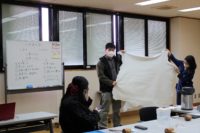
Before starting the work, the members first explained the history of the leather industry in the Chongren area using slides.
Prior to the workshop, they also visited a leather factory to learn about the leather industry, and there was also a lecture on the process from “leather” to “leather” that they had seen there. I was impressed by the impression that “when I entered the factory, I could smell the animals.”

Now that the lecture is over, it’s time to get to work! First of all, let’s choose leather.
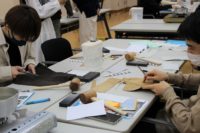
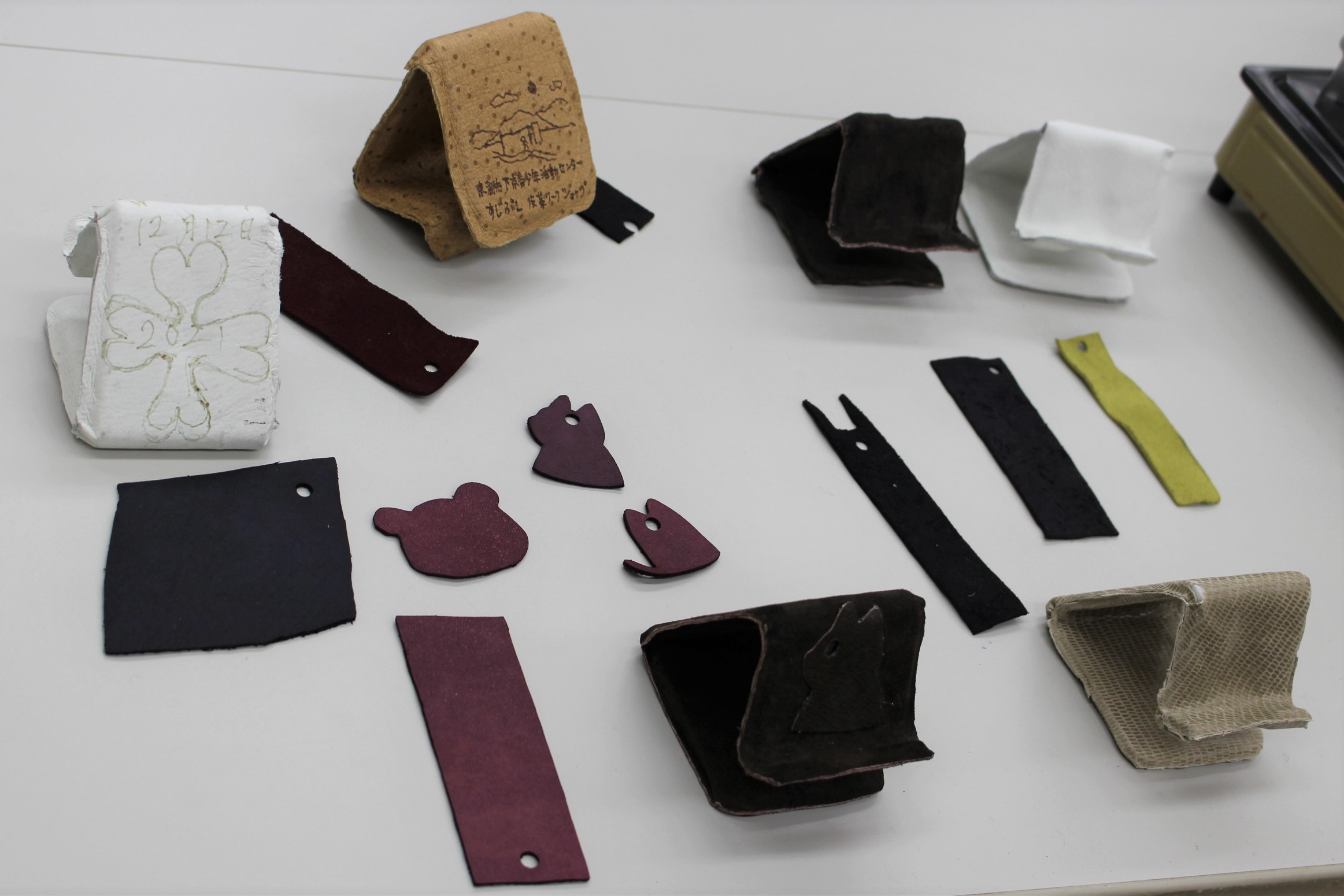
At the venue, leather from a single animal was brought in its original size to make it easier to understand the size. It seems that the ones used on this day are pighide and cowhide. Depending on the tanning method and dye, the finished color, surface pattern, and touch comfort vary. Participants will choose from four types. Each of them has its own merits, and it is difficult to decide. After receiving advice from members and instructors about the characteristics of each leather and consulting with them about the image of what they wanted to make, it seems that they finally made a decision.

Let’s get to the smartphone! Cut the selected leather along the pattern and attach it to the plastic smartphone stand with leather bond. The outside seems to be easy to stick, but the inside is a struggle. Due to the thickness of the leather, it does not go in as much as I would like. Members who have made two prototypes will be called by the participants to provide support. It’s reliable, I’ll ♪ dry it when I’m done sticking it somehow!

I’ll start making bookmarks while I’m drying!
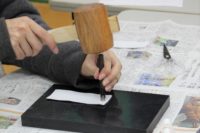
Cut the selected leather into the desired shape and make a hole through which the string will pass. …… And here’s where an unfamiliar tool comes in! It is called “eyelet removal”, and it is pressed against the leather and struck from above with a hammer called “mallet taiko”. Will there be people who are afraid, people who hit hard, and personalities (laughs)? It’s fun just to watch. The position was too high and it penetrated…… There was an accident that said, but that’s also the taste! !! There is only one bookmark in the world, and I get ♪ attached to it

Once the holes are drilled, the next step is to add color. This time, you can choose your favorite color from three colors: yellow, purple, and red. They use plant dyes, and in that order, yellowfin tuna, logwood, and madder. Boil each of them, and in the meantime, soak the leather in water to make it easier to color. As it began to boil, I could smell the smell of each dye, and I could hear a voice saying, “It looks delicious~” (laughs). Akane is said to smell like red beans. I see, maybe it’s because the colors are similar? The conversation is lively and seems to be fun. Put the bookmark in the boiled dye and boil it for a while to color.

Now, in the meantime, let’s take a look at how dry the smartphone stand is! The use of time is also ingenious, which is admirable. If it is dry, cut and trim the area around the leather. When you’re done cutting, you can use a soldering iron to add text and illustrations if you like. Please ♪ enjoy the finished product in the photo

In the meantime, it seems that the bookmarks have also become colored. Take it out and put it in a mordant solution in which the alum is dissolved and let the color settle. “Oh ~! Please see ♪ the photo of the finished product here

When they saw their finished work, they all seemed satisfied. It seems that there were many tasks that they were not used to, and they naturally consulted with people nearby, and university students cared about elementary school students.

【Activities】Kyoto City University of Arts, Kyoto Seika University, Seian University of Art and Design BORDER!executive committee

On Sunday, December 5th, I went to the “Art Festival BORDER!2021“.

BORDER!The “Executive Committee” is an organization whose members are mainly art university students in the Kansai region, such as Kyoto City University of Arts, Kyoto Seika University, and Seian University of Art and Design. With the hope that it will help young artists to aspire to become artists, we plan, manage, and hold art festivals to create opportunities for young artists who will lead the next generation to present their work.

BORDER” means “border”. There is a line between art and what is not. An invisible line that says, “I can’t do it.” The boundaries of genres. The name expresses the hope that you will be able to jump over such various boundaries and create wonderful encounters.

In 2018 and 2019, Miyako Messe held a live painting, food, and art market. In 2020, we held an online web exhibition and live painting in front of the Kyoto City Kyocera Museum of Art.
This year, there were concerns about the impact of the new coronavirus, but we decided to hold the event in person based on the demand for face-to-face events such as “people who come to see other exhibitors can see them” and “you can enjoy meeting people who are next to you at the exhibition location,” as well as the loss of opportunities for artists to present their art and people’s art due to the closure of museums. As usual, I hoped that it would catch the eye of people who came to shop, and I held it at Zest Oike with high hopes for a chance encounter.

The theme is “Rinko Nekushon”. It is said that the word “link”, “connect”, and “linker nation” are tightly attached together. Connect and connect. And I imagine that the circle will expand in an infinite chain.

Now, let’s take a look at the venue. In each of the three squares, live painting, a market, workshops and art supply booths were held.
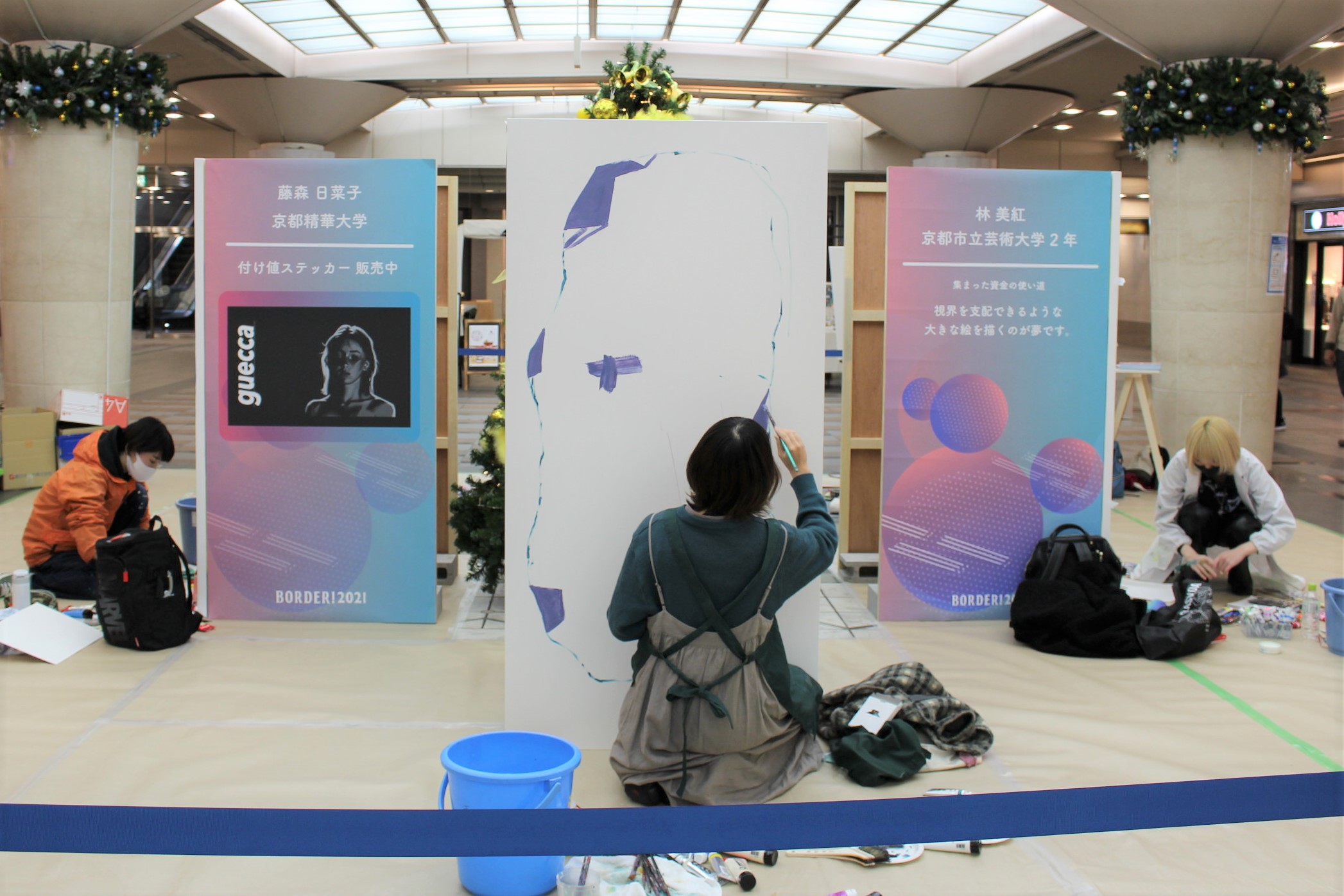
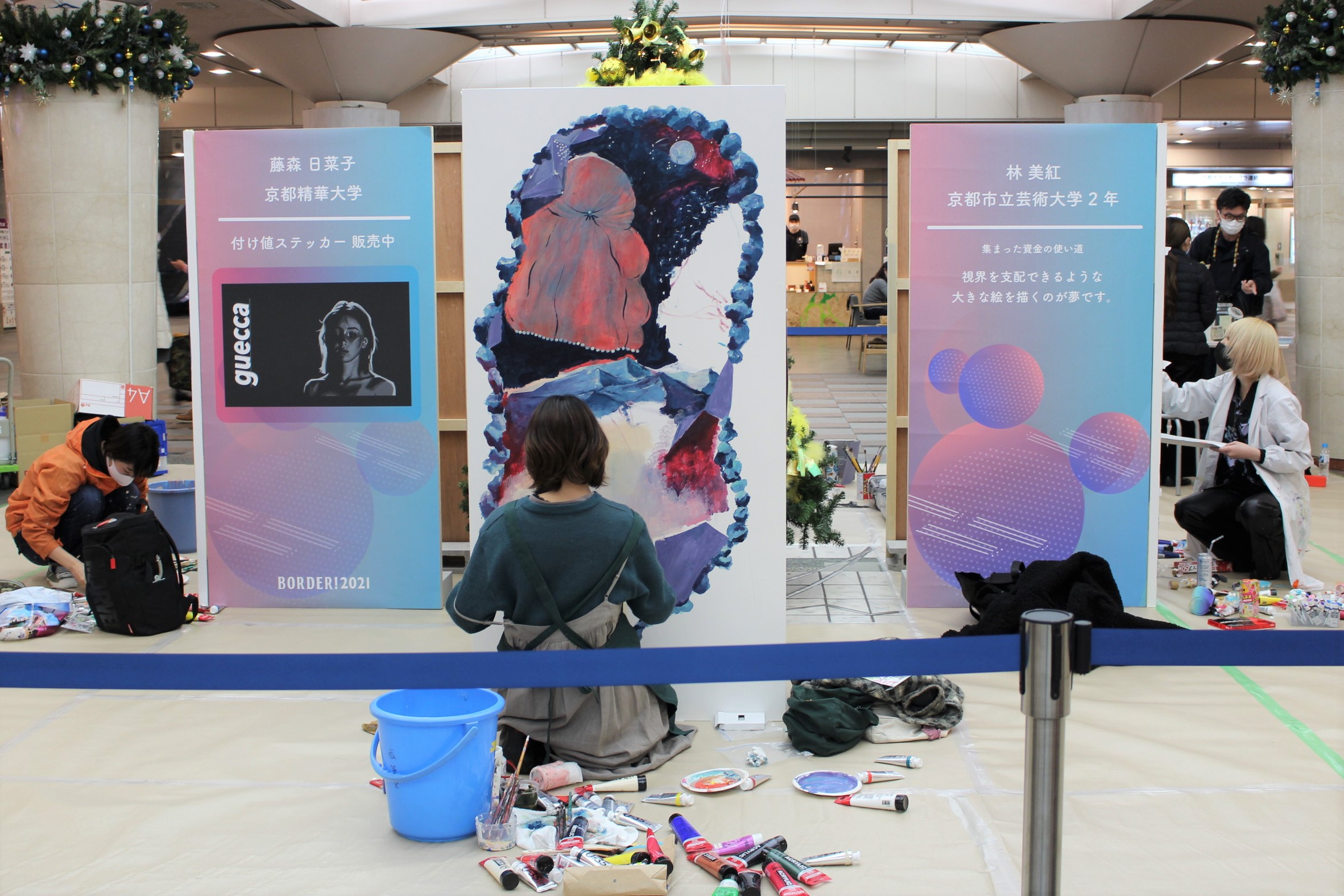
First of all, it is a live painting venue. It seems that four students will complete their work within 5 hours of the event, and at the same time as the MC announces, they will go to a large canvas about 1m wide × 2m high and start drawing! People who passed by the venue also stopped and watched the powerful scene.

I’d like to see it all the time, but the next stop is the Marche venue! A Mr./Ms. of 33 artists exhibits and sells handmade accessories, wallets, bags, vessels, paintings, illustrations, etc. There were people who bought it because they thought it was cute ♪, and there were people who were talking to the artist Mr./Ms. with great interest, saying, “How do you draw this?” You can also hear about the thoughts put into the work and the process of creating the work, so I think that many of those who purchased it were able to experience a special feeling.

Lastly, there is the workshop and art supply store booth venue. Here, workshops planned by the students themselves are held to “let people actually experience art!”, and art supply store Mr./Ms. who handles art materials that are indispensable for the production of works are exhibited and you can experience them.
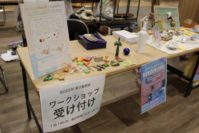
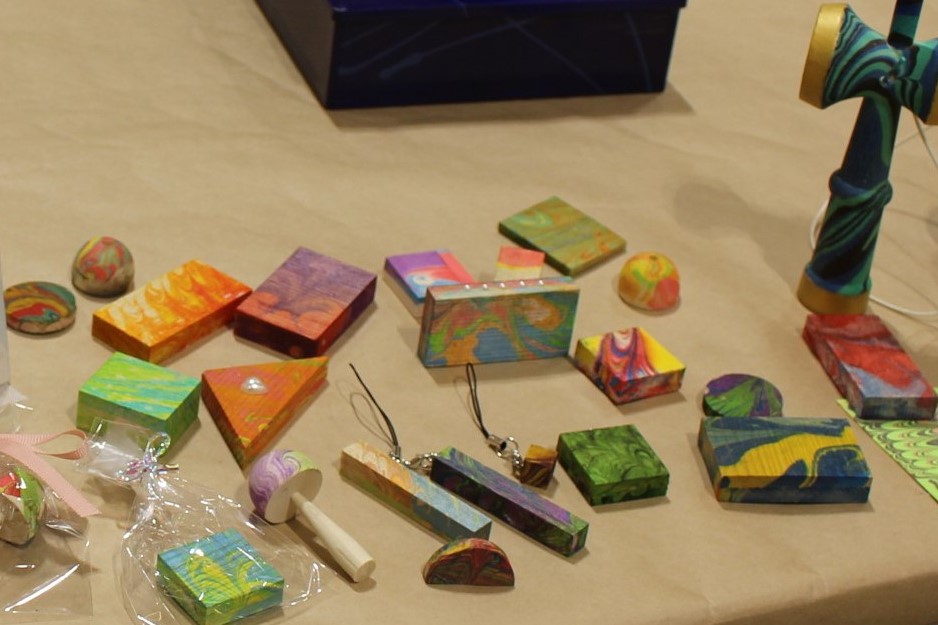
In the workshop, students create works using a technique called “marbling,” in which patterns on the surface of the water are copied onto pieces of wood or paper, which are made by dripping colored ink or paint on water. When I talked to the students who planned it, they said that marbling is a technique that uses patterns and colors that can be created by chance (it is called a modern technique!). He decided to use this technique because he wanted people who are not usually involved in art to enjoy it casually, and as the event itself, he wanted people to enjoy chance encounters. Two pieces of wood are selected and one is used for oneself and the other is for the exhibition, so that the viewer can enjoy it. It was said that adults take more time to make it than children. It’s a great success as a ♪ project

Now that we’ve come full circle, let’s go back to the live painting venue! The work is steadily approaching completion! It’s not finished yet, but please enjoy the photos.

We also talked to Mr./Ms. Gashindo, who came up with the idea of this initiative. “If we continue to do business on our own for a long time, we tend to do the same thing, so we asked the students Mr./Ms. to bring in a new wind. When I actually do it, I feel the youthful power of the student Mr./Ms., and I am often inspired by their ideas. I hope that we will continue to do so for a long time and that the base will gradually expand.”

BORDER!2021” was only held on December 5th, but the website is also very attractive, so please take a look at it Mr./Ms. ♪ there are many interview articles with the artists Mr./Ms. exhibited this time. In addition, in the past, there have been rare side-scrolling specifications. Even if you couldn’t make it to the event this time, please try the art!

Click here for the website of BORDER!2021! ⇒ https://borderfes.art/

【Activities】Bukkyo University Waku Waku Laboratory

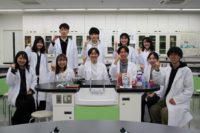
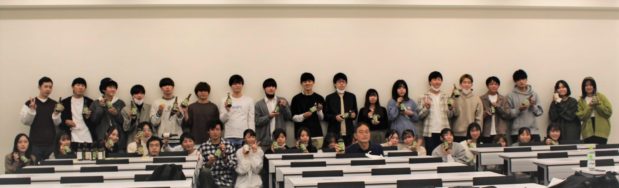
On Wednesday, December 1st, I observed the filming of a video for the online science class of the “Children’s Science Class”.

The “Waku Waku Laboratory” is an organization consisting of students of the Hirata Seminar (Science Education) of the Faculty of Education, Bukkyo University. This year’s team has 13 members. Since 2016, students have been planning and operating the “Children’s Science Class” with the aim of promoting the spread of science for children as part of the seminar’s social contribution activities. Until 2019, we held science experiment classes mainly for elementary school students at Zest Oike and student festivals (@平安神宮), mainly in the Kitano shopping district. In 2020, we were unable to hold the event due to the coronavirus pandemic, but this year, we are newly based at the Rakuda Children’s Center, which is closer to the university.

In July, we were able to hold a children’s science class at the children’s center, but in August, due to the declaration of a state of emergency, the two scheduled classes were canceled. The effects of the Corona disaster are still unsettled, so let’s try an online science class! So, on this day, I shot a video for that.

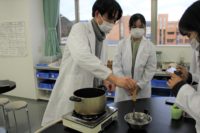
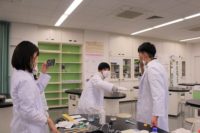
When I arrived at the shooting venue, I was greeted by 11 students in white coats.

The theme of this year’s event is “Science experiments that can be done at home!!” It seems that two experimental videos will be filmed. After considering what to use for shooting, I decided that it was easy to edit later on a smartphone! So, I started shooting with my smartphone.

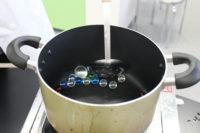
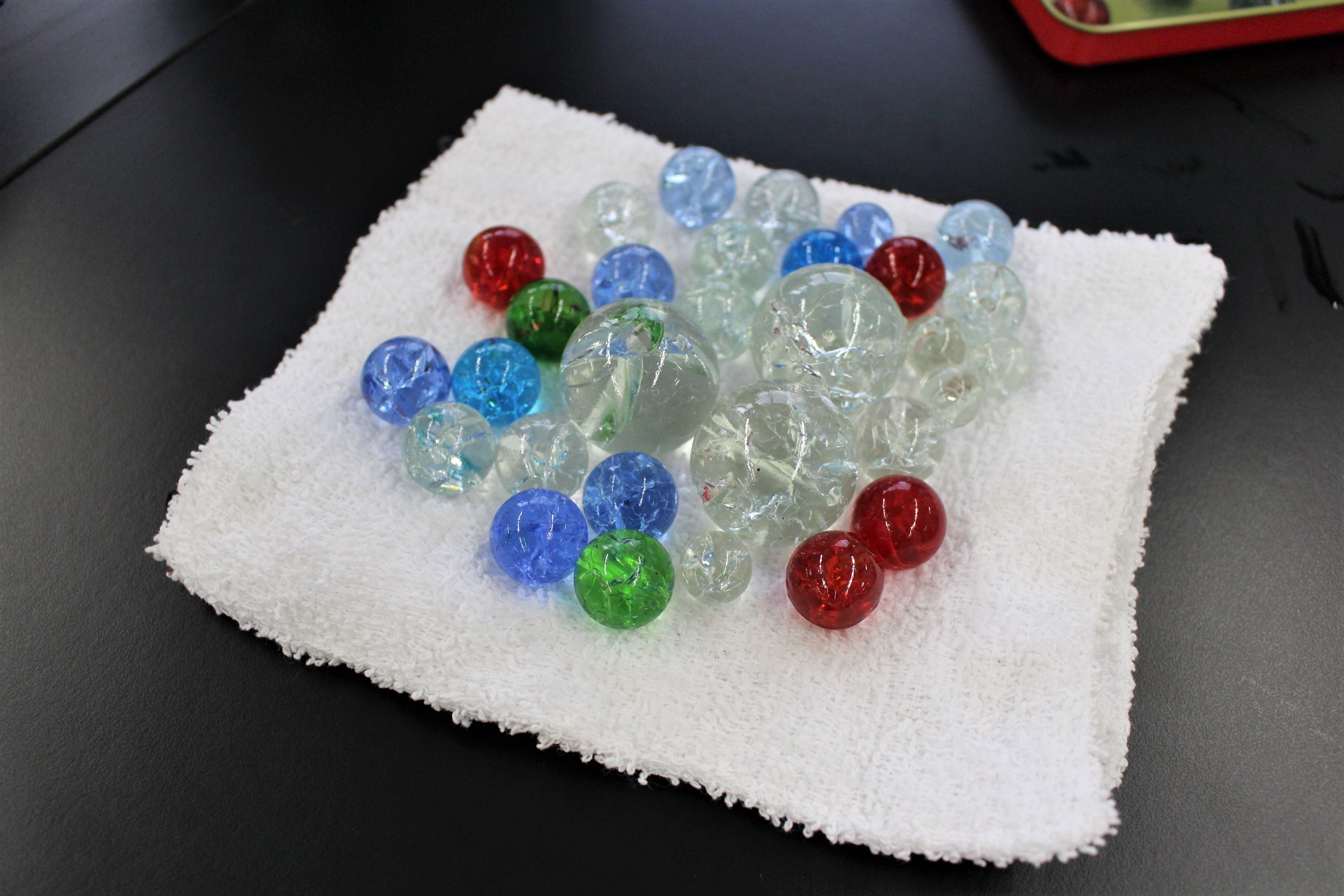
First of all, make crack marbles! Put the marbles in a pot on a gas stove and heat them over medium ~ high heat for about 10 minutes while rolling the marbles. When you’re done heating, take out the marbles and put them in ice water! If you put it in vigorously, the marble itself will break, so the point is to put it in gently. This is also chilled for about 10 minutes. The marbles were beautifully cracked.
It seems that he tried using a toaster oven instead of a gas stove, but it is difficult to get heat evenly or the amount of heat is not enough, so the gas stove can be done better.

Next, make unbreakable soap bubbles! It was a dream to touch soap bubbles, wasn’t it~ ♪ Maybe it will come true today! It is a challenge with two patterns of soap bubble liquid.

First of all, kitchen detergent, laundry glue, and sugar.
Measure each ingredient in a beaker, mix well, and let it sit for a while.
Finally, let’s fly the soap bubbles! …… And work gloves in the hands of those who are waiting for soap bubbles! !!
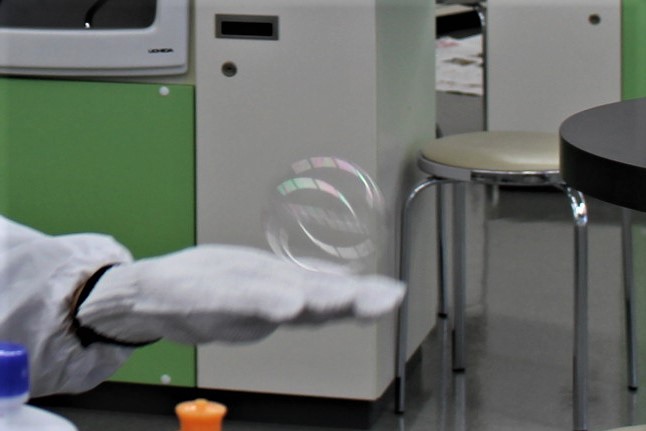
The fibers stand out on the surface of the work gloves, and they act like cushions, making it difficult for soap bubbles to break. I see, it’s one of the important goods.
With the cry of “I’m going!”, the soap bubble is blown away and received. “Whoa!!” he jumps up on his ♪ work gloves and succeeds!

Now, the next step is to add a lotion containing hyaluronic acid to a commercially available soap bubble solution.
This one seems to be struggling quite a bit. It cracks quickly, so add a lotion with hyaluronic acid to fine-tune it. The recipient also cooperates with the effort by turning the palm of the hand wearing work gloves up and down, but I feel that the purpose of this experiment is different…… (laughs)

I struggled a little with the results of the experiment, but the shooting was successfully completed! After this, the video will be edited and the explanation (audio) of the experiment will be included.

By the way, this time, the theme was “You can do it at home!”, but taking advantage of the advantages of online, “You can do it because it is a science room!!” They are planning to film dynamic experiments that cannot be done in a normal children’s science class, and to make experimental videos that people can enjoy just by looking at them. I’m ♪ looking forward to that as well

【Activities】Otani University And House

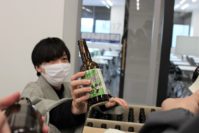
On Thursday, November 4th, we observed the labeling of beer bottles for the “Rediscovering Life in the Nakagawa School District – Beer with Tea Project”.

And House” is an organization centered on students of the Shito Seminar of the Department of Community Design, Faculty of Sociology, Otani University. Since 2015, we have been working in the Nakagawa area of Kita-ku, Kyoto City, where depopulation and aging are progressing, to learn about community development, including thinking about the inconvenience of transportation and the issues of daily welfare.
I would like many people to know and be interested in the many beautiful natures, cultures, and fascinating historical lives of the people that I noticed in the process! One of the attempts to start is the “Rediscovering the Life of the Nakagawa School District – Beer with Tea Project”.
Through the production of “Manma Bea!”, a craft beer using “Manma tea” that has been grown in the region for generations as it was when tea was introduced to Japan and has been drunk in between mountain work, we are working to further deepen our connection with the local community and expand our connections with people who are attracted to Nakagawa.

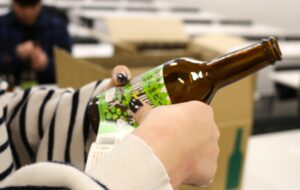
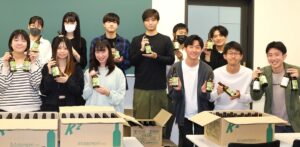
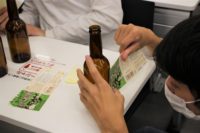
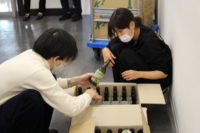
On this day, all the seminar students worked together to apply labels, which is one of the manufacturing processes of “Manma Bea!”.
First of all, you will receive a brief explanation from the teacher. If you make a mistake, you will be asked to buy it with the contents inside!!” One student said, “I’d be happy to buy it (laughs).” Yes, there was no beer in it that day. I was expecting a little bit to be able to taste it, but I was disappointed (laughs).

On October 2nd and 3rd, several students (the number of participants is limited due to the Corona disaster) went to pick tea and made tea leaves, which were brewed with Nishijin barley wine operated by the affiliated organization NPO HEROES, and it seems that it will be completed soon. It is scheduled to go on sale in early December. I’m looking forward to it, and ♪ it seems that you can also buy it from the Nishijin Beer online store!

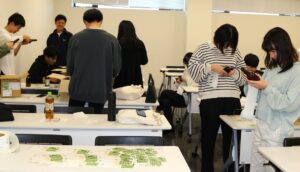
600 beer bottles and labels are brought into the classroom, and the leader of the third-year students gives instructions such as dividing the students into groups. This is the third year, so the third-year students are also labeling for the third time. Upper-year students also have the role of teaching first-year students!
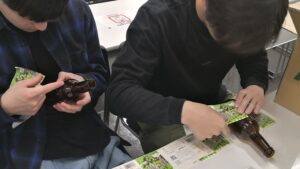
The bottle has a vertical line, and the label is easy to apply if you match the line. The position of the label should not be too high or too low. Of course, it is useless if air enters on the way. It seems that it takes a lot of concentration, and everyone’s faces are serious. When you finish pasting, show it to each other in the group and check it.
When I talked to a second-year student who was working while teaching first-year students, he seemed to be satisfied, saying, “(First-year students) absorb it ♪ like a sponge.” When the first-year students heard this, they were embarrassed but happy to laugh. This is how it is passed down from generation to generation.
Among the third-year students, the veteran group went around to inspect the products and checked the quality as quickly as a craftsman. I will give instructions for OK and repasting. I can count on you.
We also spoke to the next leader. While the number of participants in the event was limited due to the Corona disaster, he said that if he still had fun and actively participated, he would naturally become a leader. He said, “It’s fun to get involved with people in the community and hear things I don’t know!” While working on making tea leaves, he talked nostalgically about the history of tea and his childhood (in the past, the whole community used to work together).
He is also from an area where the forestry industry is thriving, and there are similarities. Maybe it’s a sense of hometown and calming down.

As a group, they also hold concerts at local facilities for the elderly, but they are currently unable to hold them due to the influence of the Corona disaster.
As I listened to their stories, I was reminded that it is really important to continue to do what we can and not to lose our connection. There are 3~40 students in the seminar. Each person may have their own thoughts, but it was a label that made me feel the importance of working on one thing and being involved in one thing.

【Activities】Kyoto Tachibana University Daigomi ETS Meeting

On Saturday, October 23rd, I visited the “Daiwa ETS” held at Umekoji Park.

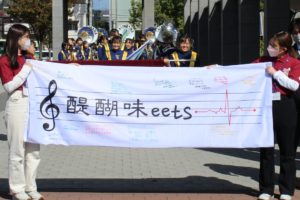
“Daigomi EETS ” is a project that aims to deepen cooperation and relationships among various entities such as citizens, businesses, students, and children in the Daigo region, where the birthrate is declining and the population is aging, and to make people feel the charm of the region anew by touring the Daigo region through events.
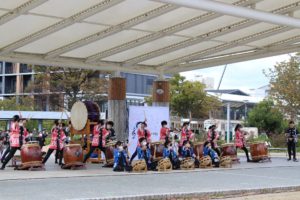
Since 2019, we have been holding stage events at multiple venues in the Daigo area of Fushimi Ward, where students and students from nearby elementary, junior high, and high schools and university clubs and circles showcase the results of their daily activities, such as brass bands, light music, Japanese drums, a cappella, dance, and batons.

In FY2019, the event was held at Paseo Daigoro, Tatsumi Bathhouse, and MOMO Terrace, and in FY2020, it was held at the Kyoto City Daigo Exchange Hall Hall, but this year, due to the ongoing coronavirus pandemic, we are considering holding it outdoors. We tried to hold the event in the Daigo area, but we had no choice but to abandon it due to the scale, setup, and budget of the event, and even after it was finally decided to hold it in Umekoji Park, we were forced to postpone it due to the declaration of a state of emergency.

Then came the day. Although some groups were unable to participate at the last minute due to the good weather, we were able to finish the entire program safely.
Last year, the opening parade, which was canceled due to the coronavirus pandemic, was also held, and the audience was fascinated by the energetic smiles of the high school students and the sharp marching band.
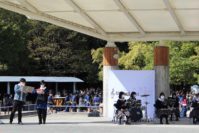
On the presentation stage, GReeeeN’s “Kiseki”, “Sing Sing Sing”, “Lupin III’s Theme”, and other songs that can be enjoyed by a wide range of generations were played, and some groups introduced the songs while performing famous scenes from the movie “Titanic”! The venue was very excited.

It seems that many groups were not able to practice as much as they wanted due to the coronavirus pandemic or had fewer opportunities to present, but in the interviews after the performance, we heard voices of joy at the event, such as “We practiced efficiently by cooperating and concentrating in a limited time,” “I am happy to be able to perform in front of many people for the first time in a long time,” and “I feel a sense of freedom.”
The fact that the entire event was managed, reception, and stage proceedings were mainly conducted by students was also reassuring and smiling.
At the finale, it seems that a joint performance was also held by volunteers from all participating organizations, and I think that both participants and Mr./Ms. audience felt a sense of unity!

This year, the event was held outside the Daigo area, but those who visited were lucky enough to know about Daigo ETS at this event! In the future, when it is held in the Daigo area, please visit ♪ it


 

2020 “Academic City Collaborative University” Promotion Project [Notice of Recruitment]


Kyoto City and the University Consortium Kyoto have been implementing the “Gakumachi Collaborative University Promotion Project” since the 28th academic year, with the aim of establishing, enhancing, and developing regional collaboration initiatives as an organizational initiative of universities beyond the boundaries of faculties and departments.

In order to further expand the base of universities engaged in university-wide regional collaboration, we are looking for the following new initiatives.

Business Overview

We provide support by setting up two types, “start-up type” and “development type”.
Please select one of the two types when applying.

Start-up type

Evolved type

Target Organizations

Universities and junior colleges (excluding participating universities) that are not members of the University Consortium Kyoto and have been selected for the 2016 Academic City Collaborative University Promotion Project and the Ministry of Education, Culture, Sports, Science and Technology’s COC and COC+ projects

Among the member universities of the University Consortium Kyoto, universities and junior colleges that have been selected for the 2016 Academic Community Collaboration University Promotion Project are promoting university-wide regional collaboration.

Initiatives to be supported

(1) Development of a systematic university-wide program

(2) Establishment of a system to promote regional cooperation within the university

* Existing initiatives are supported only for those that are enhanced and developed.

(1) Development of a systematic university-wide program

(2) Collaborative implementation of regional collaboration initiatives with other universities

* Advanced and new initiatives are eligible for support. Existing initiatives are not eligible for support.

Subsidies
(Maximum)

4Up to 19 years (5.8 million yen)

1st year: 2,000,000 yen

2nd year: 1,600,000 yen

3rd year: 1,200,000 yen

4th year: 1,000,000 yen

4Up to a maximum of an annual (8.8 million yen)

1st year: 3,000,000 yen

2nd year: 2,400,000 yen

3rd year: 1,900,000 yen

4th year: 1,500,000 yen

Number of Selections

About 3~4 cases

1~2 cases

* Please note that the budget for the second year (FY2021 (Reiwa 3)) and beyond is not a guarantee because it is a matter to be decided by the Kyoto City Assembly.
*For details, please check the application guidelines.

Application Guidelines (PDF)
Q&A(PDF)

About the application

How to
apply
Application documents must be submitted by mail by 5 p.m. on Friday, June 12, 2020.
* [Reiwa 2nd year “Gakumachi Collaborative University” promotion project application form, etc. in attendance] should be written in red and shipped with plenty of time by a method that can prove delivery (parcel, simple registered mail, courier service, etc.).

Click here to download the < application documents>

[Start-up type]
Application Form (1) (Form 1) (Word)
Application Form (2) (Form 2) (Excel)
Business Plan (Form 3) (Word)
Budget (Form 4) (Excel)


[Advanced]
Application Form (1) (Form 1) (Word)
Application Form (2) (Form 5) (Excel)
Business plan (Form 6) (Word)
Budget (Form 7) (Excel)

Questions about this project

In order to prevent the spread of new coronavirus infections, we will not hold briefings on this project. If you have any questions, please contact us as follows:

・Question Period
Tuesday, April 21, 2020 ~ Friday, May 22, 2020

・How to ask questions
Style free. Please contact us by e-mail or fax at the following contact information.

・Answers to questions
Answer questions on a case-by-case basis. In addition, the summary of the questions and answers will be published on the website of the University Consortium Kyoto.

Question Reception Date

Published on

From Tuesday, April 21 to Monday, May 11

Available before Monday, May 18

From Tuesday, May 12 to Friday, May 22

Available before Friday, May 29

(URL: https://www.consortium.or.jp/project/chiiki/sokushin)

Future Schedule (tentative)

May 22 (Fri) Closed for questions
June 12 (Fri) Application Deadline
Mid-late June ~ Early July Hearing
In July: Decision on selected projects
* Depending on the spread of the new coronavirus infection, there is a possibility that the hearing examination will not be conducted, but only the written examination will be handled.

Where to submit application documents and inquiries
〒600-8216 Shimogyo-ku, Kyoto-shi, Nishitoin-dori, Shiokoji, Shimo-ku, Kyoto, Campus Plaza Kyoto
University Consortium Kyoto, Research and Public Relations Department, “Gakumachi Collaborative University” Promotion Project
TEL :075-353-9130 FAX: 075-353-9101
MAIL:chiiki-daigaku-ml■consortium.or.jp
(Please change ■ to @ and send)
* Reception hours: Tuesday ~ Saturday 9:00 ~ 17:00

2019 Gakumachi Collaboration Project Gakumachi NEWS!

Introducing the 2019 Gakumachi Collaboration Project initiatives.

In order to create attractive communities and solve local issues, the “Gakumachi Collaboration Project” invites universities and students to work on projects in collaboration with the local community, and provides grant support for outstanding initiatives. We would like to inform you of this year’s initiatives.

【Activities】Kyoto Seika University Keihoku Utsu Treasure Hunting Club (7th !!!!!)

We would like to introduce an activity report from a member of the “Keihoku Utsu Treasure Hunting Association”, which aims to revitalize the region through the search for local treasures (nature, people, technology, tradition, history, etc.) in the Uzu area of Keihoku-cho, Ukyo-ku, Kyoto City.

Click here for the report on participation in the event “New Year’s Gathering” sponsored by Ippukuya Uzu


【Activities】Kyoto Seika University Keihoku Utsu Treasure Search Club (6th !!!!)

We would like to introduce an activity report from a member of the “Keihoku Utsu Treasure Hunting Association”, which aims to revitalize the region through the search for local treasures (nature, people, technology, tradition, history, etc.) in the Uzu area of Keihoku-cho, Ukyo-ku, Kyoto City.

Smile Bazaar, Local Information Signboard Renewal Meeting, Morning Market Activity Report Click here for the report
Participation in the University Regional Collaboration Summit Activity Report Click here for the report


【Activities】Kyoto Sangyo University Mirai Transmission Bureau Omusubi ~Shizuhara Support Team~

On Saturday, November 9th, we visited the “Once Upon a Time Farming Experience Session No. 1” by the “Mirai Transmission Station Omusubi ~Shizuhara Support Team~”.

“Soikal from Shizuhara ~Dissemination of Kyoto Soybean Food Culture~” focuses on Japan’s important food culture “Washoku”, especially “soybeans”, which are the raw materials of yuba, tofu, and miso that are indispensable for Kyoto cuisine, and for the purpose of local production for local consumption of soybeans and the transmission of food culture, we will cultivate Kyoto soybeans “Otsuru”, hold events related to soybeans, and develop products together with the people of the Shizuhara area. We are engaged in activities aimed at disseminating the appeal of soybeans and improving their status.

At the “Once Upon a Time Farming Experience Session”, you can experience the harvesting ~ threshing of giant soybeans.
Before heading to the farm where you can experience harvesting, we were guided to the 1st ~ 7th farms in order, where we usually work. The members who guided us this time were first-year students, and they had only been active for about half a year, but while visiting each farm, they said, “It is difficult to make a furrow (a place where the soil is raised in a long and straight shape to grow crops in the field),” “We grow winter vegetables here,” and “We are considering other uses because it is shaded by the mountains and the sunlight is short and the drainage is not good.” He said that there were many things he didn’t know and that he still had a long way to go, but he explained it very reassuringly. Since they are active once a week, they seem to know each other in the community, and they exchanged greetings and talked lightly. The blue T-shirts they wear during their activities also seem to play a role in spreading the initiative.

When we arrived at the farm where we could experience harvesting, in addition to the members, international students from Kyoto Sangyo University also participated and were working. It is said that the harvest time for soybeans is when the stems, leaves, and pods turn brown and become dry. As the members told me, when I held the stem and pulled it, it came out smoothly and easily. This will be dried for a week, and at the second trial session next week, it will be threshed using a foot rowing threshing machine that was used in Shizuhara a long time ago.

In the “Shizuhara Miso Project” of “Soikal”, it seems that the seedlings of giant soybeans are distributed to people on campus and in nursing homes for the elderly, and they are growing. In February, we plan to hold a workshop inviting them to make miso using the Shizuhara method using soybeans grown by themselves. From now on, the first winter for first-year students is coming. I was a little worried when I heard that it would snow, but I hope you will do your best against the cold!

【Activities】Kyoto Seika University Keihoku Uzu Treasure Hunting Club (5th !!!)

We would like to introduce an activity report from a member of the “Keihoku Utsu Treasure Hunting Association”, which aims to revitalize the region through the search for local treasures (nature, people, technology, tradition, history, etc.) in the Uzu area of Keihoku-cho, Ukyo-ku, Kyoto City.

Elementary School Exhibition + Haunted House Preparation Activity Report Click here for the report
The 3rd University Student × Children’s Summit Activity Report
Children’s Photography Class Activity Report Report

【Activities】Kyoto Tachibana University Society for Contemporary Business Studies Urban Development Study Group (Part 2!)

On Saturday, November 2nd, we visited the “Daigo Nakayama Complex Pottery Lantern Road” by the Kyoto Tachibana University Society of Contemporary Business Society’s Urban Development Study Group!

This year’s third Pottery Lantern Road at the Daigo Nakayama Complex is operated by residents of the Daigo Nakayama Complex and students from Kyoto Tachibana University, and is held with the aim of promoting interaction among residents and promoting Shimizu ware, which is concerned about the shortage of the next generation of workers.

At the main venue, Daigo Nakayama Park, the students came up with a design based on the theme of “Akiiro”. On the east side of the park, fresh greenery was drawn, and on the west side, red and yellow maples and fallen leaves were drawn, expressing the arrival of autumn. In addition to the main venue, the meeting hall was designed with the image of a river and fish, and the front of the nursery school was designed to make use of the long road.

This year, it seems that people who live in a nearby welfare facility also came to see it, and I heard that some people can only see it from a car, so they ad-libbed and set up a lantern area in a place where it is easy to see even while riding in a car.

In the Yamashina area, it seems that pottery lantern events are held in two other places in addition to the Nakayama Complex, but among them, the candlelight stands out in the Nakayama Complex and is said to be beautiful. On this day, it was sunny, there was not much wind, and the air was clear, and it was a perfect day for the pottery lantern road. It seems that they have been making preparations, such as cleaning the entire Nakayama Housing Complex for a week, so it was really good to be surrounded by the weather.

At the main venue, there was a drum performance by nursery school teachers, a calligraphy performance by Kyoto Tachibana University students, and a brass band performance. There was also a stamp rally project to further enjoy the lantern road, and participants collected stamps from students dressed as Mario and other characters in each area. If you get all the stamps, you will also get a nice gift.

Visitors to the venue commented, “The weather is just right on the porcelain road at this time of year, so I’m glad to be able to take a walk and see beautiful things,” and “I’ve been looking forward to this event since I found out about it last year.”

If you are aware of this “Daigo Zhongshan Complex Pottery Lantern Road” for the first time this year, please look forward to next year!

【Activities】Kyoto Seika University Keihoku Utsu Treasure Hunt (4th !!)

On Friday, November 1st, I visited the “Food Stalls in Kino Festival” by the Kyoto Seika University Keihoku Utsu Treasure Search Association.

Normally, the “Keihoku Utsu Fureai Learning Together” is active in the morning market, summer festival, and music festival in the Uzu area, but on this day, they set up a stall at the school festival “Kino Matsuri” of Kyoto Seika University to promote the group’s activities.

The stall was selling pork soup with plenty of vegetables and candy.

When I went there, a member of the first-year student of the Faculty of Humanities was working as a store keeper, and he said, “This year, due to typhoons and weather, the harvest of vegetables in the Keihoku Uzu area was not very good, and I was afraid until the last minute to see ……if we would be able to secure vegetables to be used for pork soup.” With the cooperation of the farmers, they managed to sell pork soup with plenty of vegetables from Keihoku, such as radishes and Chinese cabbage. I also had it, and the fresh vegetables were very delicious and the amount was really Mr./Ms., so I was full.

When I asked him if there was any Keihoku origin for the candy, he said that there was nothing in particular (laughs), but he told me, “It’s inexpensive, the color is beautiful, and you can enjoy it for a longer time than you think.” Maybe it’s because they’re used to setting up stalls at summer festivals and music festivals. Why don’t you consider other organizations as candidates when opening a store at some event?

After this, Kyoto Seika University Keihoku Utsu Treasure Search Club is planning to hold a children’s photography class, and on Saturday, November 30, a parent-child smile collaboration event “Smile Bazaar 2019”.

“Nikori Bazaar 2019” has Mr./Ms. shops planned by Uzu children, ghosts and shiki, and it seems that anyone can participate, so please come and visit!

【Activities】Kyoto Bunkyo University Bus Tours

On Sunday, October 27th, I visited the “Bus Tour Photo Exhibition in Mukojima Festival” by Kyoto Bunkyo University Bus Tours.

The Kyoto Bunkyo University Bus Tours offers one-day bus tours about five times a year that can be easily participated in directly from their homes, with the aim of taking the elderly who have not gone out much and promoting interaction with the local community in Mukojima New Town, where the population is aging.

On this day, at the Mukojima Festival, which was held mainly at Mukojima New Town Center Square, we held a photo exhibition of the bus tours that we have conducted so far.

A total of 25 tour photos were on display, from the first Fukui tour in 2013, which started its activities, to the one on Awaji Island that was held on Tuesday, September 17 this year. The number of tour participants was well received, with about 20 people each time compared to the capacity of 25 people, and it was clear from the photos that they were having fun.

When we talked to the visitors, they were surprised! He has participated in all 25 sessions. He said, “I’m looking forward to the destination, but the most fun is to be able to eat there and talk with everyone about other things.”

While looking at the photos, a first-year member said, “There are many people who have lost their husband Mr./Ms.s and are living alone, and who tend to be confined, but after participating in the bus tour, they are gradually regaining their energy. He himself participated in the tour and seemed to have a lot of things to feel.

As a first-year student, he is the representative of this organization, and although he has only participated in the tour twice, he has a good grasp of the contents of the tour from the first to now, and he is worried about where to go next time. “It’s ……a place where you can go on a day trip just by bus, and you can take a reasonable amount of time at your destination,” he says, “If you go 25 times, you’ll run out of candidates. Since the participants are mainly elderly, there are many points to pay attention to, such as the fact that you don’t have to walk that much to enjoy and that there are few stairs. Even so, it seemed to be fun to have the participants remember their faces and talk to them, and to think about various things, and he was talking with people who often participate in the tour, saying, “After all, the next one is the Japan sea side ~?”

The grandchildren of the people who participated in the tour also came to see the Mr./Ms., and I thought it would be good to hold a photo exhibition like this.

In addition to where to go, there seems to be no end to thinking about gathering members, but it seems that we are moving forward little by little as we do it, so I am looking forward to future activities!

【Activities】Kyoto Women’s University Eriko Inoue Laboratory, Takenosato and Shinbayashi Team (Takenosato Edition)

On Saturday, October 26, the “Takenosato Complex Festa” was held at the meeting hall and plaza of the Takenosato Complex.

There was a flea market in the square, and events such as herbarium making and relaxation were held in the meeting place.

At the flea market, there was a club of residents and Kyoto Women’s University, and there was also a fishing pond for children to fish for handmade knick-knacks, used books, and paper bags. The children were curious, “What’s in it?” There are many children in the Takenosato housing complex, and they often participate in the monthly community café, and they talk to the students in a friendly manner. By the way, he secretly told me that the contents were stationery that was in the member’s house.

The housing complex festival is mainly organized by students, but the residents suggested that they try to make a herbarium at the community café held once a month. It seems to have been well received, and some people said, “It was fun, so it’s the second time.” When I talked to the residents, they said, “There are many people who live in the housing complex, but they don’t have much interaction with each other, so I’m very happy about this kind of opportunity, and I hope it will continue for a long time.”
Despite these voices, there is no visible interaction between residents, so students are conducting surveys to learn about residents’ opinions and needs. A member said, “Sometimes I have to worry about it, but I’m happy when the residents remember my face and talk to me.”

In December, they are thinking of a project related to disaster prevention and child-rearing, which has been requested a lot!


【Activities】Ryukoku University, Higashitakase River Environmental Protection and Jizo Bon Project Team (Part 2!)

On Friday, October 25th, I visited the “Activity Review Meeting with Local Residents” held at Ryukoku University.

On this day, 13 students from Ryukoku University Junior College, who are members of the project team, teachers, and less than 10 local people participated in a review meeting on the Jizo Bon and related activities held in August.

First, two groups of students gave a PowerPoint presentation, and then all the students reflected on their efforts one by one.

Many of the members were from other prefectures, and some of the students began to learn about “what is Jizo Basin?” In addition, in the course of planning and managing the program, many students felt the importance of looking at things objectively and from multiple perspectives because they felt the narrowness of their own perspectives and the difficulty of communicating with them, and they felt envious of the fact that exchanges were more active than in their own hometowns, and they felt the warmth of the local people.

Local residents also talked about how the Jizo Bon Project started, and their impressions such as “By joining the students, I was able to have the opportunity to learn about the area where I live again.”

In the community, disaster prevention activities will be held on Sunday, November 10, and the teacher commented to the students and talked about the importance of disseminating rules and knowing faces in the event of a disaster.

It seems that some of the students were able to find their dreams for the future by planning the Jizo Basin. Even if it wasn’t a dream, what I learned and felt through this activity will surely be useful after I go out into the world, and it was such a reflection meeting that I hope that I will make full use of it!

【Activities】Kyoto University of Foreign Studies Halloween in Saiin Executive Committee

On Sunday, October 20th and Sunday, October 27th, we visited the “Lantern Workshop” and “Halloween Parade in Saiin” organized by the Halloween in Saiin Executive Committee.

“Halloween in Saiin” by members of Kyoto University of Foreign Studies aims to deepen exchanges between local residents, shops, and university students through the overseas culture of Halloween, strengthen their ties with each other, and create a richer place for local children to belong, focusing on the large number of dual-income households. We are mainly active in organizing events related to Halloween.

On Sunday, October 20th, we held a pumpkin lantern-making workshop at AEON MALL Kyoto Gojo. It was very popular, and it seemed that the numbered tickets were distributed immediately. Many families with small children participated, and children were in charge of drawing faces on pumpkins, and many adults were in charge of hollowing out the contents of pumpkins and cutting out them with knives according to the draft faces. When it was completed, everyone was happy to take pictures. Some students told me, “It’s a great opportunity because you don’t get many opportunities like this!”

Members of the residents’ association also came to the venue and talked with the member students. There, we were able to listen to episodes from the beginning of the business, and when we went to talk about what we wanted to do, we were scolded…… And. The members who had such an experience are now fourth-year students, and they seem to be thinking carefully about what is important in regional cooperation, such as listening to each other’s stories and having a win-win relationship.

On Sunday, October 27, the main event of this project, a Halloween parade was held. On this day, the weather was clear and about 150 people participated in their favorite attire, such as Kiki the Witch’s Delivery Service and Mr./Ms. the Winnie. There were people waiting on the sidewalk with cameras, and it seemed to be enjoyed in various ways. At the finish line, on the special stage of the Kyoto Family, there was a performance by the Kyoto University of Foreign Studies Brass Band, which made the event even more exciting.

This year marks the fifth year of “Halloween in Saiin”. There were years when the parade was canceled due to rain, but it seems that it is gradually becoming more widely known to the local people. We look forward to the future!


【Activities】Seian University of Art and Design, Kyoto City University of Arts, Kyoto Tachibana University, Ryuganji Cultural Affairs Department Tera*Parumusu

On Saturday, October 19th, we observed a live music performance and workshop by “Ryukishiji Cultural Affairs Department Tera*Parumus”.

“Ryuganji Cultural Affairs Department Tera*Parumusu” is an organization that aims to convey the familiarity of Buddhist culture through idols based at Ryuganji Temple in Shimogyo-ku, Kyoto. With the aim of making the temple a place for local people to interact and passing on Buddhist culture, we hold events such as live music on the theme of Buddhism and explanations of scriptures by the priest as an opportunity to visit the temple on a daily basis.

On this day, we held a business trip live and workshop at Jokyoji Temple.

In the live performance, the three idols danced and sang sharply. The lyrics also include Buddhist terms, combinations of sects and founders, and a mother Mr./Ms. who watched the concert with her child said, “I thought it was just a live event, but I learned more than I expected.” There were audience members of all ages, from children to the elderly, but when they called out “Together~!”, everyone happily imitated the choreography and got excited.

In the workshop, we performed the introduction of Buddhism. Each square contains various items from the birth of Buddha to the introduction of Buddhism to Japan, and those who caught the “training” square actually did zazen. Both children and adults seemed to be able to have fun and become interested in Buddhism.

When we talked to the members, they said that although they gained a fixed fan base after being featured in the media, they still have to work hard to make it known to a wider range of people, not just a limited number of people, and to make it a daily occurrence for local people to visit temples! He was enthusiastic.

From the beginning of November, Ryuganji Temple will hold the “Super Ten Nights Festival” in honor of the “Ten Nights Ceremony” held at temples such as the Tendai and Jodo sects, and various events will be held. Please take this opportunity to visit the temple!


【Activities】Kyoto Seika University Keihoku Utsu Treasure Hunt (3rd!!)

We would like to introduce an activity report from a member of the “Keihoku Utsu Treasure Hunting Association”, which aims to revitalize the region through the search for local treasures (nature, people, technology, tradition, history, etc.) in the Uzu area of Keihoku-cho, Ukyo-ku, Kyoto City.

Elementary School Exhibition Preparation + Parent-Child Smiling Mother Mr./Ms. Meeting Activity Report Click here for the report
Ippukuya Utsu Morning Market Store Opening + Easy Smartphone Classroom Activity Report Click here for the report


【Activities】Kyoto Koka Women’s University KOKA ☆ Orange Supporters

On Saturday, September 21st, we visited the “KOKA ☆ Orange Salon @ Kyoto Koka Women’s University” by KOKA ☆ Orange Supporters.

In the “KOKA ☆ Orange Project ~Let’s support the “food” of the elderly and people with disabilities!~” by members of Kyoto Koka Women’s University, we believe that food support and oral frailty prevention (prevention of oral function decline) are important issues that should be addressed in the community, which will lead to the solution of nursing care problems. While conducting training to maintain the function of eating, they are working to spread the importance of this initiative.

About 20 elderly people participated in this year’s Orange Salon, and the program included a magic show, preventive exercise for long-term care & brain training, a talk from a dentist, gymnastics to train eating ability, and a lot of Mr./Ms. content.

The members were in charge of the entire program and the gymnastics and singing corners, and taught exercises that can be done while sitting, from neck and shoulder relaxation to mouth and tongue movements. The method of vocalization and singing was devised such as raising the pitch and lengthening the endings of words, and the participants trained their eating ability to imitate the students while trying their best to raise their voices.

During the break, “soft Japanese sweets” were served, and this time I had mitarashi dumplings. When I tasted it with a little excitement, the taste was just as delicious as the Japanese sweets I usually eat, and the texture was soft and easy to eat. This year, you will be participating in the development of a new product, and it seems that it will be completed soon, so I am very much looking forward to that as well.

The next KOKA ☆ Orange Salon will be @京都光華女子大学を予定されています on Saturday, November 9th. After that, it is scheduled to be held in January and March, so I hope that this initiative will continue to spread!


【Activities】Kyoto Seika University Keihoku Utsu Treasure Hunt (2nd!)

We would like to introduce an activity report from a member of the “Keihoku Utsu Treasure Hunting Association”, which aims to revitalize the region through the search for local treasures (nature, people, technology, tradition, history, etc.) in the Uzu area of Keihoku-cho, Ukyo-ku, Kyoto City.

Keihoku Music Festa Activity Report Report
Smartphone class first thing in the morning, Children’s Summit Core Meeting activity report Click here for the report


【Activities】Kyoto University Taji Laboratory Higashikujo Town Development Team

On Wednesday, September 18th, I visited the “Higashikujo Mapping Hearing (2nd Hearing)”.

In the “Map of Higashi-Kujo Memory” by the Higashi-Kujo Town Development Team of the Taji Laboratory, Kyoto University, the number of storytellers who know the history of the Higashi-Kujo area is decreasing due to the aging of the population, and in addition to interviewing and archiving the state of the city, local residents and people who will be involved in the Higashi-Kujo area in the future are working to create a “memory map” that can be used as the basis for the future image of the region.

In this hearing, we heard from three people who have lived in Higashikujo for many years.

Putting together a map of the 1960s and the present, I asked, “What was the road like around here, and what was this apartment like?” When I asked him about the details, he said, “There is a garden when you enter from this road, …… the kitchen and toilet are shared” and “Oh yes! The three of them talked about the past while remembering it. As the members listened to the stories, they thought about how many years it had been, and wrote down what they heard on the map one after another.

I was able to hear sights that I don’t see now, and I had a very meaningful time. The content is not all positive, but the members are working with the feeling that they must envision the future of the region after learning and accepting the facts of the past, and I hope that they will continue to cherish this feeling in the future.

After this, the Higashikujo Town Development Team will conduct further interviews, organize the information, and then actually create a map. I look forward to the completion of the “Map of Memory” and am very much looking forward to seeing how this map, which will serve as the basis for the future vision of the region, will be utilized.


【Activities】Kyoto Women’s University Eriko Inoue Laboratory, Takenosato and Shinbayashi Team (Shinbayashi Edition)

On Saturday, September 14th, we visited the “Community Café” held at the Shinbayashi Complex of the “Kyoto Women’s University Eriko Inoue Laboratory Takenosato Shinbayashi Group”.

In the “Circle-like Self-Government Activities in Rakusai New Town” by members of the Eriko Inoue Laboratory at Kyoto Women’s University, each resident was inspired by what they are good at and what they like, based on the need for “human relationships that can help each other in the event of a disaster” in the Takenosato Housing Complex, where there is no autonomous organization and the local community is diluted. They are working to tackle local issues through circle-like self-government. This year, in addition to the Takenosato Housing Complex, which is celebrating its sixth year, activities have also begun at the Shinbayashi Complex.

Community cafes are held every month at the meeting hall of the housing complex, and in September they were held on Saturday 14th and Sunday 15th. When I visited, three residents had already arrived, and the conversation seemed to be lively with the students. After that, several people came to visit.
When I talked to the members, it seemed that some of them did not understand at the beginning of the initiative, and they set up a place to talk with them many times, but now, after a few months, they are participating in the café and they say that they feel that they are making progress, albeit little by little.
In order to encourage as many residents as possible to participate, the handmade flyers were not only posted on bulletin boards in the housing complex, but also posted door to door. The next day, there was also a plan to make bookmarks using leaves at the café venue. Along with the preparations for the autumn reading season, I think that the exchange of residents has also progressed.

On Saturday, October 26th, it seems that a “Festa” will be held at the Takenosato Housing Complex. Flea markets and workshops are planned, and it seems that non-residents can participate, so be sure to go there!


【Activities】Kyoto Sangyo University, Ryukoku University Satomachi Festival Executive Committee

In order to create a place for interaction between Sato (Keihoku) and the town (in the city) and to revitalize the community, the “Keihoku Satomachi Festival” organized by the Satomachi Festival Executive Committee holds events such as summer festivals and Christmas parties in the Keihoku area, led by students and working people from the Keihoku area.

On Sunday, August 25th, I participated in the Satomachi Festival (summer festival)!

The venue of the summer festival is the Keihoku Satomachi Exchange Cafe “Koi Samuraku”, which is located at the end of the JR Bus Kaohsiung-Keihoku Line, about 10 minutes by car further north of Zhoushan. About half of the participants were local residents and half from the city. In addition to the executive committee members, high school students attending local schools were active as staff, and we were entertained by Mr./Ms.’s program with a lot of fun, such as somen noodles, shaved ice, watermelon splitting, bingo tournaments, and fireworks. The ayu that I received from my neighbors was also grilled, and everything I ate in the nature of Keihoku was the most delicious. The children had a great time shooting and yo-yo fishing made by high school students.

In preparation for this day, they have held two meetings a month, but it seems that they have devised a way to hold the meeting once each in Keihoku and in the city because they want people who live in the city to know about Keihoku and people who live in Keihoku to know the city.

In the Keihoku region, the birthrate is declining, the population is aging, and the population is declining. Some of the members of the executive committee were fourth-year members of society working in the local area, but most of my classmates said that they would leave their hometowns to go on to high school, university, or find a job. In such an environment, it seems that there are many people who participated in the Satomachi Festival when they were high school students who want to be involved in some way even after graduating and becoming university students or working adults, so I hope that they will continue to do so and that their thoughts will continue to spread.

In an environment rich in nature, I was able to have an experience that is usually difficult to do in the city, and I was able to have an Mr./Ms.. If you couldn’t participate this year, please join next year and experience the charm of Keihoku!


【Activities】Bukkyo University Waku Waku Laboratory

On Friday, August 23rd, we visited the “Children’s Science Classroom” by the “Waku Waku Laboratory” of the Hirata Seminar, Faculty of Education, Bukkyo University. Once a month, seminar students conduct science experiments for elementary school students in the Kitano shopping district, and are engaged in community development activities in collaboration with the local community with the aim of intergenerational exchange and creating a place for children to belong.

This time, at a children’s center near Bukkyo University, fossil replicas were made and experiments with static electricity were conducted. The theme was “Fossil Replicas, Let’s Play with Static Electricity,” and 30 children participated.

First, fossil replicas are made, and fossil molds of their own choosing, such as ammonites and trilobites, are poured with pink resin, which is often used in dentist tooth casting. When the children saw the replica, they were surprised, saying, “Is this real?” The children made it under the guidance of the students and happily showed each other the replicas of the fossils they had completed.

After making the replica, we experimented with static electricity using plastic tape in the shape of balloons and octopus legs. Unfortunately, on this day, the heavy rain had accumulated moisture and made it difficult for static electricity to occur, but all the children were rubbing the balloons with their sweaters with all their might, trying to somehow float the vinyl tape.

The students and children seemed to get along very well and had a lot of fun, and the space was very warm. I hope that the next “Children’s Science Class” will be blessed with good weather.

*This article was interviewed and written by Mr./Ms. Yamamoto, a third-year student at Doshisha Women’s University’s Faculty of Representation and Culture, Mr./Ms. Kurita, a third-year student at Otani University’s Faculty of Letters, and Mr./Ms. Kisaragi, a second-year student at Kyoto Bunkyo University’s Faculty of Social Sciences, who are participating in training at the Foundation as part of the “Internship Business Public Course” conducted by the University Consortium Kyoto Education Division in 2019.


【Activities】Kyoto Tachibana University Society for Contemporary Business Studies Urban Development Study Group

On Wednesday, August 21st, we visited the Shimizu Yaki Chopstick Place Painting Experience of the “Kyoto Tachibana University Contemporary Business Association Urban Development Study Group”!

In the “Daigo Nakayama Housing Complex Revitalization Project” by the Kyoto Tachibana University Society for Contemporary Business Studies, in order to promote Shimizu-yaki, a traditional craft in Kyoto, and to increase the number of opportunities for interaction between the elderly and local residents, mainly the child-rearing generation, in the Daigo Nakayama Housing Complex in Fushimi Ward, a lighting event using Shimizu pottery “Pottery Road” will be held, and the venue will be cleaned. We hold workshops on making accessories using Shimizu ware, which will be exhibited at events.

On this day, about 40 children from two children’s centers and several elderly people participated.

When the students’ explanations began, the children, who had been making noise, listened attentively. First, ask them to choose their favorite shape from several types of chopstick rests. The children seem to have fun picking up one by one, deciding which one to choose. Once you’ve decided which one to use, it’s time to start painting. Each of them drew their own pictures with serious expressions.

The children who were able to paint were happy to show it to the students, saying, “Look at it~”. Those who were able to do it early enjoyed their drawing time until others were ready. The elderly people were also working hard to paint while saying, “What to draw ~?”, and they showed each other what they had finished, and it seemed that they were returning to their childhood.

It was said that from noon, a project for children and the elderly to interact with each other will be held.

On November 2nd, the “Pottery Lantern Road” at the Daigo Zhongshan Complex is scheduled. Toward that, it seems that a general cleaning operation will also be carried out. One student said, “I participated in this activity because I wanted to do it myself after seeing last year’s lantern road!” I’m looking forward to the day.


【Activities】Ritsumeikan University Camo Cinema 15 Executive Committee

On Saturday, August 17th, we visited the outdoor movie screening of the “Camo Cinema 15 Executive Committee”!

“Kamo Cinema” was launched 17 years ago by students at Ritsumeikan University who were interested in the conservation of the Kamo River, which plays a major role in creating a landscape that is unique to Kyoto. In light of the fact that Kyoto is a city of students, we, the students, who will lead the next generation, have been holding cleanup activities and outdoor movie screenings every summer as part of our efforts to raise awareness of beautification and environmental conservation among young people, especially those of the same generation. This year marks the 15th year of this initiative.

On this day, there was a cleanup activity called “Pikakamo” from 3:30 p.m., followed by a daytime project for children such as Super Ball scooping and ring tossing, a talk show by Miss &Mr./Ms. Campus finalists from Doshisha University and Kansai University, and an outdoor movie screening in the evening.

In preparation for this day, they distributed pocket tissues for advertising at the Kamogawa area “Kamogawa Naryo 2019” and asked them to place flyers at shops near the venue. Some of the people with pocket tissues in their hands said, “I went there last year!!” and “Movie screening in Kamogawa!? Looks good!” It seems that there were some people who reacted.

This year’s film is “The 700-Day War between us and Mr./Ms..” In 1979, in a peaceful rural town, seven high school students who are addicted to pranks and a brave resident Mr./Ms. who stands in front of them are engaged in a prank battle. It was a movie that could be enjoyed by both children and adults, and was perfect for this time of summer. The Kamo River was still hot during the day, but as the sun went down, it became cooler, and the wind was very pleasant. I had a luxurious time.

The “Camo Cinema 15 Executive Committee” is scheduled to volunteer for the extermination of invasive species on Sunday, August 25. We hope that you will continue to convey the charm of the Kamo River and spread the importance of beautification and environmental conservation!


【Activities】Ryukoku University, Higashitakase River Environmental Protection and Jizo Bon Project Team

On Saturday, August 17th, we visited the Jizo Bon program of the “Ryukoku University-Higashitakase River Environmental Protection and Jizo Bon Project Team”!

In order to pass on the traditional events of the region to the next generation and to improve the environment of the Higashitakase River, which is the venue of the event, the project team of the Ryukoku University Junior College Department is working with the local community to clean up the river, plan and operate the “Jizo Bon Program,” and support disaster prevention activities and drills, with the involvement of high school students and others.

Jizo Bon is a traditional event held in the hope of safety in the town and the sound development of children, and the next day, the 18th, was the actual event. On this day, the students were working on “various projects that children can enjoy” such as making eco-bags, bamboo dragonflies, and bunbun sesame seeds to liven up the Jizo Basin. The students, who usually don’t have many opportunities to interact with children, were confused at first about how to interact with them, but they quickly got used to it and seemed to enjoy being with them while teaching them how to make it.

Along the Higashi-Takase River at the Jizo Bon venue, children and students were playing with water guns, and everyone’s smiles were shining. Two weeks before preparing for the Jizo Basin, they also conducted cleanup activities as usual.

This year marks the sixth year of this initiative, and it seems that the Jizo Basin, which until six years ago was only half a day, has become a two-day event with the participation of students, and there are more opportunities for people in the town to show their faces, and it seems that communication between residents and multiple generations is being born.

The teacher who supervised the students said, “It is important to know the background of one event and continue the activity, rather than just one event.”

In the evening, bamboo lanterns and fireworks were held as the eve of the festival, and many adults participated in the festival. The lights were very beautiful in the river at night when it was cleaned.

【Activities】Kyoto Seika University Keihoku Utsu Treasure Search Club

We would like to introduce an activity report from a member of the “Keihoku Utsu Treasure Hunting Association”, which aims to revitalize the region through the search for local treasures (nature, people, technology, tradition, history, etc.) in the Uzu area of Keihoku-cho, Ukyo-ku, Kyoto City.

Click here for the Children’s Festa Activity Report

We will hold a report session for the 30th “Gakumachi Collaboration Project!!

Kyoto City and the University Consortium Kyoto will hold a report session on the “Gakumachi Collaboration Project (University Regional Collaboration Creation and Support Project)” in 2018, which supports initiatives for regional revitalization implemented in collaboration with universities, students, and the local community.

At the debriefing session, the 19 organizations selected this year will look back on their activities so far and present the results of their efforts.
Why don’t you find new possibilities for collaboration between the university and the local community and hints for regional revitalization from the reports of accredited projects by students, such as regional development through the inheritance of local customs and traditions?

On the day of the event, a briefing session will be held at the same time for the next year’s recruitment. If you are considering applying, please take this opportunity to participate.
We will also hold opinion exchange meetings and exchange meetings with visitors. Anyone is welcome to join us.

* Click here for an overview of the projects of the selected organizations ↓↓↓
“Heisei 30 (2018) Gakumachi Collaboration Project Adopted Organization _ Project Overview”

Heisei 30 (2018) “Gakumachi Collaboration Project” report meeting

Date & Time Sunday, March 24, 2019 10:00~18:00 (scheduled to end)
Venue Campus Plaza Kyoto, 5th Floor, Lecture Room 1
(939 Higashi-Shiokoji-cho, Nishitoin-dori, Shimogyo-ku, Kyoto)
[Access] 5 minutes walk from Kyoto Municipal Subway, JR, Kintetsu Kyoto Station
 * Opinion exchange meetings, exchange meetings, and award ceremonies will be held in the hall on the 2nd floor.
Flow of the day room on the floor>
10:00~ Heisei 30 (2018) Achievement Report Meeting
*1 presentation @ 15 minutes (including questions and substitutions)
15:50~ Next year’s recruitment briefing session

hall on floor>
16:15~ Opinion exchange meeting and exchange meeting
17:40~ Award Ceremony and Commentary
18:00 End (tentative)

* Please see here for the detailed schedule ↓↓↓
“Heisei 30 (2018) Academic Town Collaboration Project _ Report Session Schedule”
Participation ・Application required (Capacity: 200 people for debriefing sessions, 80 people for opinion exchange meetings and exchange meetings).
Please apply using the “Application” form below.
*All are on a first-come, first-served basis.
* If the capacity is not reached, same-day applications will also be accepted.
Participation Fee free


●Click here for the information flyer
Debriefing flyer PDF
●Click here for details of our business
https://www.consortium.or.jp/project/chiiki/gakumachi
●Click here for last year’s event
https://www.consortium.or.jp/project/chiiki/gakumachi/2017-1
 

Registration

 Applications are being accepted from February 26, 2019 (Tuesday) ~ March 21, 2019 (Thursday).
If you would like to participate, please apply using the application form below.

application

Inquiries and applications

Public Interest Incorporated Foundation University Consortium Kyoto Gakumachi Collaboration Project
TEL :075-353-9130 FAX: 075-353-9101
MAIL:gakumachi-admin-ml■consortium.or.jp
(Please change ■ to @ and send)
〒600-8216 Shimogyo-ku, Kyoto-shi, Nishitoin-dori, Shiokoji, Shimo-ku, Kyoto, Campus Plaza Kyoto
* Reception hours: Tuesday ~ Saturday 9:00 ~ 17:00