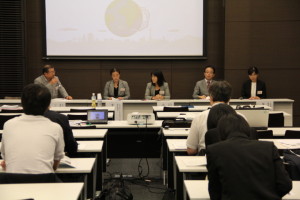
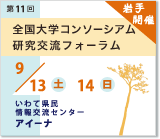
On Saturday, September 13 and Sunday, September 14, the 11th National University Consortium Research Exchange Forum was held at the Iwate Prefectural Information Exchange Center Aiina in Morioka City, Iwate Prefecture, under the theme of “Inter-University Collaboration and Regional Revitalization Initiatives.”
With the perspective and perspective that solving regional issues such as the declining birthrate and aging population and depopulation and reconstruction from the Great East Japan Earthquake has the potential to develop into a global standard originating in the region,
280 people from 117 higher education institutions and governments from all over Japan turned their attention to the role that universities play in the region and tried to learn and consider advanced initiatives to solve various regional issuesThe participants discussed the results of the collaboration between universities and the future of collaboration between universities and local communities.
The next forum is scheduled to be held in September 2015 at Kanazawa Institute of Technology in Ishikawa Prefecture. Please consider joining us.
▽Symposium ▽Trends in Higher Education Policy (Commentary)
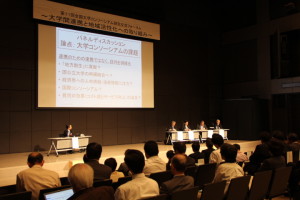
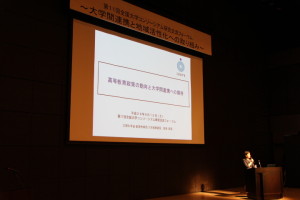
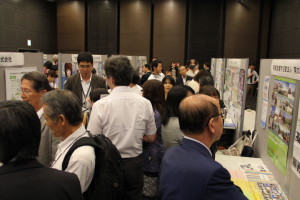
▽ Breakout Sessions (4 subcommittees in total) ▽ Poster Session (24 exhibitors)
Outline of the project
program
Day 1: Saturday, September 13, 2014
| Time |
Contents |
| 12:00~13:00 |
■ Reception |
| 12:00~17:00 |
■ Poster Session |
| 12:00~13:00 |
■Poster Session Core Time |
| 12:15~12:45 |
■ General Assembly of the National Association of University Consortiums (Target: Consortium organizations only) |
| 13:00~13:15 |
■ Greeting |
|
・Greetings from the council representative: Tetsuma Akamatsu
(Representative Secretary, National University Consortium Council, President, Ryukoku University)
|
| ・Greetings from the Venue Representative: Shigeki Sakai (President, Iwate University) |
| ・Greetings from Mr. Takuya Tatsumasu (Governor of Iwate Prefecture) |
| 13:15~16:00 |
■Symposium |
| 【Theme】 |
| Inter-University Collaboration and Regional Revitalization Initiatives |
| [Panelists] |
| Nagahiko Matsumoto (Executive Vice President, Ehime University) |
| Ryuji Oda (Vice Dean, Faculty of Regional Education and Culture, Yamagata University) |
| Toyoki Okada (President, Kobe Gakuin University) |
| Yoshihito Ozawa (Vice President for Regional Relations, Fukushima University) |
| [Coordinator] |
| Fujio Omori (Professor, Center for University Education, Tokyo Metropolitan University) |
| 16:00~16:10 |
■ Poster Session, Corporate Booth, PR Time |
| 16:00~17:00 |
■Poster Session Core Time |
| 17:00~17:40 |
■Trends in Higher Education Policy (Commentary)
Tomoka Satomi (Director, University Promotion Division, Higher Education Bureau, Ministry of Education, Culture, Sports, Science and Technology) |
| 17:40~18:15 |
■ Venue transfer and information exchange reception |
| 18:15~20:15 |
■ Information exchange meeting |
Day 2: Sunday, September 14, 2014
| Time |
Contents |
| 9:00~9:30 |
■ Reception |
| 9:30~11:30 |
■Session 1: Number of participants: 33
Collaboration between Consortium and Companies ~ Regional Revitalization through IC Cards and Campus Reporters |
■ Subcommittee 2: Number of participants: 37
Measures to prevent 20% of unoffered graduates and 120,000 internships |
■Session 3: Number of participants: 39
International Exchange and Consortia |
■Subcommittee 4: Number of participants: 54
Reconstruction & Collaboration |
Workshop: “Let’s talk about university conso!”
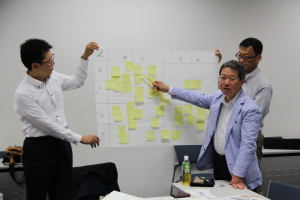
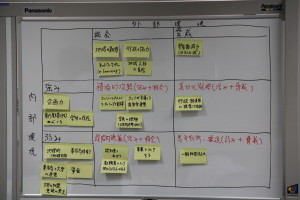
A workshop for the exchange of opinions and exchanges among those involved in the activities of the University Consortium “Let’s talk about the University Consortium!” (outside the official program) was also held at the same time in Iwate. There was a heated group discussion on the management and activities of each organization, which was very well received.
Inquiries
Secretariat of the National Council of University Consortiums (University Consortium Kyoto)
TEL 075-353-9100 FAX 075-353-9101
〒600-8216 Shimogyo-ku, Kyoto-shi, Nishitoin-dori, Shiokoji, Shimo-ku, Kyoto, Campus Plaza Kyoto
* Business hours: Tuesday ~ Saturday 9:00 ~ 17:00 (excluding year-end and New Year holidays)
We will publish the results of the analysis of the “Survey on the Realization of Citizen Life” conducted as part of the “Future Kyoto Creation Research Project” jointly implemented by the University Consortium Kyoto and Kyoto City.As part of the Kyoto City Policy Evaluation System, the “Survey on Citizens’ Perceptions of Citizens’ Lives” is conducted to grasp the actual feelings of citizens about the extent to which the policies and measures listed in the city’s basic plan are being achieved. It can be used by those who are engaged in community development activities.In addition, as a document edition, the results of the survey on the perception of life by generation, gender, and residence for all 130 items in all 27 policy areas, the survey results on the importance of policies in all 27 policy areas, and the correlation between the perception of life and the importance of the policy are also posted.Please take a look.

What can we learn from the analysis?
・Comparison results with the average of the past two years in terms of actual living conditions– Policy priority based on the correlation between people’s lives and policy importance・Policy areas where there is a correlation between the perception of life and the feeling of happiness– Potential needs of different generations through free-form analysis– Trends and issues of generation and gender in terms of life and policy importance by policy area
Data in the results of the analysis
Analysis results related to the 25th “Citizen Life Realization Survey” Overall [Click here for details]
I. Outline of the 25th Citizen Life Survey [Click here for details]
Reference: 130 items in 27 fields [Click here for details]
II. Results of responses to the questionnaire on the perception of daily life, importance of policies, interest in municipal government, and happiness [Click here for details]
III. Analysis using statistical analysis methods
1 Comparison with the average of the past two years in terms of actual life [Click here for details]
2. Consideration of policy priorities based on policy importance and lifestyle experience [Click here for details]
3 Correlation between the perception of life and the feeling of happiness [Click here for details]
4 Analysis of free text [Click here for details]
IV. Discussion by Policy Area [Click here for details]
Literature
The following items are posted as materials.・Aggregation of the results of a survey of 130 items in all 27 policy areas by generation, gender, and residence– Aggregation of
policy importance in all 27 policy areas by generation, gender, and residence– Policy priorities
by generation, gender, and residence in terms of the relationship between life perception and policy importance in all 27 policy areas(Policy areas with a high sense of life are effective, but policy areas with a low sense of life and high policy importance need to be improved, and policy areas with a low sense of life and policy importance need to be raised as a whole.) )
Data in the Archives
1 Environment:
Actual Lifestyle, Policy Importance, Policy Priorities 2. Human Rights and Gender Equality
: Actual Life Experience, Policy Importance, Policy Priorities 3. Youth Growth and Participation:
Actual Life Experience, Policy Importance, Policy Priorities 4 Civic Life and Community:
Realization of Life, Policy Importance, Policy Priorities 5 Safety of Citizens’ Lives:
Actual LifestylesPolicy Importance, Policy Priorities 6 Culture:
Lifestyle, Experience, Policy Importance, Policy Priorities 7 Sports:
Actual Life Policy, Importance, Policy Priorities 8 Industry and Commerce:
Actual Life ExperiencePolicy ImportancePolicy Priorities 9 Tourism
Lifestyle ExperiencePolicy ImportancePolicy Priorities 10 Agriculture and Forestry:
Actual Life Policies, Importance, Policy Priorities 11 Universities:
Actual Life Experience, Policy Importance, Policy Priority 12 Internationalization:
Actual Life Perceptions, Policy Importance, Policy Priorities 13 Child-rearing support:
Actual life of the policy, importance of the policy, policy priority 14 Welfare for Persons with Disabilities: Actual
Life Policy, Importance, Policy Priority 15 Community Welfare Realization of
Life Policy Importance Policy Priority 16 Welfare for the Elderly:
Actual Life Perception Policy, Importance, Policy Priority 17 Health and Hygiene and Medical Care
Actual Life Policy Importance Policy Priority 18 School Education:
Actual Life Experience, Policy Importance, Policy Priority 19 Lifelong Learning:
Actual Life ExperiencePolicy ImportancePolicy Priorities 20 Walking Towns:
Feeling of LifePolicy ImportancePolicy Priorities 21 Land Use and Urban Functional Arrangement Importance of
Lifestyle Policies Policy Priorities 22 Landscape:
Actual Lifestyle, Policy Importance, Policy Priority 23 Buildings:
Actual Lifestyle, Policy Importance, Policy Priority 24 Housing:
Perception of life, Policy importance, Policy priority 25 Roads and Greenery:
Actual Lifestyle, Policy Importance, Policy Priorities 26 Fire & Disaster Prevention Actual
Life Policy ImportancePolicy Priority 27 Water for Living:
Actual Life Policy Importance, Policy Priority
Inquiries
University Consortium Kyoto Think Tank Project
TEL 075-708-5803 FAX 075-353-9101
〒600-8216 Shimogyo-ku, Kyoto-shi, Nishitoin-dori, Shiokoji, Shimo-ku, Kyoto, Campus Plaza Kyoto
* Reception hours: Tuesday ~ Saturday 9:00 ~ 17:00 (excluding year-end and New Year holidays)
The University Consortium Kyoto is pleased to announce that the “English Skill Improvement Training (5 sessions in total)” for university faculty and staff, which was popular last year, will be held again this year.
Last year, we received more applications than the capacity for all competitions, and in the questionnaire after the event, we received many very positive comments, such as “I was motivated to learn English!”, “I learned a lot from this unprecedented initiative”, and “I was very energized”. English level is not required, so please apply by all faculty and staff. 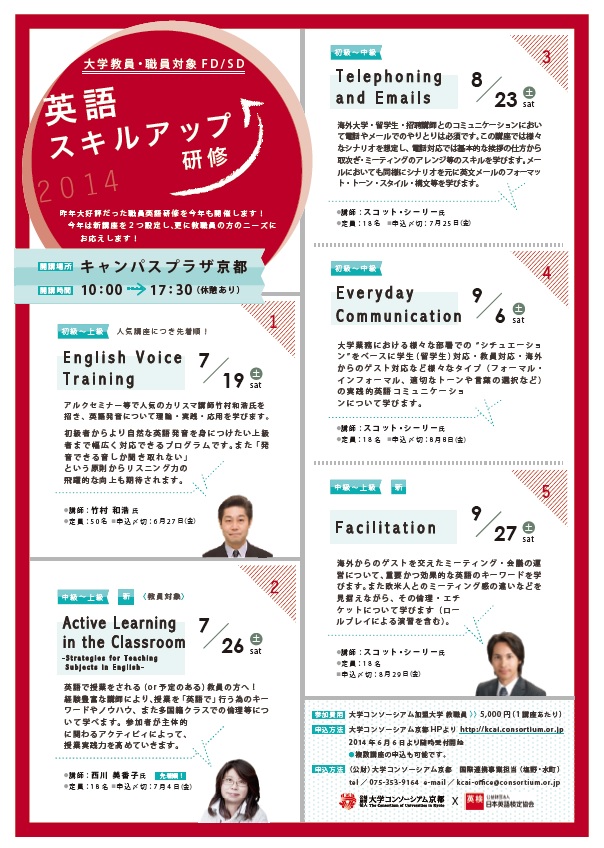
2014 “English Skill Improvement Training” for faculty and staff at member universities
University Consortium Kyoto International Collaboration Project
TEL 075-353-9164 FAX 075-353-9101
〒600-8216 Shimogyo-ku, Kyoto-shi, Nishitoin-dori, Shiokoji, Shimo-ku, Kyoto, Campus Plaza Kyoto
* Business hours: Tuesday ~ Saturday 9:00 ~ 17:00 (excluding year-end and New Year holidays)
26 Study Abroad Dispatch Program Development Support Project
Programs (10)
Of the total 19 applications for the 26th “Study Abroad Dispatch Program Development Support Project”, the following 10 were selected as a result of the examination by the committee.
The “Study Abroad Dispatch Program Development Support Project” has been operated jointly by Kyoto City and the University Consortium Kyoto since the 25th academic year, with the aim of fostering human resources who have an international perspective and can contribute to the revitalization of the Kyoto City area, and promoting students to study abroad. This project supports up to 300,000 yen in development costs (*) for excellent study abroad programs implemented by universities, graduate schools, and junior colleges that are members of the University Consortium Kyoto.

* Development expenses: Refers to the “expenses required for preliminary research and preparation” necessary to develop and enhance the study abroad dispatch program, such as travel expenses, transportation expenses, honorariums, consumables, consignment fees, and other expenses necessary for development when faculty and staff visit the site.
* Applicable policy field: Refers to the theme of the development program selected from the 27 policy areas of “Perspectives on the Revitalization of the Kyoto City Area,” which is a policy of Kyoto City.
| number |
Name of the program for which the applicant is applied |
Applicable Policy Areas |
Name of university or organization |
identity |
| 1 |
Acquire the ability to communicate with the world in English for science |
1. Environment, 12. Internationalization, 11. Universities |
Faculty of Science and Engineering, Doshisha University |
Akira Hayashida |
| 2 |
Uekubo Seminar Sakhalin Project |
11. University, 12. Internationalization |
Faculty of Policy Science, Ritsumeikan University |
Makoto Kamikubo |
| 3 |
Hands-on Global Experience in Chiang Mai |
4. Civic Life and Community, 9. Tourism, 12. Internationalization |
Kyoto Sangyo University International Center |
Hitoshi Osaka |
| 4 |
“Aiming for Coexistence with Local Nature” Hands-on Overseas Learning Program for Local Nature Conservation Activities |
1. Environment, 4. Civic Life and Community, 12. Internationalization, 27. Water for Life |
Faculty of Policy Studies, Ryukoku University |
Kim Hong-mi |
| 5 |
Global Human Resource Development and Overseas IT Experience Program |
8. Industry and Commerce, 9. Tourism |
Faculty of Science and Engineering, Doshisha University |
Takao Tsuchiya |
| 6 |
Overseas Environmental Study North America Program |
1. Environment, 11. Universities, 12. Internationalization, 15. Community Welfare, 20. Walking Towns, 21. Land Use and Urban Functional Layout, 27. Water for Living |
Faculty of Science and Engineering, Ritsumeikan University |
Yasuhiro Shiomi |
| 7 |
Overseas Environmental Studies Malaysia and Singapore Program |
1) Environment, 6. Culture, 8. Industry and Commerce, 9. Tourism, 11. Universities, 12. Internationalization, 23. Architecture, 26. Fire and Disaster Prevention, 27. Water in Life |
Faculty of Science and Engineering, Ritsumeikan University |
Shinya Uchida |
| The following is the second round of recruitment. |
| 8 |
Learning from Italian Education |
12. Internationalization 14, Welfare for Persons with Disabilities 18. School Education |
Department of Educational and Welfare Psychology, Faculty of Clinical Psychology, Kyoto Bunkyo University |
Masamutsu Kameoka |
| 9 |
Teaching experience in Australian schools |
18. Schooling 6. Culture |
Kyoto Koka Women’s University, Faculty of Career Development, Department of Career Development |
Carolyn Wright |
| 10 |
Top Design for the Establishment of an East Asian Circular Economic Zone |
1. Environment |
Ritsumeikan University Faculty of Policy Sciences |
Mr. Weisheng Zhou |
Application Period
April 1 (Tue) ~ May 15 (Thu) (Primary offering): 7 proposals selected
June 3 (Tue) ~ July 5 (Sat) (Second Offering): 3 Accepted
Study Abroad Program Development Support Project 
University Consortium Kyoto International Collaboration Project
TEL 075-353-9164 FAX 075-353-9101
〒600-8216 Shimogyo-ku, Kyoto-shi, Nishitoin-dori, Shiokoji, Shimo-ku, Kyoto, Campus Plaza Kyoto
* Business hours: Tuesday ~ Saturday 9:00 ~ 17:00 (excluding year-end and New Year holidays)
Report on “Active Learning in the Classroom”
On July 26, we invited Ms. Mikako Nishikawa, an advisor to the Japan Eiken Association, as a lecturer and held “Active Learning in the Classroom,” an English skill improvement training program for teachers at member universities.
This training was held as part of the “English Skill Improvement Training for University Teachers” conducted by the University Consortium Kyoto since 2013, and was held for faculty members with a focus on “classes” and was attended by 11 people from five universities.
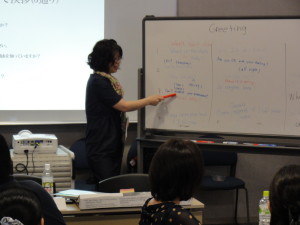
In the training, following the icebreaker, active learning (active learning is “active learning”, and it is not a lecture style in which the instructor transfers knowledge unilaterally, but subject research, PBL (project/problem based learning), discussions, presentations, etc. In addition to deepening their understanding of the class format that incorporates active learning, they also learned phrases that are often used in classes using English. There are various expressions such as demonstrative words used in classes and phrases that are useful when introducing active learning, and it was suggested that the participating teachers choose and use expressions that can be used more naturally in class.
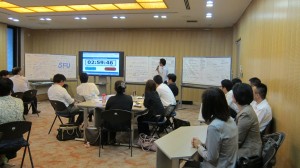
Next, while experiencing group discussions and workshop methods, the students discussed strategies for designing effective discussions and effective feedback and evaluation methods in classes using active learning while sharing case studies, and made group presentations as a result.
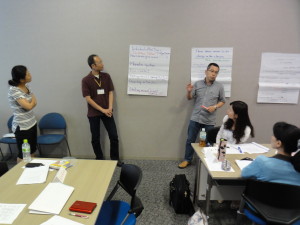
In this training, he also spoke about issues such as how difficult it is to derive common effective measures due to the difference in daily class management due to differences in specialized fields and class sizes, and how to increase the motivation of Japan students, who have not been accustomed to giving presentations in front of others since childhood. However, despite the lengthy workshop, all participants were very active in the training, such as exchanging information on ideas in the classroom across disciplines and discussing specific ways to improve the classroom through discussions.
This was the first time that the University Consortium Kyoto conducted English skill improvement training for teachers only, but we will continue to provide training programs that are in high demand while taking into account the opinions and requests of participants.
University Consortium Kyoto International Collaboration Project
TEL 075-353-9164 FAX 075-353-9101
〒600-8216 Shimogyo-ku, Kyoto-shi, Nishitoin-dori, Shiokoji, Shimo-ku, Kyoto, Campus Plaza Kyoto
* Business hours: Tuesday ~ Saturday 9:00 ~ 17:00 (excluding year-end and New Year holidays)
In a situation where the environment surrounding universities is changing rapidly, the management and operation of universities has come to occupy an important position, and the role of university staff is becoming extremely important. In order to adapt to such an environment, we are developing a variety of projects to improve the qualifications of university staff, including management and education and research support.
The Joint Training Program for University Staff is a joint project aimed at improving the abilities of staff and improving the efficiency and sophistication of university operations, as well as reducing costs for each member university by taking advantage of economies of scale.
2014 University Staff Joint Training Program [Click here for details]
University Consortium Kyoto SD Project
〒600-8216 Shimogyo-ku, Kyoto-shi, Nishitoin-dori, Shiokoji Shimoru Campus Plaza Kyoto
TEL:075-353-9163 FAX:075-353-9101
Theme: Inter-University Collaboration and Regional Revitalization Initiatives
Students will focus on the role that universities play in the community, and will learn and consider advanced initiatives to solve various regional issues. As regional issues become more complex and enormous, it is no longer possible for a single university to solve them. By collaborating not only among universities but also among other institutions, a synergistic effect will be created between wisdom and power, and it will be possible to overcome difficult problems and revitalize the region. We look forward to your participation.
| Date & Time |
Saturday, September 13, 2014 12:00~20:15 Sunday, September 14, 2014 9:30~11:30 |
| Venue |
Iwate Prefectural Information Exchange Center Aina |
| Thesis |
Inter-University Collaboration and Regional Revitalization Initiatives |
| Organizer |
National Association of University Consortiums |
| Co-organizers |
Iwate Higher Education Consortium |
|
| Participation Fee |
Participation Fee |
JPY 3,000 |
| Information Exchange Meetings |
JPY 3,500 |
| Reports |
JPY 1,000 |
| Application Period |
Saturday, June 7, 2014 ~ Thursday, July 31, 2014 |
Simultaneous recruitment! Workshop: “Let’s talk about university conso!”
Inquiries
Secretariat of the National Council of University Consortiums (University Consortium Kyoto)
TEL 075-353-9100 FAX 075-353-9101
〒600-8216 Shimogyo-ku, Kyoto-shi, Nishitoin-dori, Shiokoji, Shimo-ku, Kyoto, Campus Plaza Kyoto
* Business hours: Tuesday ~ Saturday 9:00 ~ 17:00 (excluding year-end and New Year holidays)
We are pleased to announce that six themes have been decided for this fiscal year’s “Future Kyoto Creation Research Project,” which will be conducted through the cooperation of university researchers and the department in charge of Kyoto City, in order to create policies for the creation of the future Kyoto by utilizing the accumulated “knowledge” of the “University City of Kyoto.”
 The following survey and research themes are also published in the first issue of the Research Newsletter.
“Future Kyoto Creative Research Project” Research Report No.1

Designated Projects: Surveys and Research Projects Designated by Kyoto City
Topics related to Kyoto City policies that are freely set by researchers (other than designated projects)
[Continuing Projects] Based on the results of last year’s surveys and research projects,Issues to continue to work on to achieve even greater results
Designated Assignment 1
Research on the protection, management, use, and utilization of personal information in accordance with the enforcement of the Act on the Use of Numbers to Identify a Specific Individual in Administrative Procedures (Number Act)
|
theme
|
Research on the protection, management, use, and utilization of personal information in accordance with the enforcement of the Act on the Use of Numbers to Identify a Specific Individual in Administrative Procedures (Number Act)
|
|
Principal Investigator
|
Akihiro Saeki (Professor, Faculty of Law, Doshisha University)
|
|
Research Summary
|
There is room for the My Number system, which will start in 2015 and will be enhanced, to be enhanced by local governments enacting their own ordinances. Therefore, based on the actual situation in Kyoto City, we will narrow down the issues that are expected to be solved by the use of the Number Act, and examine what kind of ordinances are necessary to enact in order to improve the convenience of citizens and the efficiency of administration.
|
Designated Assignment 2
Research on the creation of a place for interaction between merchants and others in the urban area (the area bounded by Shijo-dori, Kawaramachi-dori, Oike-dori and Karasuma dori and the surrounding area)
|
theme
|
Empirical research on the development of merchants and citizens and the formation of networks by creating opportunities for exchange
|
|
Principal Investigator
|
Masanobu Nishimura (Associate Professor, Graduate School of Craft and Technology, Kyoto Institute of Technology)
|
|
Research Summary
|
We will conduct empirical research to foster and form networks with merchants, businesses, and citizens who promote the rediscovery and creation of “regional value” through “creating a place for exchange” that takes advantage of the attractiveness of local resources accumulated in the city center.
Specifically, the following forums will be created experimentally to verify effectiveness and examine sustainable mechanisms.
(1) A place for “learning” and “network formation” where merchants, businesses, and citizens interact and connect
(2) A place of “matching” between vacant stores and large stores and attractive merchants
(3) A place for “cultural creation” and “community building” where a variety of citizens, such as merchants, young people, artists, and designers, interact and create a theme of interest
|
Designated Assignment 3
Analysis of trends in employment after graduating from university and research on support measures by local governments, companies, and universities
|
theme
|
Analysis of trends in employment after university graduation of international students and research on support measures in local governments, companies, and universities
|
|
Principal Investigator
|
Kazuhiko Ishihara (Director, Career Center, Ritsumeikan University, Professor, Faculty of Policy Science)
|
|
Research Summary
|
Through surveys of international students and companies in Kyoto, mainly at Ritsumeikan University, we will clarify the attitudes and behaviors of international students toward employment. Specifically, we will investigate the motivation and future prospects of international students who want to work for Japan companies, and the companies will investigate the abilities they are looking for in international students and their expectations for hiring. We will analyze these issues and consider employment support measures for international students and capacity building programs for companies through collaboration between universities, companies, and governments.
|
Free Assignment 1
|
theme
|
Spatial Composition and Transition in Municipal Housing and Surrounding Residential Areas in the Suburbs of Kyoto City
|
|
Principal Investigator
|
Tetsuya Masaki (Doctoral Candidate, Graduate School of Craft Sciences, Kyoto Institute of Technology)
|
|
Research Summary
|
Regarding the relationship between municipal housing distributed in the suburbs of Kyoto City and the surrounding areas, we will set up several municipal housing complexes in Yamashina Ward and Fushimi Ward as fields, and clarify the continuity between the use of outdoor space and the surrounding residential areas. To this end, (1) the exterior of the building in contact with the housing complex, (2) the use of open space in the complex, and (3) the condition of the site boundary will be recorded and collected on-site.
The results of the survey on the use of open spaces and how they blend in with the surrounding area will be used in the development and reorganization of municipal housing in the future.
|
Free Assignment 2
|
theme
|
Research on next-generation citizen collaboration policies utilizing the “Future Center” in Kyoto City
|
|
Principal Investigator
|
Hideki Sugioka (Lecturer, Faculty of Public Policy, Kyoto Prefectural University)
|
|
Research Summary
|
Focusing on the “Future Centers*” and “Future Sessions,” which have been attracting attention in recent years as methods for solving problems, we will clarify the current situation and issues in the sectors of industry, academia, government, and NPOs in Japan. In addition, by conducting a future session on a trial basis based on a survey of the current status of Kyoto City’s citizen collaboration policy, we will make recommendations on next-generation citizen collaboration policies using the Future Center in Kyoto City.
* A method in which diverse stakeholders gather across organizations, engage in future-oriented dialogue and create relationships, and take coordinated actions according to the ideas that emerge from them.
|
Ongoing Issues
|
theme
|
The Environment of Residential Gardens in Kyoto City and the Impact of Its Reduction on the Biota of City Blocks
|
|
Principal Investigator
|
Shozo Shibata (Professor, Graduate School of Global Environmental Studies, Kyoto University)
|
|
Research Summary
|
Based on the results of the research obtained last year, this year we will evaluate the characteristics of residential gardens, which are one of the elements that make up urban greenery, and the impact of the continuity of greenery on the biota of city blocks, and based on the results, we will show the role that residential gardens play in the conservation of biodiversity in the urban area of Kyoto.
Specifically, we will evaluate the green potential of residential gardens from multiple perspectives by analyzing the continuity and area change of green spaces using GIS, comparing a resident questionnaire on the biota of the target area, and the results of planting surveys in the newly established area within the target area.
|
University Consortium Kyoto Think Tank Project
TEL 075-708-5803 FAX 075-353-9101
〒600-8216 Shimogyo-ku, Kyoto-shi, Nishitoin-dori, Shiokoji, Shimo-ku, Kyoto, Campus Plaza Kyoto
* Business hours: Tuesday ~ Saturday 9:00 ~ 17:00 (excluding year-end and New Year holidays)
Kyoto City, University Consortium Kyoto, and JTB West Japan are collaborating to provide a new educational travel program, the Kyoto B&S Program, as a place for university students who serve as guides to develop their motivation to go on to universities and junior colleges in the Kyoto area, as well as opportunities for university students who serve as guides to tell themselves and Kyoto to junior high and high school students. At the same time, we will conduct research on the educational effects of this project.
◆ Inquiries from general customers
Kyoto B&S Secretariat
〒600-8023 Kyoto-shi, Shimogyo-ku, Kawaramachi-dori, Matsubara-kamiru 2-chome, Tominaga-cho 338, Kyoto Shijo Kawaramachi Bldg. 7th floor JTB West Japan Kyoto Branch Corporate Sales Department
TEL: 075-365-7779 FAX: 075-365-7713Person
in charge: Murakawa, Nakagawa
Business hours: Weekdays 9:30~17:30 *Closed on Saturdays, Sundays, and holidays
◆ Inquiries from reporters
University Consortium Kyoto, Research & Public Relations Department, “Kyoto B&S Program”
〒600-8216 Shimogyo-ku, Kyoto-shi, Nishitoin-dori, Shiokoji Shimoru Campus Plaza Kyoto
TEL:075-353-9130 FAX:075-353-9101
Hours: Tue~Sat 9:00~17:00 (Closed on Sundays, Mondays and year-end and New Year holidays)
Public lectures and lectures are held at universities and junior colleges that are members of the University Consortium Kyoto as a place where many people can easily come into contact with knowledge and culture in a wide range of fields. We look forward to your participation. This time, we would like to introduce the “Ritsumeikan University Saturday Course”.
Ritsumeikan Saturday Lecture
The Ritsumeikan Saturday Lecture was established with the aim of opening university lectures widely to the public and strengthening the ties between the university and the local community, based on the late President Emeritus Hiroshi Suekawa, who was the president of the university at the time, who advocated that “scholarship and science exist to protect the interests and human rights of the masses, and that it is the university that creates human beings through learning, and that it is important to walk with the masses, think with the masses, and learn with the masses.” On March 31, 1946, in the midst of the turbulent postwar period, Professor Hiroshi Suekawa held his first lecture entitled “On Labor Union Law,” and since then, it has continued for more than half a century, pursuing “open academia” in a practical manner.
In addition to introducing academic trends and research results in various fields, commentary on classics and famous books, the book also covers a wide variety of content that is appropriate for the purpose of opening up university scholarship to the public, such as elucidating actual current affairs down to the dimension of academic methods and theories, and setting themes that are ahead of the times.